
How to Build a Bitcoin Strategy in Plain English and Test It on Five Years of Data

A Bitcoin strategy builder turns a trading idea written in words into exact rules, then tests those rules on past prices. This guide walks through one real build, step by step: one plain English sentence, the rule the builder stored, a five year backtest and a check against simply holding Bitcoin.
The rule is simple: buy when the daily close crosses above its 30 day weighted moving average, sell when it crosses back below. From 2021 to 2026 it returned 9.58% across 99 trades, while holding Bitcoin returned 57.33%. The author built and ran it on CoinQuant, and every figure below comes from that run.
What a Bitcoin Strategy Builder Is
A Bitcoin strategy builder, or BTC strategy builder, is a tool that turns a written trading idea into precise entry and exit rules for spot Bitcoin and backtests them on historical data. CoinQuant, an AI trading platform, is one: you describe the rule in plain English with no coding required, and it stores the rule and tests it with fees.
Some tools with similar names model options payoffs. This guide is about rule builders for spot Bitcoin, where the output is a list of trades you can check. For a wider crypto strategy builder comparison, see crypto strategy builders in 2026: visual, AI and code builders compared.
Step 1: Write the Rule as One Sentence
Start with one sentence that a stranger could follow without asking questions. Then add the settings that change the result. Here is the exact request typed into CoinQuant's builder:
"Buy Bitcoin when the daily close crosses above its 30-day weighted moving average, and sell when the daily close crosses back below it. Use BTCUSDT on Binance spot, 1d timeframe, backtest period from 2021-08-01 to 2026-08-01, initial capital 10000, position size 100% of equity, long only, no leverage, one position at a time, single instrument, taker fee 0.1% on entry and exit. Name the strategy exactly 'BTC WMA 30 Close Cross 1D 2021-2026'."
The first sentence is the idea. The rest pins down what a backtest needs to be repeatable:
- Window: 2021-08-01 to 2026-08-01, long enough to include the 2022 bear market
- Fee: 0.1% on entry and 0.1% on exit, so costs show up in the result
- Sizing: 100% of equity, one position at a time, long only, no leverage
The weighted moving average (WMA) is a moving average that, in the words of CoinQuant's Supported Elements page, "gives the most recent candles the heaviest weight in a straight-line (linear) way, so it reacts faster than a simple average." For more on writing prompts that produce testable rules, see how to write an AI trading strategy prompt.
Step 2: Check the Stored Rule
Before running anything, read what the builder saved. This is the step most people skip, and it is where a vague sentence turns into a rule you did not mean. CoinQuant's reply to the request above:
"I've set up your strategy for BTCUSDT on 1d to enter long when Close on 1d crosses above WeightedMovingAverage(30) on 1d using Market Order; exit long when Close on 1d crosses below WeightedMovingAverage(30) on 1d using Market Order (max 1 triggers per position). Click the Run Backtest button when you're ready to test it."
Check three things against your sentence: the asset and timeframe (BTCUSDT, 1d), the indicator and its period (WMA, 30) and the direction of each cross (above to enter, below to exit). The Strategy tab shows the same rules in plain words, entry above exit, with the setup.
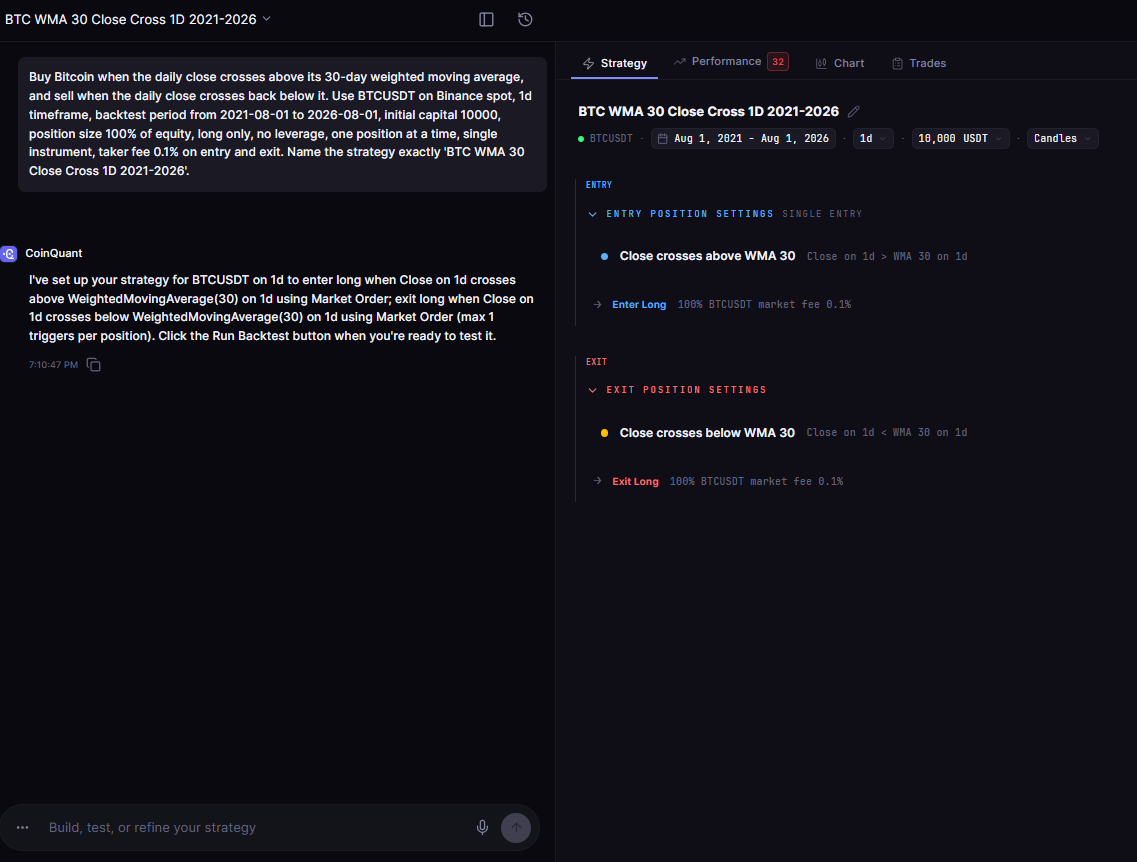
A plain English request in, a testable Bitcoin rule out
Step 3: Run the Backtest and Read the Card
With the rule confirmed, run the backtest. The results card on the Performance tab gives the headline numbers, including the final balance in whole dollars; the table adds Total Fees, which the card does not show, and gives the final balance to the cent.
| Metric | Result | What it tells you |
|---|---|---|
| Strategy | BTC WMA 30 Close Cross 1D 2021-2026 | The library name set in the prompt |
| Total Return | 9.58% | $10,000 grew to $10,958.18 over five years |
| Total Trades | 99 | Enough trades for the card to rate |
| Win Rate | 23.23% (23W / 76L) | About one trade in four made money |
| Profit Factor | 1.04 | Gross wins only just covered gross losses |
| Max Drawdown | 57.56% | The deepest fall from a peak in the account |
| Sharpe Ratio | 0.22 | Return per unit of volatility, low here |
| Total Fees | $1,858.02 | 0.1% on entry and 0.1% on exit, every trade |
A low Win Rate is normal for a trend rule: many small losses while it waits for a few long rises. The Profit Factor of 1.04 says those few wins only just paid for the rest. Fees included, no slippage modelled.
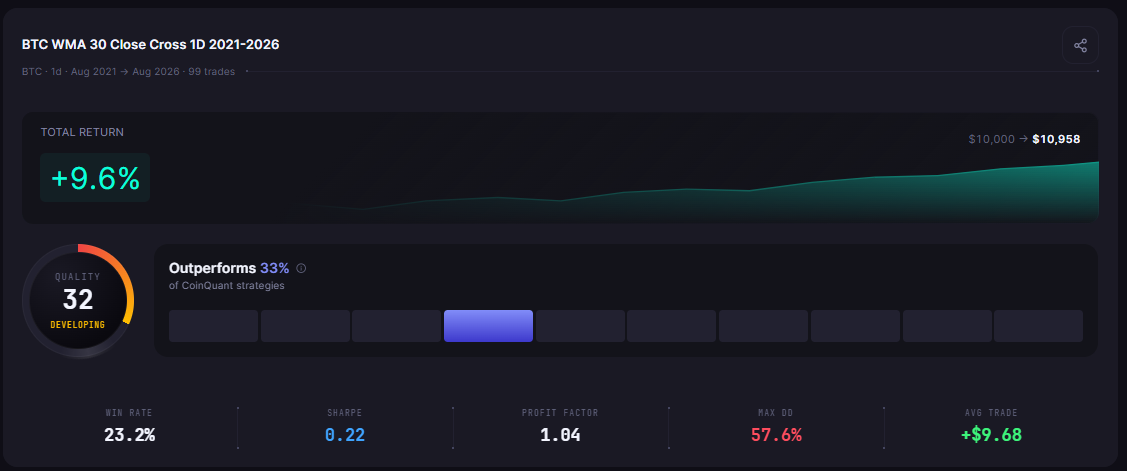
BTC WMA 30 Close Cross 1D 2021-2026: five years of daily Bitcoin, 99 trades, +9.6% Total Return, $10,000 to $10,958, QUALITY 32
Step 4: Compare With Buy and Hold
A positive return is not the test. The test is whether the rule beat the simplest alternative, buying Bitcoin on day one and holding it. BTC Buy and Hold 1D 2021-2026 is a separate library strategy on the same window, capital and 0.1% fee.
| Metric | WMA 30 rule | BTC Buy and Hold |
|---|---|---|
| Strategy | BTC WMA 30 Close Cross 1D 2021-2026 | BTC Buy and Hold 1D 2021-2026 |
| Total Return | 9.58% | 57.33% |
| Final Balance | $10,958.18 | $15,733.43 |
| Max Drawdown | 57.56% | 76.63% |
| Sharpe Ratio | 0.22 | 0.44 |
| Total Trades | 99 | 1 |
| Total Fees | $1,858.02 | $25.74 |
The rule trailed holding by a wide margin on Total Return, and its fees were almost twice the $958.18 it made. What it did offer was a shallower Max Drawdown, 57.56% against 76.63%.
That is a real compromise, not a win. With one trade, the Buy and Hold card shows its QUALITY number next to "Statistically inconclusive", so treat it as the reference line. For five other Bitcoin approaches tested against holding, see Bitcoin trading strategy: 5 approaches backtested over 7 years.
What to Change Next
Change one thing, run it again and compare the two cards. If you change the period and the timeframe together, you will not know which change mattered.
Reasonable single changes for this rule are a longer WMA period, a different timeframe or an extra condition on entry. Build each one as a new strategy with its own name, so the original result stays on record.
Common mistakes
- Skipping the stored rule: a sentence like "buy when price is above the average" can be stored with a different average or cross than you meant.
- Leaving out fees: this rule paid $1,858.02 in fees over 99 trades; without them the result would look better than it was.
- Judging the return alone: 9.58% sounds fine until you see 57.33% for holding on the same window.
- Tuning until it wins: many changes on one window can fit the past by chance.
New to building without code? Start with how to start no-code crypto trading.
The Practical Lesson
- Write one sentence plus settings: window, fee and sizing make the test repeatable.
- Read the stored rule before the result: the reply and the Strategy tab show what will be tested.
- Check against holding: this rule made 9.58% while holding made 57.33%.
A Bitcoin strategy tester is only as good as the question you ask it. Ask it the same question every time: did the rule beat holding, and at what drawdown and cost?
Build trading strategies on real data. No coding required.
Frequently Asked Questions
What is a Bitcoin strategy builder?
A Bitcoin strategy builder turns a trading idea written in words into exact entry and exit rules for Bitcoin and tests them on past prices. On CoinQuant you describe the rule in plain English and read the stored rule before you run the backtest.
Can I build a BTC strategy without coding?
Yes. The rule in this guide was built from one plain English request, with no code written. The builder stored it as a WMA 30 cross on BTCUSDT daily bars and backtested it on five years of data.
Is a strategy builder the same as an options strategy builder?
No. An options strategy builder models the payoff of option positions. The builder in this guide sets entry and exit rules for spot BTCUSDT and backtests the trades they produce.
Write your own Bitcoin rule in one sentence and see how it compares with holding.
Disclaimer:
Key Takeaway