
Take Away One Trade and This Bitcoin Rule Loses Money

In CoinQuant's backtest of a Bitcoin trend rule from 2021 to 2026, one trade made $3,774.43 while all 99 trades together made $958.18. Take that trade away and the rest lose $2,816.25.
That is the simplest check you can run on the best trade in a backtest: remove it and see what is left. The rule also trailed simply holding Bitcoin. BTC WMA 30 Close Cross 1D 2021-2026 returned 9.58% over the five years, while BTC Buy and Hold 1D 2021-2026 returned 57.33% on the same window.
This article finds that trade in the Trades tab, takes it out of the total and checks how often the same thing happens across the library. It reports the results without adjustment: no tuned parameters and no dates picked to flatter it.
The Answer First: How Much of This Profit Was One Trade
A CoinQuant backtest of the BTC WMA 30 rule shows that one trade carried the whole result. The best trade made $3,774.43. All 99 trades together made $958.18, so that single trade was worth almost four times the rule's net profit.
| Part of the trade log | Trades | Net PnL |
|---|---|---|
| Best trade (5 Nov 2024 to 19 Dec 2024) | 1 | $3,774.43 |
| The other 98 trades | 98 | -$2,816.25 |
| All trades | 99 | $958.18 |
The other 98 trades did not make money as a group: 22 more winners and 76 losers left them below zero, and the one large winner lifted the five-year total above it.
The Rule and the Setup
The rule is a plain trend rule. It buys when Bitcoin's daily close crosses above its 30-day weighted moving average (WMA) and sells when the close crosses back below it. The WMA gives newer closes more weight than older ones, so it turns faster than a simple average.
| Parameter | Setting |
|---|---|
| Strategy | BTC WMA 30 Close Cross 1D 2021-2026 |
| Instrument | BTCUSDT (spot, Binance) |
| Data source | Kaiko via CoinQuant |
| Timeframe | Daily (1D) |
| Tested window | 2021-08-01 to 2026-08-01 |
| First trade to last exit | 2021-09-01 to 2026-07-31 |
| Entry | Daily close crosses above WMA (period 30) |
| Exit | Daily close crosses below WMA (period 30) |
| Direction | Long only, no leverage, one position at a time |
| Initial capital | $10,000 |
| Position size | 100% of equity per entry |
| Fees | 0.1% taker, modelled on every fill (no slippage set) |
| Baselines (same window) | BTC Buy and Hold 1D 2021-2026 |
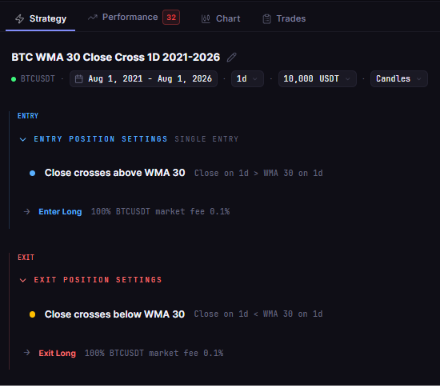
The stored rule of BTC WMA 30 Close Cross 1D 2021-2026: enter long when the daily close crosses above the 30 period WMA, exit when it crosses back below.
The rule was written as one plain English sentence, with no coding required. How to build a Bitcoin strategy in plain English and test it on five years of data walks through how this exact rule was built.
Finding the Best Trade in a Backtest's Trades Tab
The Trades tab lists every order the backtest placed: 198 order rows for 99 trades, two rows per trade. Each exit row carries the trade's PNL % and Net PnL after fees, so the best trade is the exit row with the largest Net PnL.
For this rule it is order rows 131 and 132. The entry row is stamped 5 Nov 2024 00:00, which means it was filled at the close of 5 Nov 2024 UTC; the exit was filled at the close of 19 Dec 2024 UTC.
- PNL % on the Trades tab: 40.25% after fees
- Net PnL: $3,774.43
- Holding time: 44 days
If you want to check the total yourself, add up the Net PnL of every exit row. How to check a backtest result yourself shows how to rebuild the return from the trade log.
Take It Away: What the Other Trades Made
Only 23 of 99 trades were winners, a Win Rate of 23.23%. Without the best trade, the other 98 trades net -$2,816.25. The second best trade (29 Jan to 19 Mar 2024) was almost as large, so the result rests on two trends at most.
The pattern is typical of a trend rule. Losers were cut fast and winners were left to run:
- Median holding time, winners: 25 days
- Median holding time, losers: two days
Many small losses and a few long trends is the deal a trend rule makes. The risk is that the few long trends are so few that one of them decides the result. A typical trade here lost money, which is why the average trade and the median trade tell different stories.
Buy and Hold Comparison: Same Coin, Same Window
| Metric | WMA 30 rule | BTC Spot Comparison |
|---|---|---|
| Strategy | BTC WMA 30 Close Cross 1D 2021-2026 | BTC Buy and Hold 1D 2021-2026 |
| Total Return | 9.58% | 57.33% |
| Final Balance | $10,958.18 | $15,733.43 |
| Total Trades | 99 | 1 |
| Win Rate | 23.23% (23W / 76L) | n/a (single hold) |
| Profit Factor | 1.04 | n/a |
| Sharpe Ratio | 0.22 | 0.44 |
| Max Drawdown | 57.56% | 76.63% |
| CAGR | 1.85% | 9.48% |
| Time in Market | 48.99% | 100.00% |
| Total Fees | $1,858.02 | $25.74 |
Both runs share the same window, capital, sizing and fee, so the rows compare like with like. The rule fell less at its worst (57.56% against 76.63%), but it ended well behind holding. It also paid $1,858.02 in fees across 99 trades.
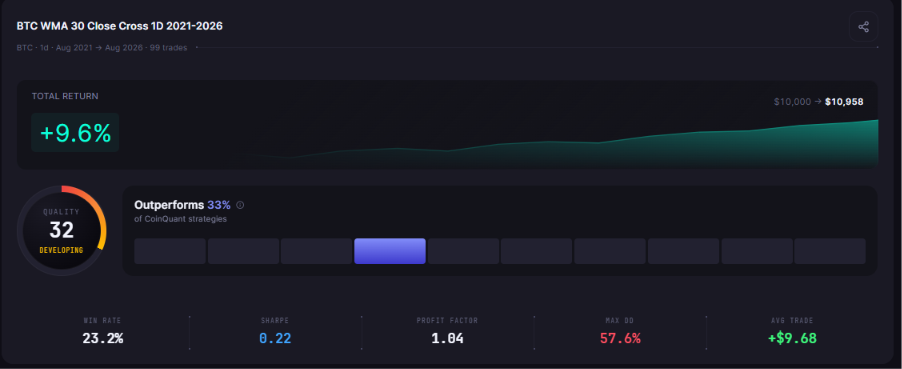
BTC WMA 30 Close Cross 1D 2021-2026, tested from August 2021 to August 2026: 99 trades, +9.6%, $10,000 to $10,958 and QUALITY 32 next to "Outperforms 33% of CoinQuant strategies".
The Performance tab also has an equity card that draws the rule against the platform's Buy and Hold line. That line carries no fees, so the table uses BTC Buy and Hold 1D 2021-2026 instead, which pays the 0.1% fee on entry and exit.
How Common Is This in the Library?
One rule could be an unlucky pick, so the same check was run across the library. It used the saved equity curves of library backtests on the team's CoinQuant account (read 6 Nov 2026), adding up each rule's Net PnL trade by trade.
- The pool: 14 five-year daily backtests (1 August 2021 to 1 August 2026) made a profit with 50 or more trades. Three are versions of one BTC Chande Momentum rule, which leaves 12 distinct rules.
- The result: only 4 of 12 stay profitable after their best trade is removed.
- The four: SOL Stochastic(14,3) Momentum 80/50 1D 2021-2026, BNB Volume Pressure Index 20 Zero Cross 1D 2021-2026, BTC Klinger 34-55-13 Cross 1D 2021-2026 and AAPL VIDYA 14 Close Cross 1D 2021-2026.
So the WMA 30 rule is not an odd case. In this library, most profitable rules with a decent number of trades lean on one trade. BTC HMA 55 Close Cross 1D 2021-2026 is one of the eight that do not: without its best trade, the rest lose money.
What This Test Cannot Tell You
- Costs: fees included (0.1% taker fee on entry and exit), no slippage modelled.
- Setup: long only, one position at a time, no leverage.
- Arithmetic, not a new backtest: removing a trade is a sum over the trade log. With 100% of equity per entry, a real account without that trade would have sized every later trade differently.
- Scope: one coin, one window and one rule; the library count covers one library.
- No forecast: past results do not predict future results.
A sample of 99 trades is reasonable for a daily rule, but as how many trades a backtest needs explains, a result that hangs on one trade is still fragile.
The Practical Lesson
- Remove the best trade: before you trust a Total Return figure, take the best trade out and see what is left. Here, $958.18 became -$2,816.25.
- Read the holding times: winners held 25 days at the median and losers two, so a few long trends paid for many small losses.
- Compare with holding: the rule made 9.58% while holding Bitcoin made 57.33% on the same window.
On CoinQuant, an AI trading platform, the Trades tab gives you every exit row with its Net PnL, so this check takes minutes. Run it on any result before you rely on it.
Build trading strategies on real data. No coding required.
Frequently Asked Questions
How do I find my best trade?
Open the Trades tab of the backtest and look at the exit rows. Each exit row shows the trade's PNL % and Net PnL after fees; the largest Net PnL is the best trade. Here it was order rows 131 and 132, worth $3,774.43.
Is a strategy bad if one trade made most of the profit?
Not always, but it is fragile. Trend rules often depend on a few large winners. If the rest of the trades lose money without that one, as they did here (-$2,816.25), the result depends on catching the next big trend.
How many trades does a backtest need?
More trades make any single trade matter less, but the count alone is not enough. This rule had 99 trades and still relied on one of them. Check the count, then remove the best trade and see what is left.
Find the best trade in your own backtest, then take it away and look at the rest.
Disclaimer:
Key Takeaway