
Swing Points Strategy Backtest on Cardano: Buying Confirmed Swing Lows (1D, 2021-2026)
A swing points strategy turns a chart habit into a rule: buy when a swing low is confirmed, sell when a swing high is confirmed. On daily Cardano from August 2021 to August 2026, that rule lost 65.85% across 127 trades. Holding ADA over the same window lost even more, 86.76%.
So the rule beat holding a collapsing asset, but it did not make money, and it trailed Bitcoin buy and hold (+57.33%) by a wide margin. The main reason is built into the indicator: a swing point can only be confirmed after the fact.
This article explains how confirmed swing points work, tests the rule mechanically with fees on ADAUSDT and reports the results as they came out. The lookback is the documented default of five bars, with nothing tuned.
What Swing Points Are and Why Confirmation Lags
A swing low is a bar whose low is lower than the bars around it; a swing high is the mirror image. CoinQuant's Swings indicator (Swing Points Detector) marks these pivots automatically, using a lookback of five bars by default, as described in the CoinQuant Supported Elements documentation.
The catch is confirmation. A pivot needs bars on both sides of it, so a swing low is only confirmed once the following bars have printed without undercutting it. The signal is reliable, but it always arrives after the low.
This test uses the indicator's direction output, which flips to 1 when a new swing low is confirmed and to -1 when a new swing high is confirmed:
Entry: Swings(5) direction crosses above 0, meaning it has just flipped from -1 to 1 on a newly confirmed swing low
Exit: Swings(5) direction equals -1, meaning a swing high has been confirmed
Long only, one position at a time, no leverage, no stop. Each entry happens only on the bar where a new swing low is confirmed, never because a low was confirmed earlier. CoinQuant's public BTC Swing Points Detector 1D backtest page describes the same idea: enter on a confirmed swing low and exit on a confirmed swing high. This article tests it on Cardano, with an entry that fires only on a newly confirmed low.
In plain English you could type: "Buy ADAUSDT on the daily chart when Swings with period 5 flips to a newly confirmed swing low. Sell when a swing high is confirmed." No coding required.
Test Setup
| Parameter | Setting |
|---|---|
| Strategy | ADA Swing Points Fresh Swing Low Entry 1D 2021-2026 |
| Instrument | ADAUSDT (spot, Binance) |
| Data source | Kaiko via CoinQuant |
| Timeframe | Daily (1D) |
| Tested window | 2021-08-01 to 2026-08-01 |
| First trade to last exit | 2021-08-19 to 2026-08-01 (last position closed at the end of the test) |
| Entry | Swings(5) direction crosses above 0 (new swing low confirmed) |
| Exit | Swings(5) direction equals -1 (swing high confirmed) |
| Direction | Long only, no leverage |
| Initial capital | $10,000 |
| Position size | 100% of equity per entry |
| Fees | 0.1% taker, modelled (no slippage set) |
| Baselines (same window) | ADA Buy and Hold 1D 2021-2026; BTC Buy and Hold 1D 2021-2026 |
The first trade came on 2021-08-19, the first bar in the window where a fresh swing low was confirmed, not on the first day of the test. All 127 entries sit on bars where the direction flipped from -1 to 1.
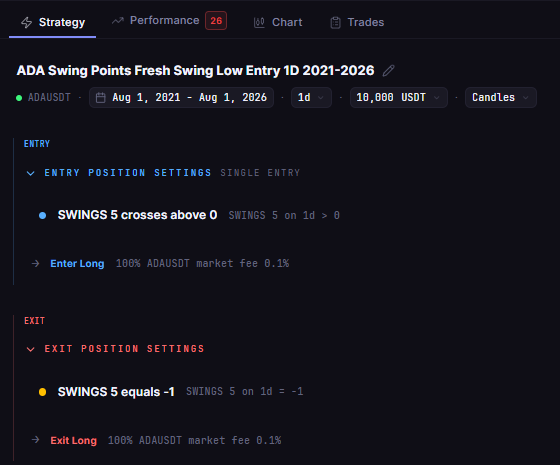
ADA Swing Points Fresh Swing Low Entry 1D 2021-2026 in the CoinQuant builder: enter when Swings(5) flips to a newly confirmed swing low, exit when a swing high is confirmed, on daily ADAUSDT.
Screenshot from the author's CoinQuant account. Backtest results are hypothetical, based on historical data with modelled fees, and do not guarantee future performance. Not financial advice.
Swing Points Strategy Results vs ADA Buy and Hold
The swing points rule turned $10,000 into $3,414.74, a -65.85% return. Holding ADA ended at $1,324.39 (-86.76%), and holding Bitcoin ended at $15,733.43 (+57.33%).
| Metric | Swing points rule | ADA buy and hold | BTC Spot Comparison |
|---|---|---|---|
| Strategy | ADA Swing Points Fresh Swing Low Entry 1D 2021-2026 | ADA Buy and Hold 1D 2021-2026 | BTC Buy and Hold 1D 2021-2026 |
| Total Return | -65.85% | -86.76% | +57.33% |
| Final Balance | $3,414.74 | $1,324.39 | $15,733.43 |
| Total Trades | 127 | 1 | 1 |
| Win Rate | 29.92% (38W / 89L) | n/a (single hold) | n/a (single hold) |
| Profit Factor | 0.83 | n/a | n/a |
| Sharpe Ratio | -0.09 | -0.02 | 0.44 |
| Max Drawdown | 84.11% | 95.15% | 76.63% |
| CAGR | -19.33% | -33.24% | +9.48% |
| Best Trade / Worst Trade | +$9,603.70 / -$4,898.37 | n/a | n/a |
| Time in Market | 44.24% | 100% | 100% |
| Total Fees | $1,709.95 | $11.32 | $25.74 |
All three runs use the same window, capital, sizing and 0.1% taker fee. Win rate and profit factor are not shown for buy and hold because each benchmark is a single trade.
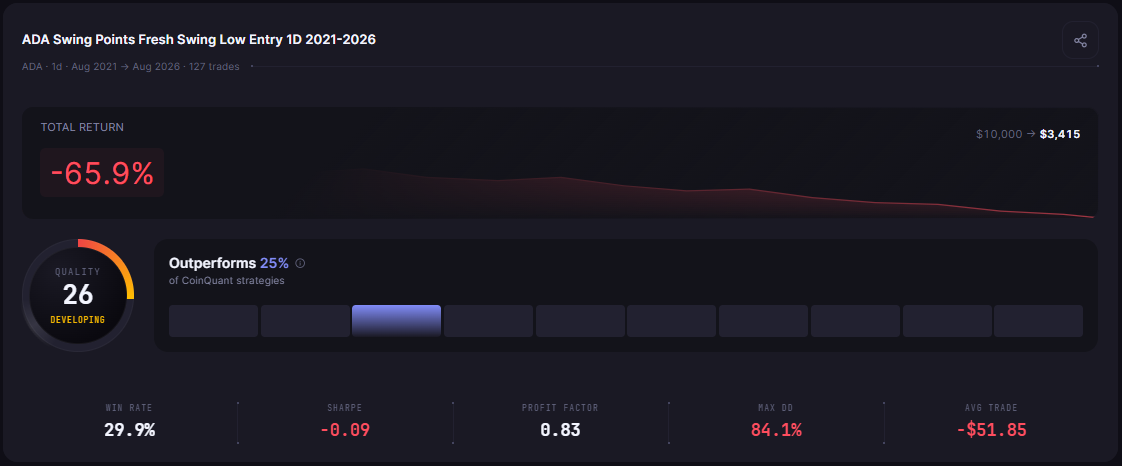
ADA Swing Points Fresh Swing Low Entry 1D 2021-2026 lost 65.85% over 127 trades, with an 84.11% max drawdown.
Screenshot from the author's CoinQuant account. Backtest results are hypothetical, based on historical data with modelled fees, and do not guarantee future performance. Not financial advice.
What the Data Shows
Less bad than holding is still a loss
The strategy lost less than ADA itself and cut the maximum drawdown from 95.15% to 84.11%. But an 84.11% drawdown is still close to a wipeout, and the Sharpe ratio of -0.09 was slightly worse than holding (-0.02).
The comparison says more about Cardano's five years than about the rule. Stepping aside for part of a long decline helps; it does not turn a falling market into a profitable one.
Frequent trades, a losing edge
The rule traded 127 times and won 38 of them, a 29.92% win rate. A profit factor of 0.83 means it earned 83 cents of gross profit for every dollar of gross loss.
Fees made that worse. The strategy paid $1,709.95 in fees, and its longest losing streak ran to 11 trades. The best single trade made +$9,603.70, which shows the rule can catch a real rebound, but not often enough to cover the 89 losing trades.
In the market less than half the time
Time in market was 44.24%. The strategy sat out long stretches of the decline, which is where the smaller drawdown came from.
The Cost of Waiting for Confirmation
Confirmation protects against false pivots, but it charges for it twice. The entry waits for the swing low to be confirmed, so it buys after the bounce has already started. The exit waits for a swing high to be confirmed, so it sells after the decline from that high has already started.
The first five trades show the pattern clearly:
| Entry | Entry price | Exit | Exit price |
|---|---|---|---|
| 2021-08-19 | $2.4411 | 2021-09-06 | $2.833 |
| 2021-09-25 | $2.30 | 2021-09-28 | $2.037 |
| 2021-10-02 | $2.247 | 2021-10-06 | $2.209 |
| 2021-10-07 | $2.278 | 2021-10-11 | $2.171 |
| 2021-10-16 | $2.179 | 2021-10-27 | $1.912 |
The first trade worked because ADA kept rising after the confirmed low. The next four each entered on a newly confirmed swing low and exited three to 11 days later below the entry price, once a swing high had been confirmed.
In a trending rebound, the lag costs a slice of the move at each end but still leaves profit
In a grinding decline, each confirmed low is followed by a lower high, and the rule pays two lags plus fees on every round trip
In a flat range, swings are short and frequent, which raises trade count and fee drag
Over five years of mostly falling ADA prices, the second case dominated. Holding ADA lost 86.76% over the same window.
The Practical Lesson
A swing points strategy that buys newly confirmed swing lows on daily ADA returned -65.85% from August 2021 to August 2026, better than holding ADA (-86.76%) but far behind holding Bitcoin (+57.33%)
It made 127 trades with a 29.92% win rate, a 0.83 profit factor and $1,709.95 in fees
The drawdown was smaller than buy and hold (84.11% against 95.15%) because the rule held ADA only 44.24% of the time
The confirmation lag is the structural cost: the rule buys after the low and sells after the high
Useful next tests include a longer Swings lookback, a trend filter that only allows entries above a long moving average or the same rule on an asset that trended up over the window. For other ways to trade Cardano and swings, see ADA RSI Strategy Backtest, What Is Crypto Swing Trading and How Do You Backtest It?, Swing Trading Bitcoin in a Bear Market and Support and Resistance Strategy on Ethereum.
CoinQuant, an AI trading platform, supports multi-indicator and multi-timeframe conditions, so adding a trend filter to this rule is one more condition, not a rebuild. Build trading strategies on real data. No coding required.
Test swing-low entries on your own coin. Run this swing points backtest free on CoinQuant
Disclaimer:
Key Takeaway
