
What Is Crypto Swing Trading and How Do You Backtest It?
.png)
A crypto swing trading strategy targets moves that develop over days to weeks, rather than the intraday noise that day traders work with or the multi-month holds that investors build. The core idea is to identify the beginning of a directional move, hold through it, and exit before the reversal. Getting that right consistently requires more than intuition. It requires a systematic approach to identifying setups and, critically, evidence that the approach has worked historically. This guide covers what swing trading is, how to structure a backtest, and how to evaluate whether your approach has an edge worth acting on.
What Crypto Swing Trading Is
Swing trading sits between day trading and position trading on the holding-period spectrum. A typical swing trade holds for two days to three weeks. The goal is to capture a single directional move, not to ride a multi-month trend and not to scalp intraday volatility.
Swing traders focus on identifying moments when momentum is shifting: when a downtrend is losing steam and a recovery looks probable, or when an asset breaks above a level that has acted as resistance and might continue higher. The entry is at the start of the anticipated move. The exit is before the momentum exhausts.
The most common indicators for swing strategy identification are RSI (for identifying oversold or overbought conditions that often precede reversals), EMA crossovers (for identifying when short-term momentum shifts relative to longer-term direction), and MACD (for momentum confirmation). These indicators are all supported in CoinQuant's AI strategy builder.
For a companion look at how specific swing strategies performed on real data, see Article 91: Crypto Swing Trading Backtested: 3 Approaches Compared.
How to Structure a Swing Trading Backtest
A well-structured crypto swing trading strategy backtest has four components: a clear entry condition, a clear exit condition, a defined timeframe, and a sufficient historical window.
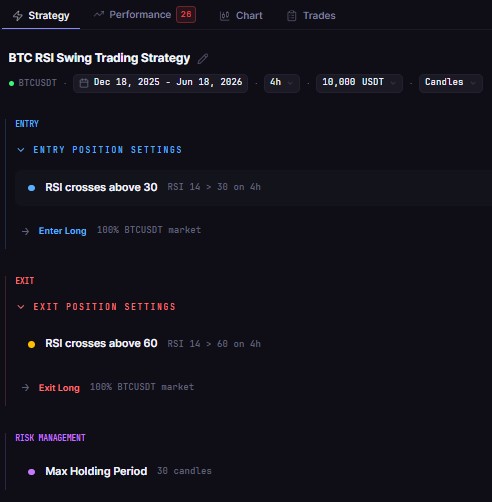
Step 1: Define Your Entry Logic
The entry condition is the specific indicator signal that tells you to open a position. For swing trading, this is typically a reversal signal: RSI moving from oversold back above a threshold, an EMA crossover, or a momentum indicator confirming a directional shift.
Be specific. "Buy when RSI is low" is not a testable condition. "Buy BTCUSDT when RSI(14) closes below 35 and then closes back above 35 on the next candle" is a precise condition the AI can parse and test.
Step 2: Define Your Exit Logic
The exit condition is as important as the entry. Swing trades need a defined exit: either a target indicator reading (RSI above 65), a price-based exit, or a time-based stop. Without a defined exit, the backtest cannot simulate realistic trade management.
Step 3: Choose a Timeframe
Swing trading most commonly uses daily or four-hour charts. Daily charts smooth out intraday noise and produce cleaner signals for multi-day holds. Four-hour charts give more granularity for entries on assets that move quickly.
Step 4: Choose a Historical Window
A meaningful swing trading backtest covers at least two to three years. This ensures the backtest includes at least one bull phase and one bear phase, so you can see how the strategy performs in both directions. CoinQuant's Kaiko data goes back to 2017 for Bitcoin, which gives access to the 2018 bear market, the 2020 crash, the 2021 bull run, and the 2022 drawdown.
A Plain-English Example Swing Strategy
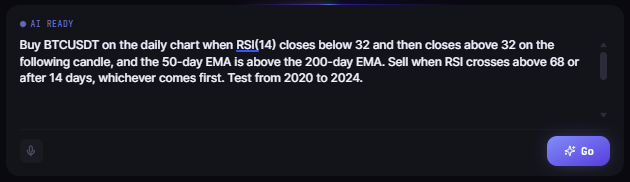
Here is an example you could type directly into CoinQuant's AI strategy builder:
"Buy BTCUSDT on the daily chart when RSI(14) closes below 32 and then closes above 32 on the following candle, and the 50-day EMA is above the 200-day EMA. Sell when RSI crosses above 68 or after 14 days, whichever comes first. Test from 2020 to 2024."
This strategy combines a mean-reversion entry (RSI oversold recovery) with a trend filter (price structure via the 50/200 EMA relationship) to avoid buying into a sustained downtrend. The time-based exit limits holding periods that do not resolve in the expected direction.
CoinQuant will parse this, build the strategy logic, and return the full metric set in seconds. Read the Sharpe Ratio first. If it is positive, move to Max Drawdown. Then check Profit Factor against trade count to assess whether the edge is meaningful and consistent.
Evaluating Your Swing Strategy Results
The metrics that matter most for swing trading evaluation are different from those for high-frequency strategies:
Sharpe Ratio: A swing strategy with fewer than 30 trades per year should have a Sharpe above 1.0 to compensate for the lower statistical reliability of a small sample.
Profit Factor: Look for values above 1.5. Swing strategies with thin Profit Factors (1.0-1.3) are vulnerable to being wiped out by a few large losing trades.
Max Drawdown vs. Average Win: If the average win is significantly smaller than the max drawdown, the strategy is relying on surviving a large loss at some point. Check the "Worst Trade" metric to understand the tail risk.
Time in Market %: Swing strategies should show moderate time in market, typically 30%-60%. If time in market approaches 90%, the strategy is closer to position trading than swing trading.
Common Mistakes in Crypto Swing Trading Backtests
Using too short a historical window. A backtest covering only the 2023 bull market tells you nothing about how the strategy handles bear conditions. Extend the window to include at least one full cycle.
Over-optimising entry parameters. Finding the exact RSI level (32 vs. 30 vs. 35) that maximised historical performance is curve-fitting. Vary the parameter by a few points and confirm the strategy still produces positive results before treating any specific number as validated.
Confusing signal frequency with signal quality. Swing strategies with too many signals on a short timeframe are typically responding to noise, not genuine momentum shifts. If your daily swing strategy is generating more than three or four entries per month on BTC, the entry condition may be too sensitive.
Ignoring the trend filter. Entering a swing trade against the prevailing trend is the most common reason mean-reversion swing strategies fail in directional markets. Add a higher-timeframe trend filter (such as requiring the 200-day EMA to be in a specific position) to avoid fighting sustained directional moves.
Disclaimer:
This content is for educational and informational purposes only and does not constitute financial, investment, or trading advice. All strategies and examples are for illustrative purposes and do not guarantee results. Always conduct your own research before making financial decisions.
Key Takeaway
