
No-Code Trading vs Coding Your Own Strategy: What Each Route Can and Can't Do in 2026

For traders who think in trading rules but don't write code, CoinQuant is the no-code route built for that job: you describe the rule in plain English, its AI turns it into blocks you can read and edit, and every backtest includes trading fees. For ideas that need something the building blocks don't cover, such as a formula of your own, outside data or a portfolio of many assets, coding in TradingView's Pine Script, QuantConnect or Backtrader is still the stronger route. Both routes do the same job, turning an idea into rules and testing them on past prices; they differ in who writes the rules, who supplies the data and the fees, and how far you can go before you hit a wall.
Who each route suits
- No-code suits you if you can state your idea as a rule (an indicator, a level, an exit and a size) and want a tested answer the same day without learning a language. CoinQuant fits when the idea is one rule on one market, crypto or traditional, and you want fees and a buy-and-hold comparison in every result. Composer is the no-code pick for US investors who think in rebalancing portfolios of stocks and ETFs.
- Code suits you if your idea needs a calculation no platform offers as a block, data the platform doesn't carry, logic across many assets at once, or control over every assumption in the test. Pine Script fits traders who already chart on TradingView, QuantConnect fits Python or C# programmers who want cloud data and multi-asset portfolios, and Backtrader fits Python programmers who want an open-source library on their own machine.
- The two routes are not exclusive. You can screen and discard ideas quickly without code, then code only the few that survive and need something the blocks can't express.
How we assessed
We followed one trading idea through seven stages: the idea itself, turning it into rules, the price data, running the test and reading the result, changing and retesting, what it costs, and where each route stops. At each stage we asked what the trader has to do by hand on each route, using only what the vendors document on their own pages, read on November 23, 2026: TradingView's Pine Script documentation and help center, QuantConnect's site and documentation, Backtrader's documentation and GitHub repository, Composer's homepage and pricing page, and CoinQuant's documentation.
This compares capabilities, not speed or accuracy. No strategy was run on all five tools, so nothing here ranks their results. Several vendors were running Black Friday promotions that day; every price below ignores them and uses the regular rate. We publish CoinQuant, and its gaps are listed with the same care as everyone else's.
The seven stages side by side
| Stage | No-code route | Coded route |
|---|---|---|
| The idea | A sentence or a few blocks | A full specification you translate into code |
| The rules | An AI or a visual editor builds them; you check them | You write every line in Pine Script, Python or C# |
| The data | Supplied for every market the platform lists | Supplied by the platform, or found and loaded by you |
| Test and fees | Fees applied to every CoinQuant test | Zero commission in Pine Script and Backtrader until you set it |
| Iteration | Edit a block or ask, then rerun | Edit the code, rerun, fix errors |
| Costs | A subscription | From $0, plus the time to learn a language |
| Limits | The list of indicators, markets and order types | Your skill, your data and your time |
Each row is summarized from the vendors' own documentation, read on November 23, 2026. The stages below give the detail.
Stage 1: the idea
Both routes start from the same place, an idea such as "buy Bitcoin once its 50-day average moves above the 200-day, and sell when it drops back under". What changes is how much work the idea needs before a test can run.
On a no-code platform the sentence is close to the finished input: on CoinQuant you type it the way you would say it, and its AI generates a structured strategy for you to review and adjust. On the coded route the sentence first becomes a specification. You settle every detail it left open, such as which price the averages use and how much each trade buys, because code does exactly what you write, and defaults you never chose still shape the result. That discipline is useful, and it is the main reason code takes longer to reach a first result.
Stage 2: turning the idea into rules
On CoinQuant, the Strategy Builder shows the strategy as clickable pills: the instrument, the indicator, the timeframe, the comparison, the value and the action, plus the position size and the order type. Each pill opens its own settings, so one condition can change without rebuilding the rest. If the AI reads your sentence differently from what you meant, the documentation FAQ points to two fixes: change the entry and exit blocks by hand, or reword the prompt and generate the strategy again. Composer's no-code editor works with weights and if-then conditions, and its AI-assisted editor builds a strategy from a description of your goals.
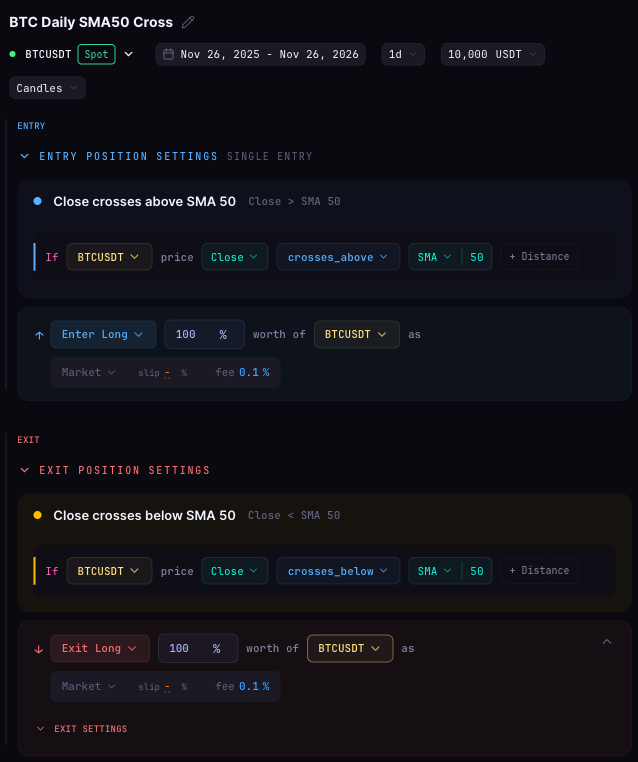
Illustrative interface example: CoinQuant's Strategy Builder with the rule "buy Bitcoin when the daily close crosses above the 50-day simple moving average, sell when it crosses back below" laid out as pills: BTCUSDT, Close, crosses_above or crosses_below, SMA 50, then Enter Long or Exit Long with 100% of capital at market and a 0.1% fee. Builder view only; no backtest result is shown, and it is not a recommendation.
On the coded route you write the rules yourself. TradingView's help center puts the requirement plainly: writing your own strategy means knowing Pine Script, whose strategy commands include strategy.entry and strategy.exit. A QuantConnect algorithm is a class written in Python or C#, with an initialize method where you set up the data and the holdings. Backtrader strategies are Python classes to which you add indicators and orders. You get control over every line. You also get syntax to learn and errors to fix that have nothing to do with the trading idea.
Stage 3: the price data
No-code platforms supply the data. CoinQuant's Supported assets page shows 13,151 instruments in six asset classes, including 48 major crypto pairs, and gives the first date of data for each one. Crypto can also be tested on individual trades on the Elite plan, for up to about six months, while every other asset class runs on candle data.
On the coded route it depends on the tool. Pine Script strategies run on the history of the chart they sit on. QuantConnect describes cloud research terminals attached to terabytes of financial, fundamental and alternative data, with alternative data from more than 40 vendors and the option to import custom data. Backtrader ships parsers for CSV files, Yahoo data and Pandas data frames, so you find, clean and load the prices yourself. This is the clearest dividing line: only the coded route lets you test against data the platform doesn't carry, from a vendor's alternative dataset to your own spreadsheet.
Stage 4: reading the result
This is where defaults matter most. CoinQuant applies trading fees to every test, lets you set the fee you really pay, and supports separate maker and taker fees per order. Pine Script's documentation says that if a strategy doesn't specify commission_type and commission_value in its declaration, it applies no commission to filled orders. Backtrader's setcommission parameter defaults to 0.0, and its quickstart adds a 0.1% rate in one line. QuantConnect models fees, fills and slippage, and notes that its default models assume you trade highly liquid assets. On the coded route, one forgotten setting can make a rule look better than it was.
The results screens differ as much. A CoinQuant result opens on a header with the trade count and the headline numbers (total return, win rate, Sharpe ratio, profit factor, max drawdown and average trade), then a Detailed Statistics panel, then an equity chart with its drawdown that also shows buying and holding the same asset. TradingView's Strategy Report has a Metrics section and a List of Trades. Backtrader shows what you ask it to print and plot through the analyzers and observers you add.
On CoinQuant, every order also lands in a trade log: one row per order with its side, order and execution date and time, symbol and fill price, plus a CSV button, and the FAQ confirms that Download Data exports the metrics and the trade log so you can check the numbers yourself.
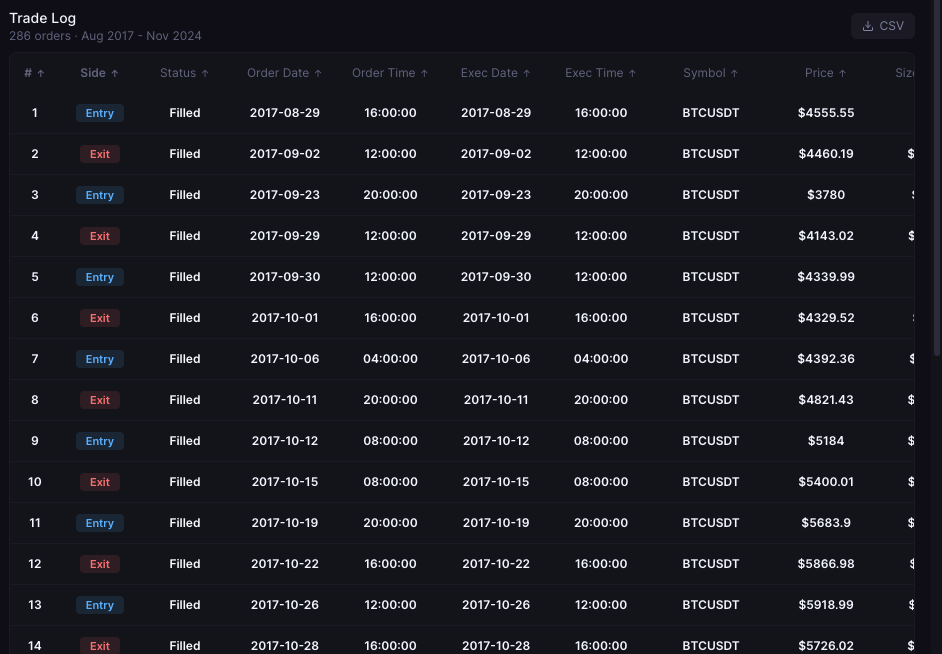
Illustrative interface example: the Trade Log of a historical CoinQuant backtest on BTCUSDT, listing 286 orders from Aug 2017 to Nov 2024 with side, status, order and execution dates and times, symbol, price and a CSV button. It was not run for this article and is not a recommendation.
Stage 5: changing and retesting
No-code iteration is a short loop: change one pill or ask for the change in a sentence, rerun the backtest and compare. CoinQuant's how-to guide describes version labels such as v1 to keep track of changes, and the Strategy Builder lets each condition use its own timeframe.
The coded route is slower per change and stronger at volume. A loop can run one rule across many settings in a single pass, and Backtrader's quickstart ends with an optimization example. The risk is the same on both routes: the easier retesting becomes, the easier it is to tune a rule until it fits the past and nothing else, so keep a count of how many versions you tried.
Stage 6: what it costs
| Tool | Route | Starting price | Best for |
|---|---|---|---|
| TradingView | Code (Pine Script) | Basic at $0; Essential $14.95 a month billed monthly | Traders who already chart there |
| QuantConnect | Code (Python or C#) | Free at $0; Researcher $84 a month | Programmers who want cloud data and portfolios |
| Backtrader | Code (Python) | $0, open source under GPL-3.0 | Programmers who want a local library |
| Composer | No-code (visual or AI) | Starter at $0; Advanced $10 a month | US investors building stock and ETF portfolios |
| CoinQuant | No-code (plain English) | Pro from $12.99 weekly ($39.99 monthly, $399 yearly) | Rule traders who do not code |
Regular prices taken from TradingView pricing, QuantConnect pricing, Composer pricing and Backtrader on GitHub, plus CoinQuant's plan page, read on November 23, 2026. CoinQuant Elite runs $69.99 weekly, $220 monthly or $1,999 yearly.
The coded route can cost nothing in money, because Backtrader is open source and both TradingView and QuantConnect have $0 plans. What it costs instead is time: learning a language, then writing and checking the data handling and fee settings that a no-code platform does for you.
Stage 7: where each route stops
The no-code route stops at the edge of its building blocks. CoinQuant's Supported elements page lists over 35 technical indicators, from moving averages to Ichimoku and candle patterns, six order types, and operators such as crosses above, for N bars and wait N bars. An indicator can even take another indicator as its input, such as a moving average of RSI. If your idea fits inside that list, no-code is enough. If it doesn't, no amount of rewording will make it fit.
The coded route stops at your own skill, data and time. It has no fixed list, but every assumption is yours to get right, and a bug in your code is a bug in your result.
What code can still do that no-code can't
Here is what CoinQuant's documentation does not cover as of November 23, 2026, next to how the coded route handles each one.
| Need | CoinQuant documentation | Coded workaround |
|---|---|---|
| Your own indicator formula | Over 35 built-in indicators; writing a new formula is not documented | Write the calculation in Pine Script or Python |
| Data the platform does not carry | Tests run on its listed instruments; importing your own data is not documented | QuantConnect custom and alternative data, or Backtrader CSV feeds |
| Rules across a portfolio of assets | Each rule is built around an instrument pill; portfolio rules are not documented | QuantConnect multi-asset algorithms; Composer covers stock and ETF portfolios without code |
| The strategy as code | Metrics and trade logs export; exporting the strategy as code is not documented | The code is the strategy, ready to version and reuse |
| Walk-forward or Monte Carlo tests | Not documented for the app | Code them around your strategy |
Sources: CoinQuant's Strategy Builder, Supported elements, Supported assets and FAQ pages; QuantConnect; Pine Script strategies documentation; Backtrader data feeds, all read on November 23, 2026.
What the no-code route does without being asked
The other side of the ledger matters as much for a trader who doesn't code. On CoinQuant, five jobs come with every test instead of being written by you: fees are on in every result, each result sets the rule against buying and holding, the rules read as plain pills you can check against your sentence, one rule can be pointed at crypto, stocks, ETFs, forex or commodities by changing the instrument pill, and the trade log and statistics export with Download Data.
CoinQuant is a no-code strategy research and backtesting platform: you describe a trading idea in plain English, its AI writes the rules, and CoinQuant backtests them on years of price history across more than 13,000 assets, after fees.
FAQ
How does no-code trading compare to traditional coding-based trading strategies?
No-code trading gets an idea to a tested result faster, because the platform writes the rules, supplies the data and applies the fees; coding takes longer but reaches further. On CoinQuant you describe a rule in plain English and check the blocks its AI writes. Code in Pine Script, QuantConnect or Backtrader is the better route when you need your own indicator formula, outside data, portfolio logic across many assets or full control of every assumption.
Is no code backtesting suitable for all types of trading strategies?
Not every strategy. The no-code route covers ideas built from the platform's own pieces: listed indicators, price levels, timeframes, order types, stops and position sizes. A strategy that needs a new formula, data the platform doesn't carry or decisions across a portfolio of assets needs code.
Does writing your own code make a backtest more accurate?
Not by default. Accuracy depends on the data, the fee and fill assumptions and the absence of bugs. In Pine Script and Backtrader, commission is zero until you set it, so a coded test can be less realistic than a no-code test that applies fees automatically. Code gives you more control over those assumptions, not better ones.
Can I start without code and move to code later?
Yes. Many of the skills carry over: stating the entry, exit, stop and size precisely, choosing the test period and reading drawdown and trade count. CoinQuant lets you download the metrics and the trade log, which you can use as a reference when you rebuild a rule in code. Exporting the strategy itself as code is not documented.
Your next step
Take one rule you already trade or watch and write it as a single sentence. Describe it to CoinQuant, open each block its AI builds, and see whether everything you meant is there. If it is, you have a backtest with fees and a buy-and-hold comparison without writing code. If something is missing, you now know exactly which part of the idea needs code.
Describe your rule on CoinQuant and check every block
Related reading
Disclaimer:
Key Takeaway