
How to Develop a Crypto Trading Strategy Without Coding

You can develop, test and refine a complete crypto trading strategy without writing a single line of code. No-code strategy builders take a description of your idea in plain English and turn it into a working trading system with entries, exits, position sizing and risk rules, then test it against real historical data. The full process has eight steps: define the idea, turn it into rules, pick a platform, build the strategy, run a realistic backtest, read the results honestly, iterate, and finally decide whether to paper trade or go live.
None of those steps requires Python, Pine Script or any other programming language. The skills that decide whether you succeed are not programming skills; they are the ability to describe what you think will happen in the market, and the discipline to test that idea before risking money. If you can explain a trade idea clearly enough that another person could act on it, you can build it in a no-code platform.
This guide walks each step with the tooling a non-programmer actually has in 2026. Where a step needs judgment rather than software, the guide says so, because judgment is where beginners win or lose.
Step 1. Define your trading idea in plain language
Before you open any platform, write your idea down as if you were explaining it to a friend. Answer four questions in full sentences:
What am I trading? Pick one asset first, such as Bitcoin or Ethereum. Naming it matters because behavior differs: a range-bound coin and a trending one will not suit the same strategy.
When do I enter? Describe the moment that makes you want to buy. Example: "Bitcoin has been falling for weeks, and I want to buy when it starts climbing again."
When do I exit? Describe both sides: the exit that locks in a profit and the exit that admits the idea is wrong. Beginners who skip the second one do not have a strategy, they have a hope.
How much am I willing to lose on this idea? A number, not a feeling. "I will risk 1% of my account on this trade" is a decision. "I will play it by ear" is not a strategy.
The working example used throughout this guide: "When Bitcoin's 50-day average crosses back above its 200-day average, the trend may be turning up. Buy while the 50-day stays above the 200-day, sell when it crosses below again, never risk more than 1% of the account." Simple, testable, and expressed with zero code.
Step 2. Translate the idea into testable rules
A platform cannot execute "buy when it starts climbing again" because that phrase is not measurable. This step converts your idea into rules that are specific, use data the platform can access, and cover every moment between entry and exit.
The four rule groups every strategy needs:
Entry conditions. The exact trigger: "the 50-day average crosses above the 200-day average" or "RSI below 30". Cannot name the indicator? Describe the behavior and let the builder map it.
Exit conditions. The exact exit for winners and losers: a target, a stop loss, or a condition like the moving average crossover reversing. Without a defined exit, the backtest cannot know when the trade ends.
Position sizing. How much of the account each trade uses, and whether that scales with the account.
Risk limits. The maximum loss per trade and per day, usually a percentage of the account.
Vague rules are the most common reason a no-code strategy fails its first backtest, and it is not the platform's fault. If your rule says "buy when momentum is strong", the builder has to guess what strong means. Rewrite until a stranger could execute the rule without asking a question. No-code building does not limit what you can express; the only question is whether your rule is clear.
Step 3. Choose a no-code strategy builder for your market
No-code builders are not interchangeable, and the first honest filter is the market you trade. The short survey as of September 2026:
CoinQuant. A no-code AI trading platform for crypto: describe the strategy in plain English and the AI assembles the full system, with backtests that include fees, slippage and a buy-and-hold benchmark. Step 4 walks through its flow.
Composer. A visual flowchart-style builder aimed mainly at US equities and ETFs. Smooth for stock investors; crypto coverage is thin.
Backtrex. A visual backtesting platform aimed at forex and price-action styles such as SMC and ICT. Fits order-block and fair-value-gap ideas.
TrendSpider. An AI-assisted technical analysis platform with a visual strategy builder across stocks, forex and crypto. Powerful, but dense, and backtest depth is capped on lower plans.
The pattern: each tool wins in the market its workflow was built for. If your idea is crypto, a crypto-native builder removes the two steps where beginners quit, data import and rule translation. For a platform-by-platform read on first-run experience, our ranking of the best backtesting software for beginners covers the full 2026 field.
Step 4. Build the strategy by describing it
With the idea defined and rules drafted, building on a plain-English platform takes minutes. Using CoinQuant as the example:
Describe the strategy in a sentence or two. You can paste the Bitcoin moving-average idea from Step 1 almost word for word: what to trade, the entry trigger, the exit condition, and the risk per trade. The AI assembles the trading system from that description: entries, exits, position sizing, filters and risk rules.
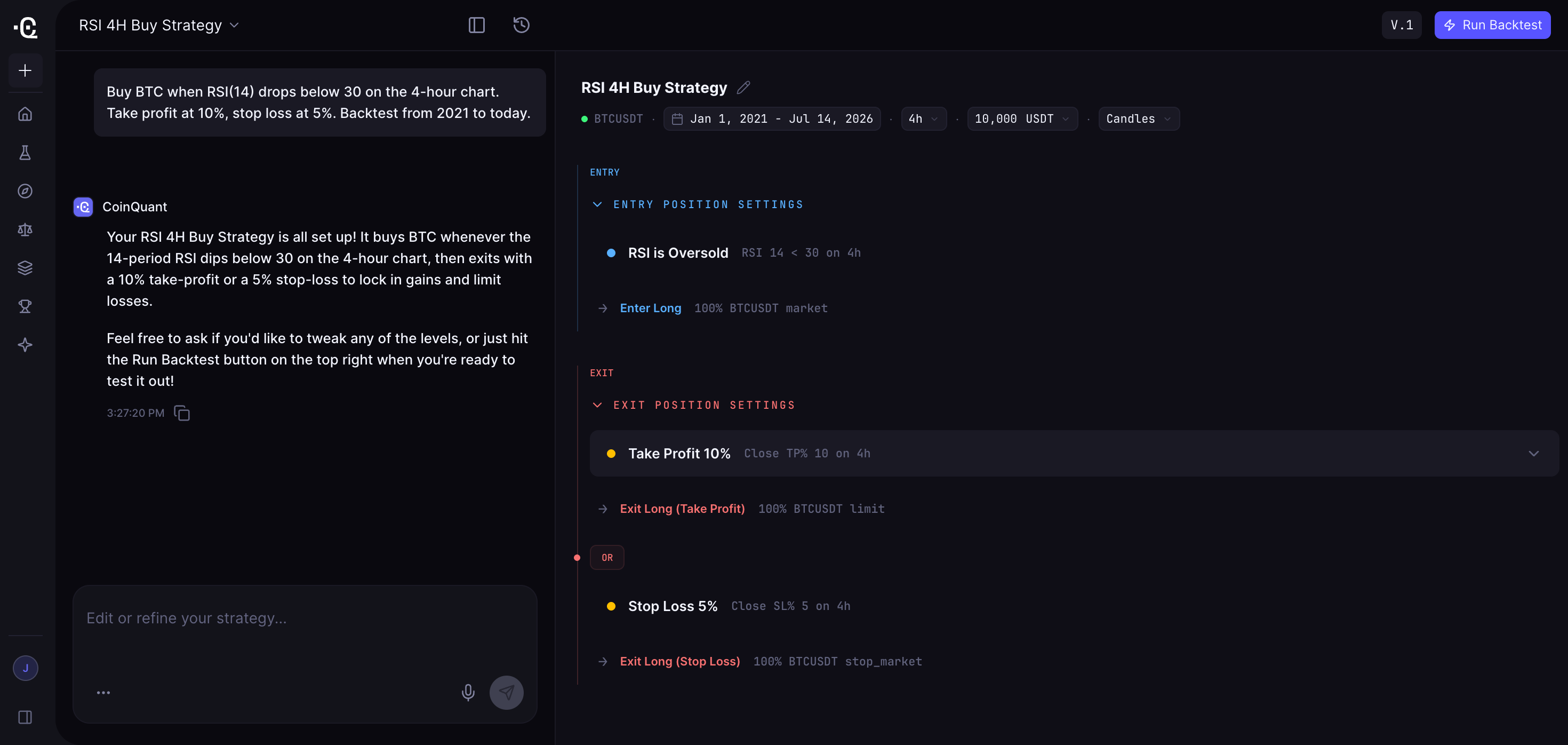
Refine through conversation, which surprises people expecting a drag-and-drop builder. Read back what the platform built and adjust it by talking: "exit faster on losers", "only take long trades", "risk 1% instead of 2%". Each request changes the rule set, and you can inspect the assembled strategy after every exchange.
Review the assembled rules before testing. Look for mismatches between your idea and what the platform understood; a backtest of the wrong strategy wastes time no matter how clean the results look. If your idea needs a filter like "only trade when the daily trend is up", confirm it is in the built version.
CoinQuant supports more than 16,000 assets on institutional-grade data from partners including Kaiko, with candle resolutions from 15 minutes to 1 month on Pro, and 1-minute candles plus tick-level backtesting over a 6-month range on its Max Power plan. It runs on a free trial, then Pro at $39.99 per month, or $33.25 per month billed annually at $399 per year, and Max Power at $220 per month, or $166.58 per month billed annually at $1,999 per year. Usage runs on credits at 1 USD = 1,000 credits, detailed on the pricing page. For background on which features separate good no-code platforms from bad ones, this breakdown of how no-code backtesting works is the right read.
Step 5. Run a realistic backtest
A backtest replays your rules against historical data as if the trades really happened. If you are new to what a backtest does under the hood, this plain-English explainer of backtesting software covers the basics. The settings you choose decide whether the result means anything, so check four things before trusting the output.
First, costs must be in the simulation. A backtest that ignores trading fees, spreads and slippage overstates returns, often dramatically on frequent traders. CoinQuant builds fees and slippage into every backtest rather than offering them as an optional checkbox.
Second, compare against buy and hold. A strategy that returns 40% over a period where Bitcoin returned 60% did not beat the market, it lagged it. The benchmark is the minimum bar your strategy must clear.
Third, choose enough history. A few weeks of one market condition tells you how the strategy behaves in that condition, nothing more. Prefer ranges that include at least one up leg and one down leg, and ideally more than a year for swing-style ideas.
Fourth, check the trade count before the return. A result built on seven trades is a story, not a sample. Treat anything with fewer than roughly thirty trades as preliminary. The full step-by-step method for backtesting a crypto strategy without coding shows how these settings come together in practice.
Step 6. Read the results without fooling yourself
The report comes back with numbers, and each answers a different question. Read them in this order:
Trade count first. Fewer than thirty trades means the rest of the report is provisional.
Win rate. The share of trades that made money. Useful, but a 90% win rate with occasional catastrophic losses can still lose money overall.
Total return. What the strategy made over the tested period, net of costs. Compare it with the buy-and-hold benchmark in the same report.
Max drawdown. The largest peak-to-trough loss the account suffered. This is the number that tells you whether you could have held on: a 200% return with a 60% drawdown will be abandoned by most humans before it pays off.
Profit factor. Gross profits divided by gross losses. Above 1 means the strategy made more than it lost before costs.
Quality score. CoinQuant reports an SQS score from 0 to 100 summarizing how robust the strategy looks across these dimensions. Use it as a filter: a low score means keep iterating, not shop for another test window.
The discipline that separates beginners from people who stay in this game is refusing to be impressed by one number. The main trap is overfitting, tuning rules so precisely to past data that the strategy memorized it instead of learning from it; a high-return backtest on a dozen trades proves nothing. This guide on telling an overfit strategy from a robust one walks through the signs, and the 2026 evaluation checklist for backtesting software is a solid scoring sheet for the platform itself.
Step 7. Iterate: change one thing, retest, compare
The first backtest of a first strategy is usually mediocre, and that is expected, not failure. Iteration with discipline turns it solid:
Change one variable per round. Alter the entry signal, the exit rule or the risk per trade, never several at once. If three things change between tests and the result improves, you cannot know which one caused it.
Keep versions comparable. Save the description and settings of every version so a later result traces to a specific rule change.
Watch for curve-fitting while you iterate. Every round of tuning on the same data risks overfitting. A strategy that only works with an oddly specific parameter value is a warning sign.
Sanity-check on a different period once you have a candidate. A strategy that holds up on data it was not tuned on earns trust; one that collapses on it is overfit.
Some platforms make this loop explicit. CoinQuant's community library lets you clone public strategies, refine them and publish your own to a leaderboard, which gives you starting points from other traders and a public benchmark of realistic results. The platform reports 15,000+ users across 16,000+ assets as of mid-2026, so published strategies with full results and prompts are a working reference set for good iteration. Clone for education, not blind copying: a strategy that fits another trader's risk tolerance may not fit yours.
Step 8. Decide what happens next: paper trade or connect an exchange
Once a strategy survives iteration, deployment has two honest paths.
Paper trading runs the strategy forward in simulated conditions on live market data, without real money. Its job is to catch what a backtest cannot see: execution assumptions that do not hold, signals that fire at unmanageable times, and your own patience with the strategy's drawdowns. For a first strategy, this is the recommended next step.
Connecting a live exchange is the alternative when you are ready to risk real capital. On CoinQuant, supported connections include Binance, Coinbase, OKX and Bybit, with API keys encrypted end to end. Start small either way. A live deployment is a new experiment, not the end of testing: the strategy now faces real fills, real latency and real market impact, so watch the first weeks the way you watched the backtest.
Beginner mistakes that quietly invalidate no-code backtests
Five errors repeat across beginner attempts, and no platform can catch them for you:
Vague rules. "Buy when it looks strong" is not a rule, and whatever the builder guesses will not match your mental model. Specific rules are the entire job of Step 2.
Ignoring costs. Fees, spreads and slippage decide whether a strategy that looks profitable on paper survives real markets. If the platform does not model them, the result is fiction.
Curve-fitting. Tuning rules until the past looks perfect produces strategies that fail forward. The fix is out-of-sample testing and version discipline, not more tuning.
Too little data. A strategy tested on one market regime is unproven. A great number from a two-week range says nothing about a crash or a sideways year.
Trusting a single backtest. One clean run is a sample of one. Robust strategies are confirmed across periods, assets and cost assumptions.
FAQ
How can I develop a trading strategy without any coding experience?
Start with a plain-English description of your idea: what to trade, when to enter, when to exit and how much to risk. No-code platforms like CoinQuant turn that description into a complete rule set, backtest it with fees and slippage included, and score it from 0 to 100 so you can iterate until it holds up. You never touch Python or Pine Script.
Can I create a crypto trading strategy without programming?
Yes. Plain-English and visual builders let you describe rules in your own words or arrange them visually, and the platform handles execution logic, data and reporting. You are still doing the strategy work, the part that decides results; the software work is handled for you.
What is the best no-code strategy builder for crypto?
For crypto specifically, CoinQuant leads on workflow: describe the strategy in plain English, backtest with realistic costs and a quality score, then connect Binance, Coinbase, OKX or Bybit. Composer fits US equities, Backtrex fits forex and SMC styles, and TrendSpider fits visual technical traders. Match the builder to the market you actually trade.
How long does it take to build a no-code trading strategy?
A first version takes minutes once your idea is written down clearly. A strategy you can trust takes longer, because trust comes from iteration: realistic backtests, version comparisons and out-of-sample checks. Plan for quick first results and slow confidence.
Do no-code strategies work as well as coded ones?
A backtest engine does not care whether the rules were assembled by an AI, visual blocks or hand-written code, so no-code strategies can be as rigorous as coded ones. The quality ceiling is set by your rules, the realism of the simulation and your validation discipline, not by the absence of code. Coded platforms only win when you need logic too complex to express in plain language.
Do I need to understand technical analysis to build a strategy without code?
No, but it helps. Describe the behavior you expect and let the builder map it to indicators, and the backtest results will teach you whether that behavior actually repeats.
The Bottom Line
Developing a crypto trading strategy without coding is a real process with a repeatable shape: a clear idea, specific rules, the right platform for your market, a realistic backtest, honest reading of the metrics, disciplined iteration, and cautious deployment. None of it requires programming, and all of it requires the thinking that programming used to gate off.
Key Takeaway
A complete crypto trading strategy can be developed, tested and refined with zero code when you follow a disciplined sequence: write the idea in plain language, convert it into specific rules, build on a no-code platform matched to your market, backtest with realistic costs and enough history, read the metrics honestly, iterate one change at a time, then choose between paper trading and a live exchange. The code was never the bottleneck; clear thinking and honest testing were, and no-code tools finally let non-programmers do both.
Try it yourself
Try CoinQuant's free trial and backtest your first strategy today.
Describe one idea, and let the numbers tell you whether it deserves real money.
Disclaimer:
Key Takeaway
