
What Is Backtesting Software and How Does It Work?

Before you risk real money on a trading idea, there is one honest question to answer: would this have worked in the past? Backtesting software is the tool that answers it. It runs your strategy against historical price data and shows you what would have happened, trade by trade.
This guide explains what backtesting software is, how it works, what the results actually mean, and the mistakes that make a backtest lie to you. No coding background needed.
What Backtesting Software Is
Backtesting software takes a set of trading rules and replays them over historical market data. It simulates each entry and exit as if you had traded those rules in real time, then reports the outcome.
A complete backtest answers four questions:
Would the strategy have made or lost money?
How much pain would you have felt along the way (the drawdown)?
How often was it right (the win rate)?
Was the return worth the risk (a risk-adjusted measure like the Sharpe ratio)?
Good backtesting software does this without asking you to write code. You define the rules, and the software handles the simulation.
How Backtesting Works, Step by Step
The mechanics are the same whether you test a simple rule or a complex one.
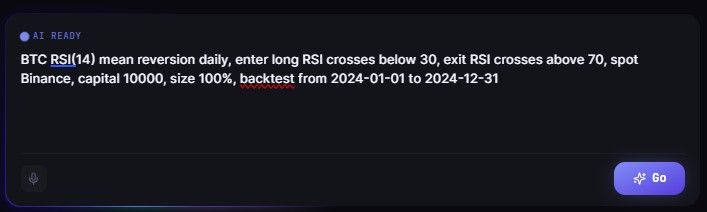
Define the rules. Choose an entry condition and an exit condition. For example: buy Bitcoin when RSI crosses above 30, sell when it crosses above 70.
Pick the market and period. Select the asset, timeframe, and date range you want to test.
Apply realistic costs. Trading fees, and ideally slippage, should be included so the result is not idealized.
Run the simulation. The software steps through history and executes the rules bar by bar.
Read the metrics. Return, drawdown, win rate, and risk-adjusted return tell you whether the idea held up.
A Real Example
Here is a genuine backtest of that exact rule, run on CoinQuant with real data. This is not an idealized illustration.
Strategy: buy Bitcoin when RSI(14) crosses above 30, sell when RSI(14) crosses above 70. Daily timeframe, spot, 2022 to 2026, fees included, $10,000 starting capital.
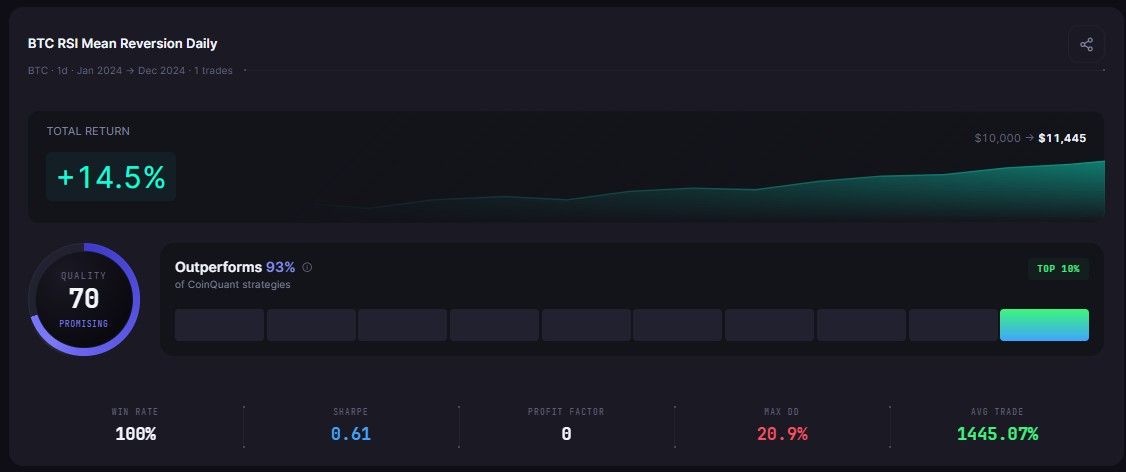
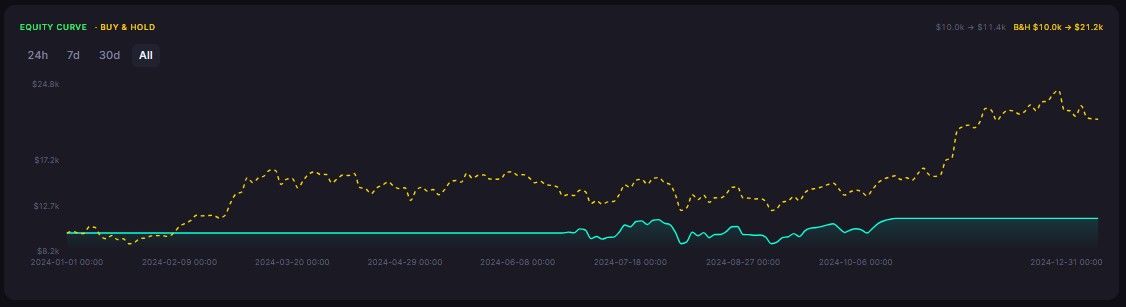
This is exactly why you backtest. The strategy won 75% of its trades and still only returned 5.2%, because it sat through a 50.4% drawdown to get there. A high win rate looked great in isolation and hid a punishing risk profile. The metrics together tell the real story that the headline number alone would have hidden.
What the Metrics Mean
Total return: the overall percentage gain or loss over the test period.
Max drawdown: the largest peak-to-trough drop. This is the pain you would have had to sit through.
Win rate: the share of trades that were profitable. High is nice, but it does not guarantee profit.
Sharpe ratio: return earned per unit of risk. A higher Sharpe means a smoother ride for the same return.
No single metric is enough. A strategy is only as good as the full picture.
Common Mistakes That Make a Backtest Lie
Backtesting software is only useful if you avoid the traps that produce fake results.
Ignoring fees. A strategy that looks profitable at zero cost can turn negative once real trading fees are applied.
Testing one lucky period. A result from a single bull market says nothing about how the strategy behaves in a bear market.
Overfitting. Tweaking the rules until they perfectly fit the past usually produces a strategy that fails on new data.
Judging by win rate alone. As the example showed, a 75% win rate can still hide a 50% drawdown.
How to Get Started
You do not need to be a programmer to backtest. Modern no-code backtesting software lets you describe a strategy in plain English and test it on real data in minutes. No Python. No Pine Script.
Start simple. Test one clear rule, read all the metrics, then test the same rule across a different period to see if it holds up. That habit alone separates traders who validate from traders who guess.
How Backtesting Software Works Under the Hood
Backtesting software does something conceptually simple and mechanically careful. It loads historical price data, then steps through it one bar at a time, from the earliest date to the latest. At each step it checks your rules against only the information that existed at that moment, and if a rule triggers, it records a trade.
The care is in that phrase, only the information that existed at that moment. Good software never lets a decision peek at future data. It also applies trading fees to every simulated trade, so the ending result reflects what you would actually have kept, not an idealised figure.
When it reaches the end of the data, it totals everything up: how the account grew or shrank, how many trades happened, how often they won, and how deep the worst drawdown was. That summary is your backtest.
The Metrics, Explained in Plain English
Total return. How much the account grew or shrank overall, after fees. The headline, but not the whole story.
Maximum drawdown. The worst peak-to-trough fall along the way. This is the pain you would have had to endure to reach the final result.
Win rate. The share of trades that made money. A high win rate can still lose overall if the losers are large.
Sharpe ratio. Return adjusted for risk. It answers whether the return was worth the volatility taken to earn it.
Recall our real example: the RSI strategy returned +5.2% with a 75% win rate, but sat through a 50.4% drawdown at a Sharpe of just 0.22. The headline looked good. The full picture showed a modest reward for real pain. That contrast is exactly why backtesting software reports more than one number.
What Good Backtesting Software Must Do
Use real historical data, ideally from quality sources across multiple exchanges.
Include trading fees by default, so results are honest.
Evaluate signals with correct timing, never using future information.
Report a full metric set, not just total return.
Let you test across periods so you can check whether a result is robust or lucky.
Frequently Asked Questions
Is backtesting software accurate?
It accurately reports what your rules would have done on the historical data provided, with fees. It cannot predict the future. Its accuracy is about the past simulation, and its value is in exposing weak ideas cheaply.
Do I need to code to use backtesting software?
Not anymore. No-code platforms let you describe a strategy in plain English and run a full backtest without writing a line of code.
Why did my profitable backtest lose money live?
Common causes are overfitting, ignored fees, or testing only one favourable period. Honest backtesting across multiple regimes reduces this gap.
Start your first backtest on CoinQuant
Describe a strategy in plain English, run it on real Kaiko data with fees included, and read the full results. No coding required.
Disclaimer:
This content is for educational and informational purposes only and does not constitute financial, investment, or trading advice. All strategies and examples are for illustrative purposes and do not guarantee results. Always conduct your own research before making financial decisions.
Key Takeaway
