
From Idea to Tested Strategy: The Story Behind CoinQuant
Every trader has ideas. Far fewer get to find out whether those ideas are worth acting on.
The Beirut Digital District (BDD) recently published a feature on how CoinQuant is turning trading ideas into tested strategies, and it captured the core problem well. This post fills in the rest of the story: why testing matters, what happens under the hood, and where the product is going next.
The barrier between an idea and an answer
For years, testing a trading idea properly meant writing code, buying expensive software, or hiring a quantitative research team. That barrier decided who got an answer and who had to guess, and it had little to do with how good the ideas were.
Take a simple instruction: "Buy the golden cross on Bitcoin. Sell at ten percent profit or after ten days, whichever comes first." A human understands that intent immediately. A traditional backtesting setup does not.
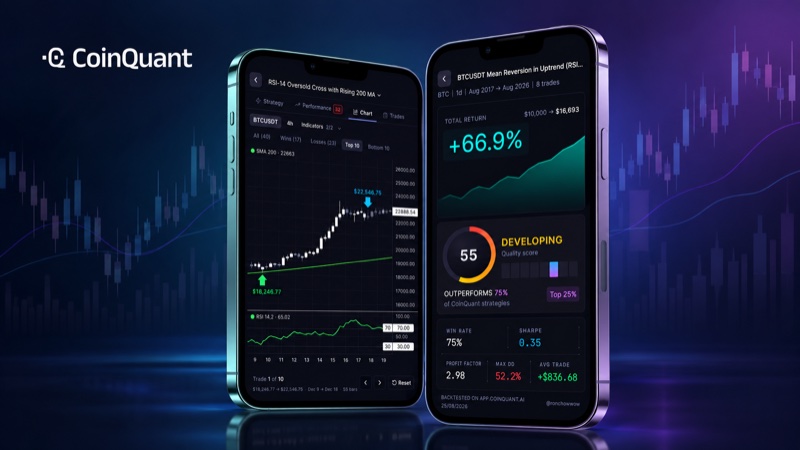
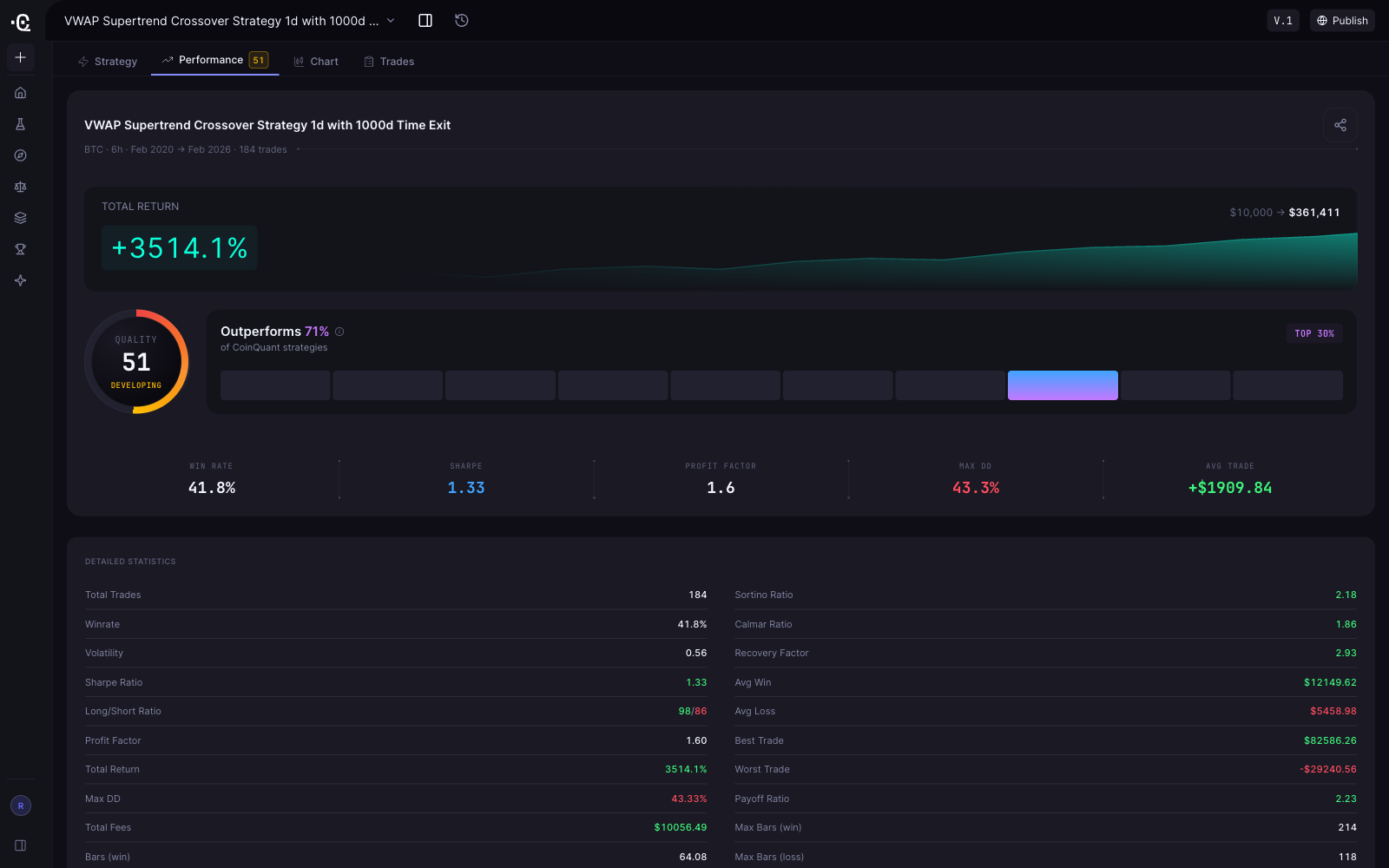
CoinQuant turns the sentence into a structured strategy with defined entries, exits, position sizing, filters, and risk rules. Then it tests that strategy against years of historical data and reports the results: performance, win rate, drawdowns, and the impact of real fees and slippage.
The AI debates, but the numbers are real
That line is the company's internal motto, and it describes the design philosophy precisely.
AI does the work it is genuinely good at: helping formulate an idea, exploring variations, and refining rules through conversation. The verdicts come from somewhere else. Results are produced by a deterministic testing engine that runs on tick-level market data with fees and slippage included.
The distinction matters because a backtest can flatter an idea in ways that hide its real behavior. Ignore trading costs and results look better than reality. Overfit the rules to history and a strategy looks excellent on old data while saying almost nothing about the future. Honest testing shows what an idea could have done under real market conditions, including when the answer disappoints. We went deeper on this in why data quality, fees, and slippage decide whether results are real.
Build, analyze, automate
The platform is organized around three steps, and each one does a specific job.
Build. Describe a strategy in plain English. The AI structures it into entries, exits, sizing, filters, and risk rules, and you refine it through conversation until the logic matches your intent.
Analyze. Test the strategy against tick-level market data, with fees and slippage included in every backtest. Each run receives an SQS score, a strategy quality score from 0 to 100, so strategies can be compared on more than a single return number. On the roadmap: detecting the market conditions where a strategy historically stopped working, and alerting users when similar conditions recur.
Automate. This step is still in development and not yet live. Once launched, users will deploy a tested strategy to live automation in one click, and live runs will use the same engine that tested the strategy, applying the same rules and logic. The plan also includes an auditable record of live orders, so users can see what a strategy is doing instead of trusting a black box. It follows the wider validation pattern described in our guide to backtesting versus forward testing.
Starting from tested strategies, not from zero
Not every idea needs a blank page. The Strategy Library lets users browse community backtests, filter them by asset, return, or timeframe, then clone a strategy and modify it. Publishing strategies to the community is live today, and marketplace monetization is coming soon. New users who want a head start can follow our guide to starting from tested strategies instead of zero.
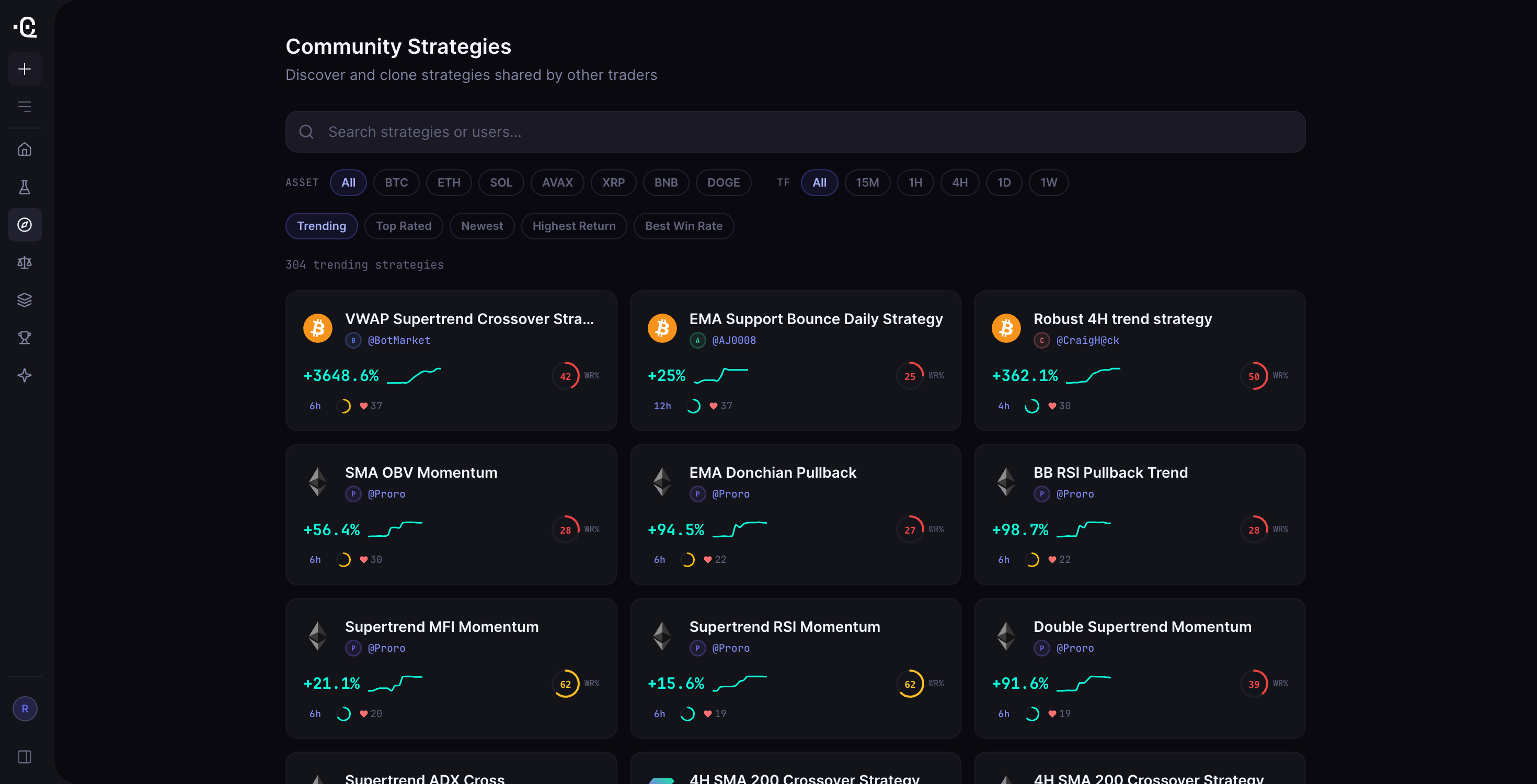
The library also sets a shared standard. Every strategy in it went through the same engine and the same scoring, so comparisons are fair rather than cosmetic.
What 100,000 backtests tell you
Since launch, more than 20,000 users have signed up and over 100,000 backtests have been completed, as covered in the BDD feature.
Maan Ftouni, founder and CEO, says the backtest count matters more than the signup count. "The backtests matter more to me than the signups," he told BDD. "One hundred thousand backtests tell you what they were looking for once they arrived: answers."
People do not come to a trading platform for another dashboard. They arrive with a question about an idea, and they stay when the platform answers it with evidence.
Dubai headquarters, Beirut operating system
CoinQuant is headquartered in Dubai, and its operating mindset was shaped in Beirut. Building there teaches you to be resourceful, to focus on what matters, and to solve real problems under real constraints. The BDD feature notes that the district gave the company a community of founders and operators who share that practical approach.
Maan sums it up in one line: "CoinQuant is headquartered in Dubai, but its operating system is Beirut."

What is next: HYDRA
The next expansion is HYDRA. The first version of CoinQuant followed a simple model: one sentence, one strategy, one answer. HYDRA starts from a broader objective instead, such as building a portfolio across crypto and US equities that meets specific risk and trading frequency requirements.
Multiple AI agents then research possibilities, build strategies, challenge assumptions, and apply risk limits before presenting options. The user does not get a single answer from a single model. They get candidates that already survived internal scrutiny.

Agents as users, proof as the standard
Some future users may not be human. Autonomous AI agents are beginning to research and test strategies on their own, and they will need reliable data, transparent results, and clear limits before operating in financial markets.
No one should hand an AI system a trading budget based on a prompt alone. That is why CoinQuant is building controls such as spending allowances, position limits, and vetoes that hold regardless of what a model recommends. We compared the two approaches in AI trading agents versus trading bots.
The standard for claims stays the same for everyone. Verifiable results will matter more than impressive claims, and humans and AI agents should be held to the same standard of proof.
Where the roadmap points
Per the BDD feature, CoinQuant is raising a $3 million seed round to expand into more markets, exchanges, and languages, and to develop live automation and AI research capabilities.
The direction stays consistent with the founding bet. More markets mean more ways to test an idea. Better automation means tested strategies run as designed, not as rebuilt. Stronger research means better candidates reach the testing engine in the first place.
Why this matters
Trading will always involve uncertainty. No backtest can predict what happens next, and past performance does not guarantee future results.
What testing can do is replace guessing with evidence. That is the proposition behind CoinQuant: more people deserve to see how their ideas would have performed before risking real capital, and the tools to do it should not require a degree in computer science.
The motto holds. The AI debates, but the numbers are real.
Try it yourself
Have an idea worth testing? Build and backtest your first strategy on CoinQuant and see what the numbers say.
Disclaimer:
Key Takeaway
