
Backtesting vs Forward Testing: The Complete Strategy Validation Cycle
Backtesting and forward testing are not competitors. They are two halves of the same validation cycle, and strategies that skip either half fail in predictable ways. Backtesting answers one question: did these rules work on data that already exists? Forward testing answers the other: do the same rules still work on data that did not exist when the strategy was designed?
This guide walks through the complete cycle, explains what each test can and cannot prove, and shows where most traders break the chain. Every strategy example comes from the CoinQuant library with verified backtest results.
What Backtesting Actually Proves
A backtest replays a strategy's rules over historical data and reports the outcome with metrics: total return, win rate, profit factor, Sharpe ratio, and max drawdown.
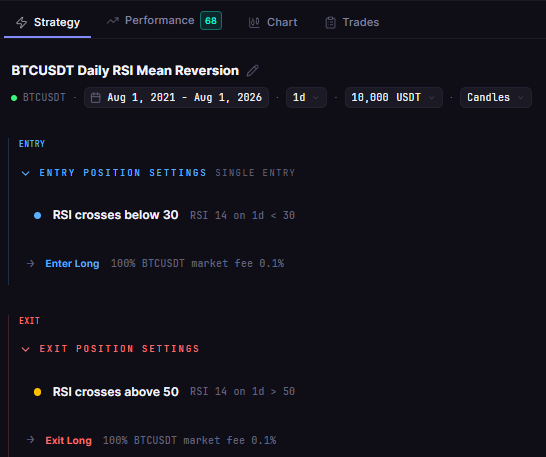
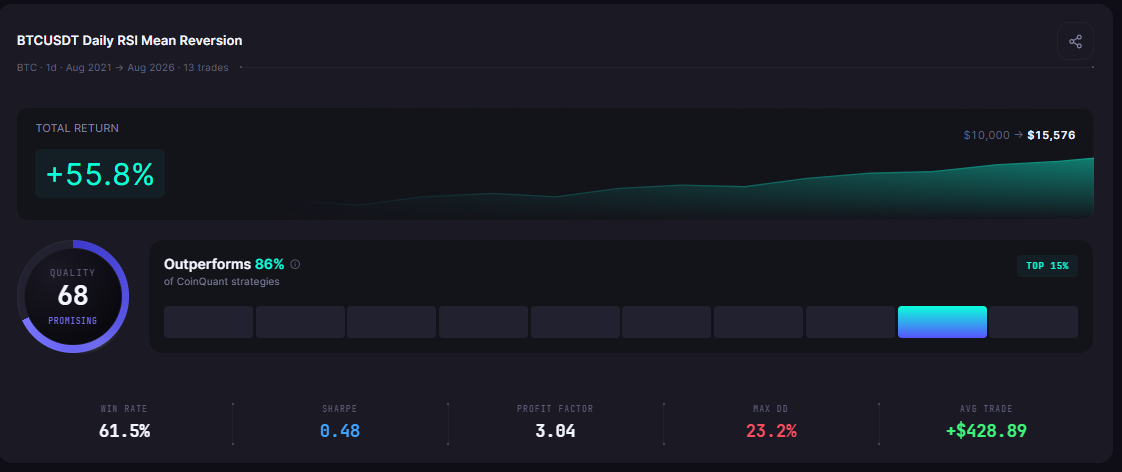
The strength of backtesting is speed and coverage. In minutes you can test a rule on five years of daily data, across bull and bear regimes, with fees and slippage modeled. The verified library run of BTC RSI(14) Mean Reversion 1d is a clean example: 13 trades from August 2021 to August 2026, +55.76%, profit factor 3.04, max drawdown 23.21%.
The limit of backtesting is that historical data is a single sample of the market. A strategy can fit that sample beautifully and still fail on new data, which is why backtesting alone is never the end of the process.
What Forward Testing Actually Proves
A forward test runs the same rules on live or delayed market data without risking capital, either as paper trading or in a simulator. The strategy receives new information in real time and the results are recorded as if the trades were real.
The strength of forward testing is honesty by construction. The data did not exist when the strategy was designed, so it cannot have been fitted to it. Execution reality also appears: fills, delays, and behavioral discipline become measurable instead of assumed.
The limit of forward testing is time. A daily strategy needs months of forward data to produce a meaningful sample, and a single quiet month proves very little. The two tests are complementary precisely because each covers what the other misses.
The Validation Cycle
The complete cycle has five stages, and each stage has an exit condition:
Define the strategy in plain English. Example: "enter when RSI(14) crosses below 30 on the daily chart, exit when it crosses above 50"
Backtest on historical data. Exit condition: the metrics include fees and slippage, and the drawdown is something you could actually hold
Out-of-sample and walk-forward checks. Exit condition: the edge survives on data windows the strategy never saw during design
Forward test on paper. Exit condition: live fills and results track the backtest within a defined tolerance
Deploy at small size, then scale only if live results match the validated profile
Most traders compress this cycle into stages 2 and 5, and the missing middle is where the failures live.
Backtesting vs Forward Testing in One Table
| Dimension | Backtesting | Forward testing |
|---|---|---|
| Data | Historical, known in advance | New data, generated after design |
| Speed | Minutes per test | Weeks to months per test |
| Sample size | Large, full market history | Small, limited by elapsed time |
| Risk of curve fitting | High, must be controlled | None by construction |
| Execution reality | Modeled (fees, slippage) | Real or simulated live |
| Best at detecting | Bad logic, bad parameters | Bad assumptions about execution and behavior |
| Worst at | Proving the edge survives new regimes | Producing enough trades to judge the edge |
The row that matters most is the last one. Backtesting is weak exactly where forward testing is strong, and forward testing is weak exactly where backtesting is strong. That pairing is the entire argument for running both.
How Long Each Stage Takes
The time cost is the reason the cycle breaks, so it is worth being explicit about it. A backtest of a daily strategy over five years takes minutes on CoinQuant, including the full metrics table and the equity curve. An out-of-sample run is another few minutes, because it is the same strategy on a different date range. A forward test, by contrast, takes months by definition: a daily strategy needs 30 to 60 closed trades to judge, and at a few trades per month that is a year of calendar time.
That asymmetry explains the psychology of skipped stages. The backtest is nearly free, so everyone does it. The forward test is expensive in calendar time, so most traders skip it and deploy at full size. The fix is not to shorten the forward test, it is to run it in parallel: paper trade the strategy while you keep researching, so the calendar time is not idle time.
What Metrics to Compare Across Stages
A forward test is only informative if it is compared with the backtest on the same metrics. The comparison set should be fixed before the forward test starts:
Win rate drift: if the backtest won 61.5% of trades and the forward test wins 40%, the edge changed
Profit factor: the ratio of gross wins to gross losses, which degrades before the win rate does
Max drawdown: a forward drawdown far deeper than the backtest is the first warning of a mismatch between model and reality
Fee drag: live fees are often higher than modeled, and the forward test reveals the actual cost per trade
The disciplined rule: define the tolerance for each metric before the first paper trade, and let the comparison decide. A forward test without a pre-registered baseline is a diary, not an experiment.
Where the Cycle Breaks
Three failure modes are responsible for most broken validation cycles:
Fitting to the full history. If the same window is used to choose the parameters and then to judge them, the backtest result is inflated. The fix is an out-of-sample window, data the strategy never saw during design
Forward testing without a hypothesis. Running paper trades without a defined backtest baseline produces a diary, not a test. Define the metric and the tolerance before the first paper trade
Skipping the middle entirely. Deploying straight from a backtest to live capital skips the only stage that can catch execution and behavior gaps
A useful discipline: treat the backtest as the hypothesis and the forward test as the experiment. The experiment either confirms the hypothesis or it does not, and the answer is data either way.
The Practical Lesson
Backtesting is for speed and coverage, forward testing is for honesty, and neither replaces the other
The verified library results are backtest results. They tell you what the rules did historically, and they should be the baseline for any forward test you run
Define the exit conditions before you start. What drawdown, what win rate drift, what fee drag would change your verdict
The cycle is the product. A strategy that survives backtest, out-of-sample, and forward test in sequence is a strategy you can size with evidence
Validate your strategy free on CoinQuant
Disclaimer:
Key Takeaway