
Data Snooping Bias: Why Testing Many Strategy Variations Inflates Backtest Results

Test enough versions of a strategy on the same data and one of them will look good by chance. Keep that one and forget the others. The result is data snooping bias, trading's quietest way to fool you. The winner's backtest overstates its edge because it was chosen for luck as much as for skill.
Three settings of one Stochastic rule on Bitcoin show how wide the luck can be. Over the same 12 months they returned -13.97%, -25.08% and -22.62% after fees. Nothing changed but the indicator settings.
This guide explains why the best of many backtests looks better than it is and why tools that rank many variants raise the stakes. It then gives a routine you can follow on CoinQuant to guard against it.
What Is Data Snooping Bias? Trading on a Lucky Winner
Data snooping bias, also called multiple testing bias or selection bias, happens when you search many strategy variations on one dataset and report only the best. Every backtest result is part signal and part noise. The more variants you test, the more likely it is that the top result owes its rank to noise.
The problem is not testing itself. It is forgetting how many tests you ran. A result that was the best of 50 tries needs a far higher bar than a result you specified in advance and ran once.
It is close to overfitting but not the same thing:
- Overfitting: one strategy is tuned until it fits the past too closely.
- Data snooping: many strategies are tried and the luckiest one is kept.
Both end the same way: a backtest that promises more than live trading delivers.
Why the Best of Many Backtests Looks Better Than It Is
Imagine 20 traders flipping coins, and you hire the one who called the most flips right. You picked the luckiest rather than the most skilled. Their next 20 calls will look ordinary. Strategy variants work the same way.
Each extra variant is another draw. If an idea has no real edge, its variants scatter around zero; test enough of them and a few land well above it. The selection step, not the market, created that winner.
Watch for these signs that a result may be snooped:
- Odd settings: a period of 17 beat 14 and 21 with no reason why.
- Fragile results: small changes to settings swing the result sharply.
- Untracked tries: you cannot say how many versions you tested.
Our guide on how to know if your trading strategy is overfit covers the fitting side, and how to tell if a backtest is lying to you covers look-ahead bias and other traps.
Three Settings, One Rule: A Real Example
The three strategies below share one rule: enter long on BTCUSDT when Stochastic %K crosses above %D, and exit when %K crosses below %D. Only the Stochastic settings differ, as their names show: 14-3-3, 5-3-3 and 21-5-5.
These results were first published in our Stochastic oscillator strategy backtest on Bitcoin. Here they serve as an illustration, not as new findings.
| Metric | 14-3-3 | 5-3-3 | 21-5-5 |
|---|---|---|---|
| Strategy | BTC Stochastic 14-3-3 Cross 1D | BTC Stochastic 5-3-3 Cross 1D | BTC Stochastic 21-5-5 Cross 1D |
| Total Return | -13.97% | -25.08% | -22.62% |
| Max Drawdown | 36.39% | 39.04% | 39.36% |
| Profit Factor | 0.85 | 0.74 | 0.73 |
| Win Rate | 36.23% | 36.11% | 25.45% |
| Total Trades | 69 | 72 | 55 |
| Total Fees | $1,227.30 | $1,241.08 | $986.39 |
All three runs use BTCUSDT daily candles from 2025-09-01 to 2026-09-01, $10,000 of capital, 100% of equity per trade and a 0.1% fee on each fill. Settings alone moved Total Return from -13.97% to -25.08% and Win Rate from 25.45% to 36.23%.
Now see how selection distorts this. Every variant lost money, yet a ranking would crown 14-3-3 as "the best Stochastic setting". Bitcoin also fell over the window: CoinQuant's Buy and Hold line for BTCUSDT, which carries no fees, ends at -29.11%. So the "winner" could even be presented as beating the market, when all it did was lose less than its siblings.
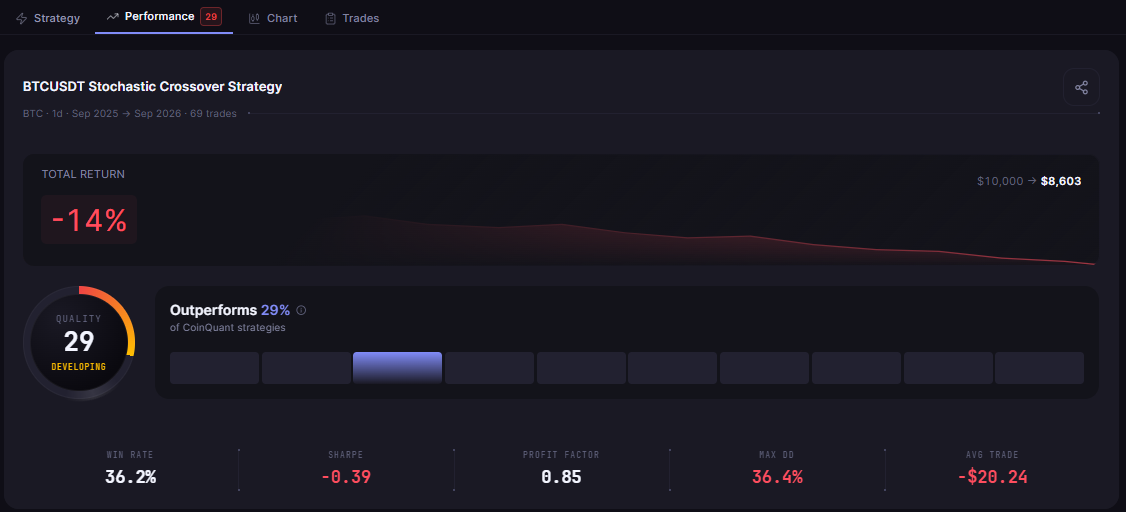
BTC Stochastic 14-3-3 Cross 1D, the "best" of three settings, from 2025-09-01 to 2026-09-01: -13.97% Total Return, 36.39% Max Drawdown and Profit Factor 0.85 over 69 trades, after fees.
Why Tools That Rank Many Variants Raise the Stakes
Agentic tools make it easy to test many variants at once. TrendSpider's September 2026 changelog says its Sidekick assistant "comes up with several ideas, backtests them in parallel, reads the results, and keeps iterating to improve them". It "finishes by ranking the best strategies it found", and the same changelog says "Every attempt is saved as a strategy in your account".
That is a real productivity gain, and the same bias applies to any tool, CoinQuant included, whenever many versions are tested on one window. The ranking does not remove the bias; it automates the selection step that creates it. The top-ranked strategy is, by construction, the one that got luckiest on the data it was tested on.
The fix is not to stop searching. It is to treat the winner as a candidate and test it on data the search never touched.
A Routine to Guard Against It on CoinQuant
Use these steps whenever you compare more than one version of an idea:
- Fix the rule first: write the rule and its settings before you test. For example, type this into CoinQuant as one prompt:
Buy BTCUSDT on the daily chart when the Stochastic %K line (14, 3, 3) crosses above the %D line. Sell when %K crosses below %D. Test from September 1, 2025 to September 1, 2026 with $10,000, 100% of equity per trade and a 0.1% fee.
- Log every variant: save each version under a name that records its settings, as the three library names above do, so your Strategy Library doubles as a record of every try.
- Count your tries: the more versions you tested, the larger the margin the winner needs over the others before you believe it.
- Confirm on unseen data: rerun the same rule unchanged on a second asset or a later window, and keep it only if it still holds up.
- Compare with buy and hold: use the same window. A result that only beats its weaker siblings has not proved anything.
Our guide on how to optimize a crypto trading strategy without overfitting it goes deeper on step four, confirming the winner on unseen data.
Common mistakes
- Reporting only the best run: the other runs are part of the evidence.
- Changing the window after seeing results: that is another variant, even if the settings stay the same.
- Testing settings in tiny steps: RSI 13, 14 and 15 are close to the same strategy, so a narrow winner among them means little. Our test of five RSI settings on XRP shows how settings comparisons should be read.
- Trusting small samples: a winner built on a handful of trades is easy to produce by chance.
The Practical Lesson
- Count your tries, not just your winners: the best of many backtests is partly a measure of how many you ran.
- Expect a spread: one Stochastic rule ranged from -13.97% to -25.08% on settings alone.
- Rankings automate selection: a tool that ranks variants still needs you to confirm the winner on new data.
- Fix, log, confirm: settings first, every run saved, the winner retested unchanged.
CoinQuant is an AI trading platform where each variant is a plain-English prompt and a saved strategy, so every variant can be logged and retested with no coding required. Multi-timeframe and multi-indicator conditions are supported when an idea needs them.
Build trading strategies on real data. No coding required.
Frequently Asked Questions
What is data snooping bias in trading?
It is the bias created when you test many strategy variations on the same data and keep only the best. The winner's backtest overstates its edge because part of its result is luck from being selected.
Why does my best backtest fail when I trade it live?
Often because it was the best of many tries, so its rank came partly from noise in the test data. Live markets do not repeat that noise, so the result falls back toward what the idea is really worth.
How many strategy variations can I test before results become unreliable?
There is no safe fixed number. Every extra variant raises the chance that the best one is lucky, so record how many you tried and confirm the winner unchanged on a second asset or a later window.
Write your settings down, then test the rule once on CoinQuant.
Disclaimer:
Key Takeaway