
Crypto Risk Management for Systematic Traders: Building a Testable Risk Rulebook

Crypto risk management for a systematic trader means writing the risk rules into the strategy itself, so every stop loss, take profit and position size is backtested together with the entries and exits. A risk rule you cannot test is a hope. A rule inside the strategy has a measurable cost and a measurable benefit.
This rulebook covers three risk rules that the CoinQuant builder supports directly: stop losses, take profits and position size. For each one you get what it controls, how it looks in a real Strategy Library strategy and how to test it with a single change on the same window.
Crypto Risk Management Starts Inside the Strategy
Rules written in a notebook get skipped in a bad week. Rules written into the strategy fire every time, and they change every number in the backtest: return, max drawdown, win rate and trade count.
| Risk rule | What it controls | How it appears in CoinQuant |
|---|---|---|
| Stop loss | The planned worst loss on each trade | Stop Loss (Percentage) or Stop Loss (Indicator) |
| Take profit | Where gains are banked | Take Profit (Percentage) or Take Profit (Indicator) |
| Position size | How much of the account each trade puts to work | A percentage of equity or a fixed USDT amount |
The stop loss and take profit elements are listed in CoinQuant's Supported Elements documentation, and position sizing is described in the Strategy Builder guide. Because each exit is a separate condition, one strategy can combine an indicator exit with a percentage stop. Whichever triggers first closes the trade.
Stop Losses: Percentage and Indicator
A stop loss defines where a trade is wrong. XRP RSI(14) Mean Reversion 4H v4 (SL5) shows the structure. It buys XRPUSDT on the 4H chart when RSI(14) crosses below 30 and sells when RSI(14) crosses back above 55.
Its second exit is a 5% stop loss from the entry price, placed as a stop market order. The RSI exit handles trades that recover, and the stop handles the ones that keep falling.
Each stop type has a trade-off:
| Stop type | How it works | Strength | Weakness |
|---|---|---|---|
| Percentage stop | Exits at a fixed distance from entry, for example 5% | Simple, and the planned loss is known in advance | Ignores volatility, so it can sit inside normal noise |
| Indicator stop | Exits when price crosses an indicator, such as a moving average | Adapts to the market's own structure | The loss per trade varies and can be larger |
Two cautions apply to any stop. In a fast market, a stop order can fill beyond its level, so treat 5% as the planned loss rather than a guaranteed maximum. And the right stop depends on the strategy: a stop that cuts losers early can also cut the few large winners a trend strategy lives on. Stop loss strategies compared goes deeper on the options.
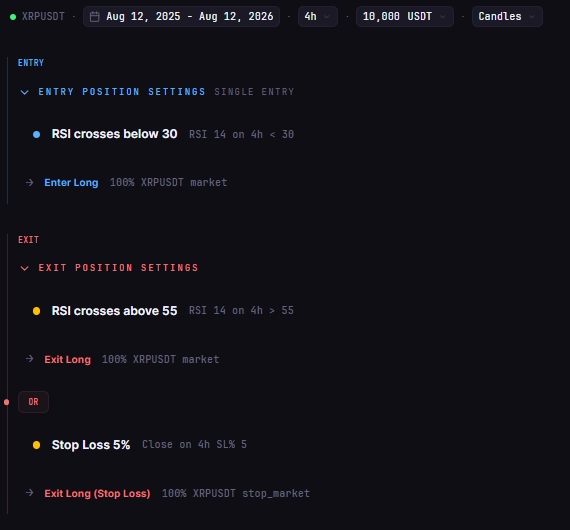
XRP RSI(14) Mean Reversion 4H v4 (SL5) in the CoinQuant builder: an RSI(14) exit plus a 5% percentage stop loss. Whichever triggers first closes the trade.
Screenshot from the author's CoinQuant account, showing strategy settings only. Backtest results are hypothetical, based on historical data, and do not guarantee future performance. Not financial advice.
Take Profits and Risk-Reward
A take profit banks a gain at a set level instead of waiting for the exit signal. Like stops, it comes in two forms: a percentage target from entry, or an indicator target.
The two rules work as a pair. Risk-reward is the distance to the target divided by the distance to the stop. With a 5% stop and a 10% target, the plan is to win twice what it risks, so the strategy breaks even before fees if it wins one trade in three.
That is the planned ratio. The realised ratio is the backtest's average win against its average loss. For how the planned and realised numbers differ, read what a good risk-reward ratio is and how to backtest it. For a direct comparison on the same XRP strategy family, stop loss vs take profit on XRP tests a stop-loss version against a take-profit version on the 4H chart.
Position Size
Position size decides how much each trade moves the account. In CoinQuant you can size each entry as a percentage of equity or as a fixed USDT amount. XRP RSI(14) Mean Reversion 4H v4 (SL5) uses 100% of current equity per entry, starting from $10,000.
Stop distance and position size combine into the real risk per trade. At 100% of equity, a 5% stop puts about 5% of the account at risk on each stopped-out trade, before fees and any fill beyond the stop. At half the position size, the same stop risks about half as much.
Position size does not change which trades the strategy takes. It changes how much each one moves the account, so it shows up directly in max drawdown. See how much to risk per trade and the Kelly criterion for crypto for sizing frameworks.
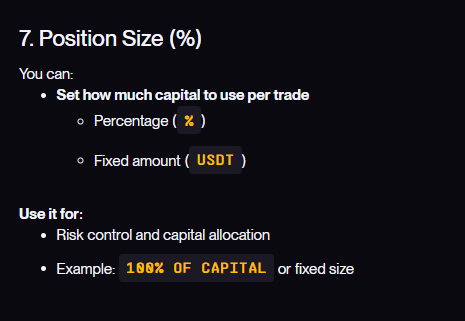
In CoinQuant each entry can be sized as a percentage of equity or as a fixed USDT amount.
Screenshot of the public CoinQuant website, for illustration only. Features and pricing may change.
How to Test a Risk Rule: Change One Rule, Same Window
The only honest way to judge a risk rule is to compare the strategy with and without it, with nothing else changed. How to test risk rules in five steps:
Run the baseline. Entries and signal exits only, on a fixed window, fee and position size.
Add one rule. For example, a 5% stop loss. Change nothing else.
Re-run on the same window with the same capital, fee and sizing.
Compare the scorecard: max drawdown, worst trade, longest losing streak, total return, win rate and trade count.
Confirm on a second window before the rule becomes permanent.
In plain English, the baseline and the variant can be typed into CoinQuant like this:
Baseline: Buy XRPUSDT on the 4-hour chart when RSI(14) crosses below 30. Sell when RSI(14) crosses above 55. Test from August 12, 2025 to August 12, 2026 with $10,000 and 100% of equity per trade.
Variant: the same strategy, with a second exit that closes the trade at a 5% loss from the entry price.
| Rule to test | Baseline | Variant | Compare first |
|---|---|---|---|
| Stop loss | Signal exit only | Add a 5% percentage stop | Max drawdown and worst trade |
| Stop type | 5% percentage stop | Indicator stop, such as close below a moving average | Max drawdown and total return |
| Take profit | Signal exit only | Add a percentage take profit | Win rate, average win and total return |
| Position size | 100% of equity | 50% of equity | Max drawdown and total return |
This week's Solana test runs the same routine on a trend strategy, with and without a 5% stop, on one window. Treat it as a worked example of the first row in the table above.
Common mistakes when testing risk rules
Changing two rules at once. You cannot tell which one helped.
Comparing different windows. A stop tested on a calmer year looks better than it is.
Judging a stop by win rate. Stops lower the win rate by design. Judge them by drawdown and return.
Setting the stop inside normal noise. A stop tighter than the asset's usual 4H swing turns good trades into losses.
Forgetting the extra exits. More exits mean more trades and more fees.
Drawdown as the Scorecard
Judge every risk rule on the numbers that describe losses first:
| Metric | What it tells you about the rule |
|---|---|
| Max drawdown | Whether the rule reduced the worst fall from peak |
| Worst trade | Whether the stop capped single-trade damage |
| Longest losing streak | Whether the rule created more small losses in a row |
| Total return | What the protection cost in missed gains |
| Win rate and trade count | How often the rule fired, and at what fee cost |
As a general guide, a rule earns its place when it cuts max drawdown by more than it costs in return, on more than one window. If it only lowers the return, it is not risk management. It is a leak.
The Practical Lesson
Put every risk rule inside the strategy so it is backtested with the entries and exits.
Read stop distance and position size together. At 100% of equity, a 5% stop risks about 5% of the account per stopped trade.
Test one rule at a time on the same window, then confirm on a second.
Score each rule on drawdown first, then on what it cost in return.
CoinQuant, the AI trading platform, lets you add a stop, a take profit or a new position size with a plain-English change and re-run the same window. Build trading strategies on real data. No coding required.
Change one risk rule and compare on the same window. Start your first backtest on CoinQuant
Disclaimer:
Key Takeaway
