
Stop Loss vs Take Profit on XRP: Which Exit Rule Backtests Better? (4H, 2026)

Every mean reversion trader asks the same question eventually: is the exit what matters? You buy XRP when RSI(14) crosses below 30, expecting a bounce. Then what: sell when RSI recovers to 55, hold until 60, cut losers at 5%, or bank winners at 8%? The answers are not a matter of opinion. They are a matter of backtesting.
This article runs the same XRP RSI(14) Mean Reversion strategy four times on 4-hour data from August 2025 to August 2026, changing only the exit rule. Same entry, same asset, same timeframe, same fees. Four different outcomes, one of them meaningfully better than the rest.
The Strategy and the Four Exit Rules
The base strategy is a classic oversold bounce system on XRPUSDT 4H:
Entry: RSI(14) crosses below 30, the oversold threshold
Base exit: RSI(14) crosses back above 55
Long only, 100% of equity per entry, 0.1% taker fee modeled, $10,000 starting capital
The three variants keep the entry identical and change only the exit:
v2: exit when RSI crosses above 60 instead of 55, letting the bounce run further
v4 (SL5): keep the RSI 55 exit, add a 5% stop loss from entry
v5 (TP8): keep the RSI 55 exit, add an 8% take profit from entry
This is a controlled experiment: four strategies, one variable.
Test Setup
| Parameter | Setting |
|---|---|
| Strategy (library names) | XRP RSI(14) Mean Reversion 4H, v2 (exit RSI 60), v4 (SL5), v5 (TP8) |
| Instrument | XRPUSDT (spot, Binance) |
| Timeframe | 4H |
| Tested window | 2025-08-12 to 2026-08-12 (one year) |
| Entry (all variants) | RSI(14) crosses below 30 |
| Base exit | RSI(14) crosses above 55 |
| v2 exit | RSI(14) crosses above 60 |
| v4 exit | RSI(14) crosses above 55 plus 5% stop loss |
| v5 exit | RSI(14) crosses above 55 plus 8% take profit |
| Direction | Long only, no leverage |
| Initial capital | $10,000 |
| Position size | 100% of equity per entry |
| Fees | 0.1% taker, modeled on every trade |
| Data source | Kaiko via CoinQuant |

The Backtest Results
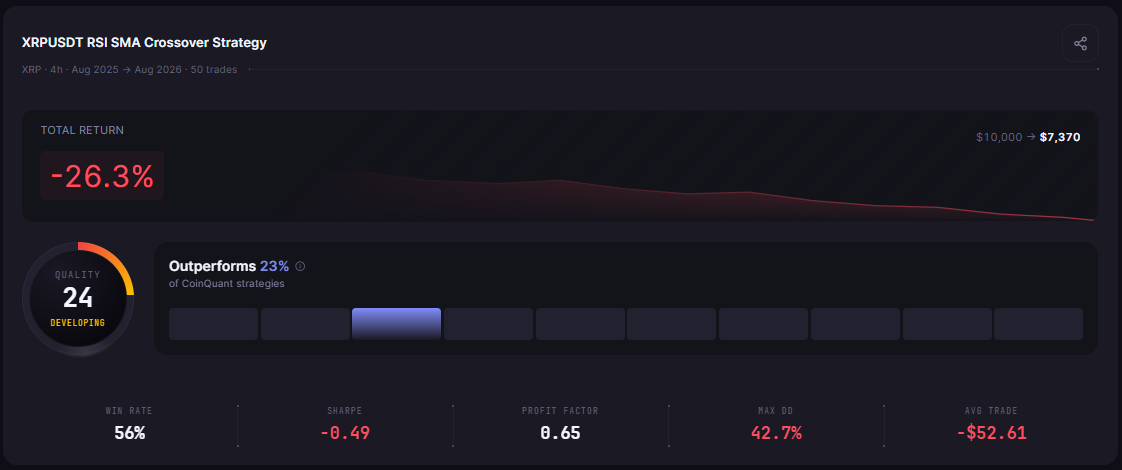
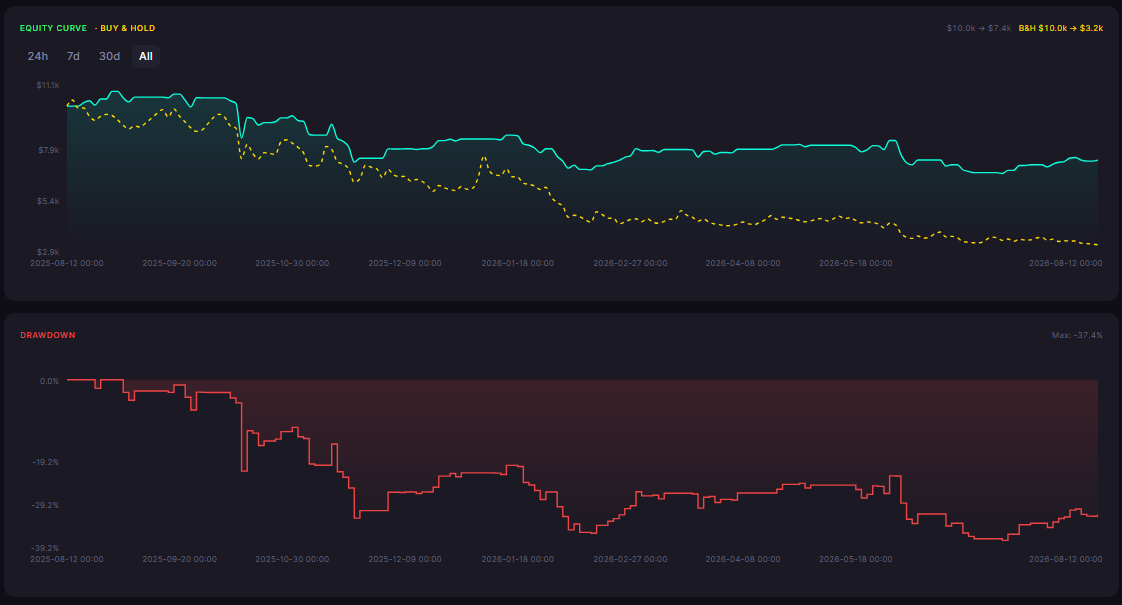
None of the four exit rules made the strategy profitable over this window. XRP's 4-hour mean reversion was a losing game in 2025-2026 regardless of how positions were exited. The interesting result is the size of the losses, because the exit rule changed them dramatically.
| Metric | Base (exit 55) | v2 (exit 60) | v4 (SL5) | v5 (TP8) |
|---|---|---|---|---|
| Total Return | -26.30% | -34.34% | -46.44% | -16.19% |
| Final Balance | $7,370.24 | $6,566.01 | $5,355.64 | $8,381.34 |
| Total Trades | 50 | 44 | 67 | 51 |
| Win Rate | 56.0% | 54.5% | 50.7% | 56.9% |
| Profit Factor | 0.65 | 0.55 | 0.51 | 0.79 |
| Sharpe Ratio | -0.49 | -0.71 | -1.68 | -0.20 |
| Max Drawdown | 42.73% | 44.80% | 52.84% | 34.88% |
| Average Win | $173.70 | $174.40 | $142.85 | $214.08 |
| Average Loss | $340.60 | $380.98 | $287.91 | $355.77 |
| Best Trade | +$456.93 | +$495.08 | +$367.39 | +$683.90 |
| Worst Trade | -$1,129.58 | -$1,479.10 | -$512.42 | -$1,077.55 |
| Time in Market | 40.16% | 45.92% | 33.09% | 39.57% |
| Total Fees | $164.15 | $138.68 | $175.16 | $181.68 |
What the Data Shows
The first lesson is that exits matter enormously. The gap between the worst variant (v4, -46.44%) and the best (v5, -16.19%) is 30 percentage points on the exact same entry rule. The trader who added an 8% take profit lost roughly a third of what the trader who added a 5% stop loss lost, on the same signals.
The 5% stop loss made things worse
The most counterintuitive result is v4. Adding a 5% stop loss did not protect the account, it damaged it. The strategy's trades jumped from 50 to 67, because the stop kept cutting positions that would have recovered, and the win rate fell from 56.0% to 50.7%. XRP's 4-hour oversold bounces routinely dip more than 5% before snapping back, so the stop was firing inside the setup's normal range of motion.
The stop did cut the average loss from $340.60 to $287.91 and the worst trade from -$1,129.58 to -$512.42. That is the intended effect. But it came at the cost of turning a 56% win rate into a coin flip, and the profit factor fell from 0.65 to 0.51. On this strategy, in this window, the 5% stop was a drag, not a shield.
The 8% take profit helped the most
v5 was the best of the four by every measure that matters. Total return improved from -26.30% to -16.19%, max drawdown fell from 42.73% to 34.88%, and profit factor rose from 0.65 to 0.79.
The reason is visible in the trade data. The average win jumped from $173.70 to $214.08, and the best trade grew from +$456.93 to +$683.90, because the take profit locked in the strongest bounces before they faded. XRP's oversold bounces in this window tended to reach about 8% more often than they faded from RSI 55 alone, so banking the move at 8% captured more of what the strategy was actually good at.
The take profit did not rescue the strategy. All four variants still lost money, and a 0.79 profit factor is not an edge. But v5 shows the exit rule working as intended: the same signals, better captured.
Why the Base Exit Beat the Wider One
v2, which let the bounce run to RSI 60 instead of exiting at 55, was the worst of the two RSI-only variants. Its average win was nearly identical to base ($174.40 versus $173.70), which means the extra distance to RSI 60 rarely added profit. It mainly added risk: the average loss grew from $340.60 to $380.98, the worst trade deepened to -$1,479.10, and the max drawdown widened to 44.80%.
The signal is clear. On XRP 4H in this window, waiting for a stronger RSI exit did not pay. The bounces faded before RSI reached 60 often enough that the wider exit gave back what it captured.
The Practical Lesson
Exit rules matter as much as entry rules: the same entry swung from -16.19% to -46.44% depending on the exit
A stop loss is not automatically protective: the 5% stop fired inside XRP's normal bounce range and turned a 56% win rate into 50.7%
A take profit can be the better exit for mean reversion: v5 banked the strongest bounces and delivered the best return, drawdown, and profit factor of the four
No exit rule rescued a losing strategy: all four variants lost money, which is itself the most important result to verify before trading
The exit question is not a preference, it is a measurement. Run the same entry with different exits on real data, read the trade log, and let the metrics choose. That is what backtesting is for: discovering that the 8% take profit beat the 5% stop loss by 30 points before risking a dollar, not after.
Run these four exit-rule variants yourself on CoinQuant and test your own exits. Run this XRP exit-rule backtest free on CoinQuant
Disclaimer:
Key Takeaway