
Kelly Criterion for Crypto: How Much Should You Really Risk Per Trade?

Most traders pick position size by feel: a percentage that sounds safe, a number they saw on a forum, or the amount that makes the last losing week tolerable. There is a better answer, and it has been published since 1956. The Kelly criterion computes the bet size that maximizes long-run growth for a given edge.
The catch is that the formula needs two honest inputs: your true win rate and your true payoff ratio. Crypto traders rarely have them, which is why the Kelly criterion is both the most useful and the most abused idea in position sizing.
What the Kelly Criterion Is
The Kelly criterion is a formula for the fraction of your bankroll to risk on each trade, given a known edge. In its trading form it is:
Kelly fraction = win rate minus ((1 minus win rate) / payoff ratio)
where the payoff ratio is the average win divided by the average loss. If the result is positive, the strategy has positive expectancy and Kelly says how aggressively to size it. If it is negative, the formula says do not trade the strategy at all.
The logic is mathematical. Betting less than Kelly grows slower than the maximum. Betting more than Kelly does not just grow slower, it eventually guarantees ruin, because the drawdowns compound faster than the wins.
A Worked Example
Take a strategy with a 55% win rate and an average win 1.5 times the average loss:
Kelly fraction = 0.55 minus (0.45 / 1.5) = 0.55 minus 0.30 = 0.25
The formula suggests risking 25% of the account per trade. Most traders would never do that, and they are right not to. Full Kelly is aggressive by design, because it assumes the inputs are exactly right, and they never are.
The standard fix is fractional Kelly: risking half or a quarter of the Kelly fraction. Half Kelly on the example above means 12.5% per trade, still steep for most accounts, which is itself the lesson: strategies with modest edges cannot support aggressive sizing.
Where the Inputs Come From
The formula is only as good as its inputs, and the inputs are backtest outputs. The win rate and the payoff ratio must be measured on historical data, with fees and slippage included, because costs change both numbers.
This is the connection between Kelly and backtesting. The backtest produces the average win and the average loss across the strategy's full history. Those realized numbers feed the formula. Without them, the Kelly fraction is theater: a precise-looking calculation built on guessed inputs.
The CoinQuant results page reports exactly what Kelly needs: win rate, average win, average loss, and profit factor on every completed backtest. The workflow is to backtest first, read the realized inputs, then size accordingly.
The Dangerous Assumptions
Kelly looks scientific, and it is, but its assumptions are brutal for crypto:
The inputs are estimates. Win rate and payoff ratio measured on five years of history are still estimates of the future. Full Kelly treats them as truth, which is why it over-bets.
Crypto regimes shift. A win rate measured in a bull market may not survive a bear market. Kelly sized for the measured edge will be oversized for the next regime.
Drawdowns are sequential. Kelly assumes compounding through continuous play. Real traders cut risk after losses, which changes the math, and the psychological cost of a deep drawdown is not in the formula.
The formula assumes you can always take the trade. Slippage, liquidity, and exchange limits can make the theoretical bet size unexecutable.
None of these make Kelly useless. They make full Kelly dangerous and fractional Kelly sensible.
How to Use Kelly in Practice
A practical Kelly workflow for crypto has four steps:
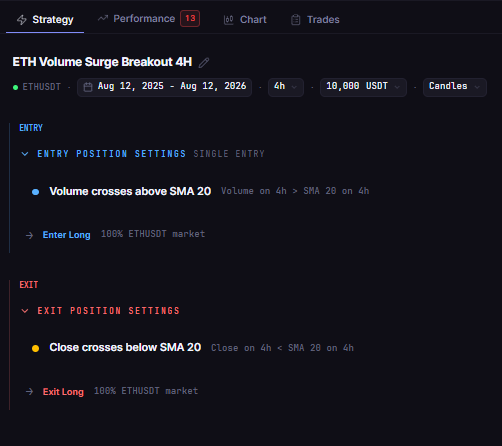
Backtest the strategy over a full market cycle, with fees and slippage modeled, and read the realized win rate, average win, and average loss
Compute the Kelly fraction from those realized inputs
Use a fraction of it: half Kelly or quarter Kelly are the common conservative choices
Recompute whenever the backtest changes, because the edge and the sizing are linked
The discipline matters more than the formula. Kelly is a sizing governor, not a strategy generator. It tells you how much to risk on an edge you have already proven; it does not tell you what to trade.
Common Mistakes to Avoid
Full Kelly on crypto. The inputs are estimates and the regimes shift. Full Kelly over-bets by construction. Use half or quarter Kelly.
Guessing the inputs. The formula with invented win rates produces a confident-looking number with no basis. The inputs must come from a backtest.
Ignoring drawdown. Kelly optimizes long-run growth, not comfort. A Kelly-sized account can still draw down more than you can hold, so pair the sizing with a drawdown you can survive.
Reusing stale numbers. The edge changes when the market changes. Recompute the inputs from fresh backtests, not from last year's results.
The Practical Lesson
Kelly sizes the bet for maximum long-run growth given a true edge: win rate and payoff ratio are the inputs
The inputs are backtest outputs: measured win rate, average win, and average loss, with fees and slippage included
Full Kelly over-bets on estimated inputs; fractional Kelly is the defensible choice for crypto
The formula governs sizing, it does not create edge, and it never replaces the backtest that proves the edge
The Kelly criterion rewards the traders who do the research first. The formula is one line; the edge behind it takes a backtest across a full cycle to establish. Get the inputs right and the sizing question answers itself.
Backtest your strategy to get the real win rate and payoff ratio that Kelly needs. Start your first backtest on CoinQuant
Disclaimer:
Key Takeaway