
Crypto in 2026, 1 Jan to 1 Aug: 51 Rules Beat Holding, 5 Made Money
From the close of 31 Dec 2025 to the close of 1 Aug 2026, all 51 distinct crypto rules in our CoinQuant library did better than holding their own coin, but only 5 made money and the median rule returned -14.58%. Holding lost between 28.39% (Bitcoin) and 47.76% (Cardano) over the same days, fees included.
That is the short version of crypto performance 2026 in this library: rules lost less and most still lost. "Beat holding" here means a smaller loss in a falling market, not a profit.
This scorecard covers the first seven months of 2026 only, because the test data for these coins ends on 1 Aug 2026. It reports every rule, the winners and the losers, without adjustment.
Crypto performance 2026, the answer first: 51 beat holding, 5 made money
Every rule is measured against its own coin. A Bitcoin rule is compared with holding Bitcoin, an Ether rule with holding Ether, and so on: each rule against its own coin's same window Buy and Hold, over exactly the same days.
| Metric | 51 rules | BTC Spot Comparison |
|---|---|---|
| Strategy | 51 distinct crypto 1D rules in the library | BTC Buy and Hold 1D 2021-2026 |
| Window | Close 31 Dec 2025 to close 1 Aug 2026 | Same days |
| Did better than holding its own coin | 51 of 51 | Benchmark (holding Bitcoin) |
| Made money | 5 of 51 | No |
| Median Total Return over the window | -14.58% | -28.39% |
All figures share the same days, fees and sizing: 0.1% per fill, $10,000 starting capital, the full balance on each entry, no slippage modelled.
Two facts sit side by side here. Not one rule did worse than holding its coin. But 46 of the 51 made no money over the window.
The window and the set (why it ends 1 Aug 2026)
The set is every distinct crypto rule in the team's library with a five-year daily test, 2021-08-01 to 2026-08-01. Fee and test copies of the same rule are left out, and so is one stock rule, because a stock is not a coin. That leaves 51 rules on six coins: Bitcoin, Ether, Solana, XRP, BNB and Cardano, all tested on Kaiko data via CoinQuant.
The 2026 figures are cut from each rule's saved equity curve: the equity at the close of 1 Aug 2026 against the equity at the close of 31 Dec 2025. The Buy and Hold side uses each coin's library record, such as BTC Buy and Hold 1D 2021-2026 and ADA Buy and Hold 1D 2021-2026, over the same days. These records pay the 0.1% fee on entry and exit.
- Why 1 Aug: the tests for these coins end on 2026-08-01, so the scorecard cannot go further.
- Why the base matters: counted from the close of 1 Jan 2026 instead, only four rules made money, not five. One result sits that close to zero.
- Same coin, same window: the right benchmark for a rule is holding its own coin over the same dates, as which benchmark a crypto strategy should beat explains.
Each coin's holding result in 2026
Holding lost money on all six coins over these seven months. Bitcoin lost the least, 28.39%. Cardano lost the most, 47.76%. Ether, Solana, XRP and BNB all landed between those two.
| Coin | Library record | Return, same window | Rules in the set |
|---|---|---|---|
| Bitcoin | BTC Buy and Hold 1D 2021-2026 | -28.39% | 13 |
| BNB | BNB Buy and Hold 1D 2021-2026 | -33.52% | 6 |
| Ether | ETH Buy and Hold 1D 2021-2026 | -37.98% | 13 |
| Solana | SOL Buy and Hold 1D 2021-2026 | -42.34% | 7 |
| XRP | XRP Buy and Hold 1D 2021-2026 | -42.50% | 5 |
| Cardano | ADA Buy and Hold 1D 2021-2026 | -47.76% | 7 |
So every rule started from a hard base. A rule that sat in cash for most of the window would beat holding by a wide margin without doing anything clever.
The fall did not stop on 1 Aug, and the scorecard does not cover what came later. As dated context only, from the open of 1 Nov 2026 to the close of 15 Nov 2026 (Binance spot daily candles, UTC):
- Bitcoin: -15.77%
- Ether: -18.63%
- Solana: -23.83%
- XRP: -22.18%
- Cardano: -19.39%
From the close of 31 Dec 2025 to the close of 15 Nov 2026, Bitcoin was down 25.44% (Binance BTCUSDT daily closes, UTC). For how one XRP rule handled the separate falls inside 2026, see an XRP trend rule split year by year.
The 5 rules that made money
Five of the 51 rules ended the window above where they started it. That is under one in ten. Counted from the 1 Jan close, the number drops to four.
| Rule | Rule's return | Holding its own coin, same days |
|---|---|---|
| ETH MFI(14) Oversold 20/80 1D 2021-2026 | +22.08% | -37.98% |
| BTC Breakout ATR Filter 1D 2021-2026 | +3.91% | -28.39% |
| BTC Klinger 34-55-13 Cross 1D 2021-2026 | +2.33% | -28.39% |
| BTC HMA 55 Close Cross 1D 2021-2026 | +0.64% | -28.39% |
| BTC WMA 30 Close Cross 1D 2021-2026 | +0.49% | -28.39% |
Only one made a clear gain; the other four finished within four percentage points of zero. BTC HMA 55 Close Cross 1D 2021-2026 drops out from the 1 Jan close, at -0.71%.
Here is one of the 51 rules over its full five years, so you can see what a library result looks like. XRP Klinger 34-55-13 Zero-Line Cross 1D 2021-2026 is a Klinger oscillator (34, 55, 13) zero line cross rule on XRP daily candles.
| Metric | Klinger rule (five years) |
|---|---|
| Strategy | XRP Klinger 34-55-13 Zero-Line Cross 1D 2021-2026 |
| Tested window | 2021-08-01 to 2026-08-01 |
| Total Return | 49.99% |
| Final Balance | $14,999.00 |
| Total Trades | 115 |
| Win Rate | 29.57% (34W / 81L) |
| Profit Factor | 1.12 |
| Sharpe Ratio | 0.41 |
| Max Drawdown | 55.60% |
| CAGR | 8.44% |
| Time in Market | 45.33% |
| Total Fees | $2,735.75 |
The rule was in the market less than half the time over five years. Its results card on the Performance tab shows the whole run in one place.
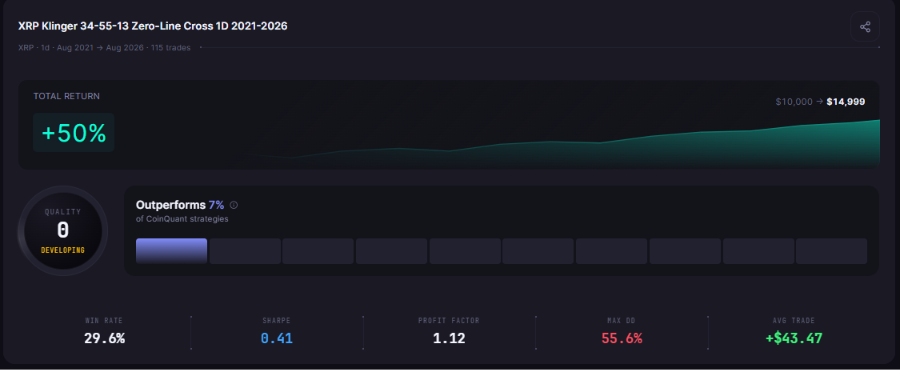
One of the 51 rules: XRP Klinger 34-55-13 Zero-Line Cross 1D 2021-2026, August 2021 to August 2026: 115 trades, +50% and $10,000 to $14,999.
Losing less is not making money
The median rule returned -14.58% over the window. On $10,000, that is still a loss of well over a thousand dollars. Holding Bitcoin over the same days lost 28.39%, so the median rule lost about half as much as the best holding result.
That gap is real, and it matters for anyone who has to sit through a falling year. But it is not a gain:
- Against holding: 51 of 51 rules lost less.
- Against cash: only 5 of 51 rules did better than doing nothing.
- Against zero: the median rule needs a rise of more than 14.58% just to get back to its 31 Dec 2025 level.
The Performance tab's equity card puts a rule's curve next to the platform's Buy and Hold line, so you can see where in the timeline the rule pulled ahead. The platform's Buy and Hold line carries no fees, unlike the library Buy and Hold records used in the scorecard above, which pay the 0.1% fee on entry and exit.
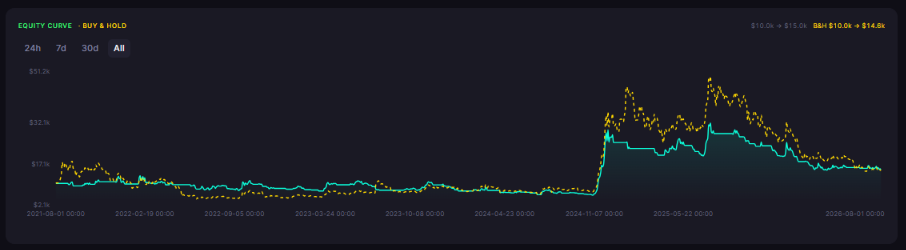
XRP Klinger 34-55-13 Zero-Line Cross 1D 2021-2026 against the platform's Buy and Hold line on CoinQuant, August 2021 to August 2026: $10.0k → $15.0k for the rule and B&H $10.0k → $14.6k, with 2026 at the right-hand end.
What this means if you are starting this year
If you are new and asking which rule to start with, this scorecard gives an honest answer: in the first seven months of 2026, no simple rule in this library was a reliable way to make money. Every one of the 51 lost less than holding its own coin.
- Start with the benchmark: check a rule against holding its own coin on the same dates, then against zero.
- Look at more than one year: a rule that lost less in 2026 may have trailed holding over five years. Rankings over several years are in the best crypto trading strategy in 2026, backtested and ranked.
- Keep the rule simple enough to follow: for first rules and how to test them, see the best crypto trading strategy for beginners in 2026.
The Practical Lesson
- Read both comparisons: 51 of 51 rules beat holding their coin, but only 5 of 51 made money.
- Know the base: close of 31 Dec 2025 to close of 1 Aug 2026; from the 1 Jan close, only four made money.
- Name the cost of holding: holding lost between 28.39% (Bitcoin) and 47.76% (Cardano) over the same days.
On CoinQuant, an AI trading platform, every backtest's Performance tab shows the results card, Detailed Statistics and the equity card, so you can check a rule against holding and against zero before you trust it.
Build trading strategies on real data. No coding required.
Frequently Asked Questions
What's the best crypto trading strategy for beginners looking to start this year?
In this library's 2026 scorecard (close of 31 Dec 2025 to close of 1 Aug 2026), no rule stood out as a safe way to make money: 5 of 51 rules made money and the median rule returned -14.58%. Every rule did better than holding its own coin, so a simple rule tested against holding and against zero on the same dates is a sensible place to start.
How did crypto perform in 2026?
Holding lost money on all six coins tested from the close of 31 Dec 2025 to the close of 1 Aug 2026, from 28.39% on Bitcoin to 47.76% on Cardano, fees included. Bitcoin was down 25.44% for 2026 to the 15 Nov close (Binance BTCUSDT daily closes).
Does beating Buy and Hold mean a strategy made money?
No. In a falling market, a rule can beat holding and still lose. Here all 51 rules beat holding their coin, but 46 of them made no money.
Check your own rule against holding and against zero on the same dates.
Disclaimer:
Key Takeaway