
Backtesting Software Reviews (2026): What Users Actually Say About the Popular Platforms

Reviews of the popular backtesting platforms in 2026 split by tool type. Charting-first tools like TradingView and TrendSpider win on analysis and community. Code-first engines like QuantConnect, Backtrader and VectorBT win on depth and low cost. No-code platforms like Composer, Backtrex and CoinQuant win on speed to a first result. Users rarely say any of them is bad at what it does. The recurring complaints are about pricing changes, plan limits, support, and how steep the learning curve is before the first backtest runs. This roundup covers eight platforms: what users on Reddit, Trustpilot and G2 actually say about each, pricing verified from official pages in September 2026, and who each tool fits.
Quick Verdict
| Platform | Price from | Coding required | Best for | What users say in one line |
|---|---|---|---|---|
| TradingView | Free plan; paid from $12.95/mo billed annually | Yes (Pine Script) | Charting, community scripts, quick checks | Loved for charts, tired of price hikes and plan limits |
| QuantConnect | Free tier; paid plans from about $60/mo | Yes (Python/C#) | Serious quant research on the LEAN engine | The most mature free engine, but developer-only |
| TrendSpider | About $54/mo billed annually (no free plan) | No (visual) | AI-assisted analysis and multi-timeframe testing | 4.8/5 on Trustpilot, but expensive at higher tiers |
| Composer | Free plan; paid from $10/mo | No (visual) | No-code automated equities strategies | Easy and now SoFi-backed, thinner crypto support |
| Backtrader | Free (open source) | Yes (Python) | Developers who want full control | Powerful, but development has slowed |
| VectorBT | Free (open source) | Yes (Python) | Fast parameter sweeps and research | Blazing fast on price data, not for beginners |
| Backtrex | Pro from €29/mo (7-day trial) | No (visual) | Forex and SMC/ICT traders | Clever workflow, young platform, small community |
| CoinQuant | Free trial; Pro from $39.99/mo | No (plain English) | Crypto traders who want AI-built, tested strategies | Fastest from idea to full backtest on crypto |
Prices were checked against official vendor pages in September 2026; sentiment comes from Reddit (r/algotrading, r/TradingView, r/ComposerTrade), Trustpilot, G2 and 2026 hands-on reviews. Where a figure could not be verified, the tier structure is described instead.
TradingView
What it is: the dominant retail charting platform, with tens of millions of users, real-time data across stocks, forex, futures and crypto, and the largest library of community indicators anywhere. Its Strategy Tester backtests Pine Script strategies directly on the chart.
Who it is for: chartists and discretionary traders who want analysis plus quick strategy checks. Custom backtesting requires Pine Script. Community strategies run with one click but carry no quality control, and repainting scripts are a known risk.
What users say: product praise is near-universal; the complaints are not about charts. Reddit tracks a May 2026 price increase and features moving to higher tiers, with "killing benefits every quarter while increasing prices" a recurring theme in r/TradingView. Trustpilot tells a different story: a poor average of around 2 out of 5 from roughly 800 reviews, about half at one star, mostly about support and account bans rather than the software. The product is well liked; the company relationship is not.
Pricing (official page, September 2026): free Basic plan; Essential at $14.95/mo month to month ($12.95/mo billed annually), Plus at $34.95/mo ($29.95 billed annually), Premium at $69.95/mo ($59.95 billed annually); promos are frequent.
One-line verdict: the best charting tool in retail trading, a middling backtesting platform, and a user base increasingly annoyed about pricing.
QuantConnect
What it is: a cloud research platform built on LEAN, an open-source backtesting engine you can also self-host. Strategies are written in Python or C#, with 20+ years of data across stocks, forex, crypto, futures and options, and a large free data library.
Who it is for: developers and quant-minded traders who want institutional-grade research without building infrastructure. There is no visual builder at all, the learning curve is the steepest here, and the interface is developer-first, which users say openly.
What users say: on Reddit, QuantConnect is the benchmark. A May 2026 r/algotrading thread on the backtesting landscape calls it "the most mature managed option," with a free tier that is "decent" and paid plans that "scale reasonably." The repeated warning: the free tier is generous for research, but production gets expensive once you run live nodes and large backtests, so many users self-host LEAN to control cost.
Pricing: a free community tier with monthly compute caps; the paid Researcher plan starts at about $60/mo and includes up to two compute nodes, with costs scaling with what you run.
One-line verdict: the deepest free research stack in this review, but you must be comfortable writing code before your first backtest runs.
TrendSpider
What it is: an AI-assisted technical analysis platform with a visual, no-code strategy builder, multi-timeframe and multi-symbol backtesting, variance testing, slippage and cost adjustments, forward testing, and scanners across a very large symbol universe. Trading bots and an AI assistant (Sidekick) are paid layers.
Who it is for: technical traders who want automated analysis and visual strategy testing across stocks, forex and crypto, and will pay for it. Backtest depth on lower plans is capped, and upgrading to 20,000 bars costs an extra $39/mo on Standard and Premium, a common frustration in reviews.
What users say: TrendSpider holds an "Excellent" 4.8/5 on Trustpilot from roughly 880 reviews at the time of writing, an outlier in this category, with reviewers frequently praising support. The criticisms are cost and complexity: no free plan, paid trials, stacking add-ons, and a dense interface that takes time despite being no-code.
Pricing (official page, September 2026): no permanent free plan; 14-day paid trials. Month to month: Standard $82/mo, Premium $137/mo, Enhanced $183/mo, Advanced $321/mo. Billed annually: about $54, $91, $122 and $214/mo, with frequent first-term promos.
One-line verdict: the strongest high-rating review profile in this category, and the most expensive no-code option here once you need real backtest depth.
Composer
What it is: now branded Composer by SoFi, a no-code automated trading platform where strategies are built as visual "symphonies" with AI assistance, backtested on the platform, then executed live. The company reported a record $1.6 billion traded in January 2026.
Who it is for: investors focused on US equities and ETFs who want automated strategies without code. Crypto coverage is not its strength; serious crypto traders will find the asset list thin.
What users say: the dedicated subreddit is active and mostly positive, and SoFi backing is cited as a credibility upgrade in 2026 discussions. The negative threads are older: 2023 Reddit posts alleging problems with funds, and a few Trustpilot reviews complaining about withdrawals and support. No large consensus exists either way; the platform is smaller than the charting giants.
Pricing (official page, September 2026): a free Starter plan that includes automating a first strategy and unlimited strategy backtests in the no-code editor; Advanced at $10/mo; and Pro at $32/mo billed annually ($384/yr) for up to 500 automated strategies.
One-line verdict: the smoothest no-code route into automated equities trading, still building its track record and review base.
Backtrader
What it is: a free, open-source Python backtesting framework that has been a community staple for years. You write strategies in Python, plug in your own data, and get full control over the simulation, including custom commissions and analytics.
Who it is for: programmers who want a self-hosted engine with no subscription and no data lock-in. There is no UI to speak of, no bundled data, and the learning curve is real, which is why a 2026 r/algotrading comment calls Backtrader "great but... difficult to work with."
What users say: warm but cautious. The recurring line in 2026 threads is that Backtrader "still works but development has slowed," while other users say they are "very happy with it" in production. Fine for event-driven strategies at moderate scale, less ideal for heavy tick-level work, where Rust-backed engines are increasingly recommended.
Pricing: free (open source). Support comes from the community, and users note the documentation is dated.
One-line verdict: free, flexible and battle-tested, but a project in maintenance mode that assumes you already know Python.
VectorBT
What it is: an open-source Python library known for vectorized, NumPy-accelerated backtesting that runs enormous parameter sweeps on price data in seconds. A commercial successor, VectorBT PRO, adds production-grade features and is distributed by the developer through a $25/mo membership, while the community edition stays free on GitHub.
Who it is for: quant researchers doing heavy parameter exploration on price data. The 2026 r/algotrading consensus: VectorBT is the fastest option for pure price-data backtests, "but limited if you need order book or microstructure" detail.
What users say: respected more than loved, a specialist tool: brilliant for sweeps and research, thin on built-in execution realism, steep learning curve, sparse beginner material. Non-programmers should not start here.
Pricing: free for the open-source edition; VectorBT PRO requires the paid membership for commercial-grade features.
One-line verdict: the fastest research engine in this list, and the least suitable for a non-programmer.
Backtrex
What it is: a no-code visual backtesting platform founded by retail trader Matthieu David, aimed mainly at forex, indices and crypto with native SMC/ICT tools (order blocks, fair value gaps, break of structure). Its signature workflow: you mark a few of your own trades on a chart and the engine reverse-engineers the rules behind them across 61 indicators, then hands you an editable strategy. It exports strategies to Pine Script, with the vendor claiming backtest results match live results.
Who it is for: traders who want to test manual, price-action style setups without coding and without starting from a blank page. It is not a live trading platform yet, so it is a testing layer only.
What users say: coverage is thin because the platform is young, and the most detailed comparisons are its own blog posts testing competitors head to head, so treat those as vendor content. Independent threads acknowledge the clever workflow and anti-repainting safeguards, and flag the small community and forex-first focus as the main risks.
Pricing (official page, September 2026): a 7-day free Pro trial, then Pro from around €29/mo (excl. tax), with a Max tier for unlimited backtests.
One-line verdict: a genuinely different no-code workflow for SMC and price-action traders, still earning its independent review base.
CoinQuant
What it is: a no-code AI trading platform for building and backtesting strategies in one workflow. You describe a strategy in plain English, and the AI assembles the full trading system: entries, exits, sizing, filters and risk rules, refined through conversation. Every backtest runs on real historical data with fees and slippage included, a buy-and-hold benchmark, and an SQS quality score from 0 to 100. Crypto backtesting covers candle resolutions from 15 minutes to 1 month on Pro, and the full range from 1 minute to 1 month plus tick-level data (6-month range) on Max Power; stocks, ETFs, forex and commodities run on bars. Data is institutional-grade with partners including Kaiko, and the platform connects to exchanges such as Binance, Coinbase, OKX and Bybit, with keys encrypted end to end.
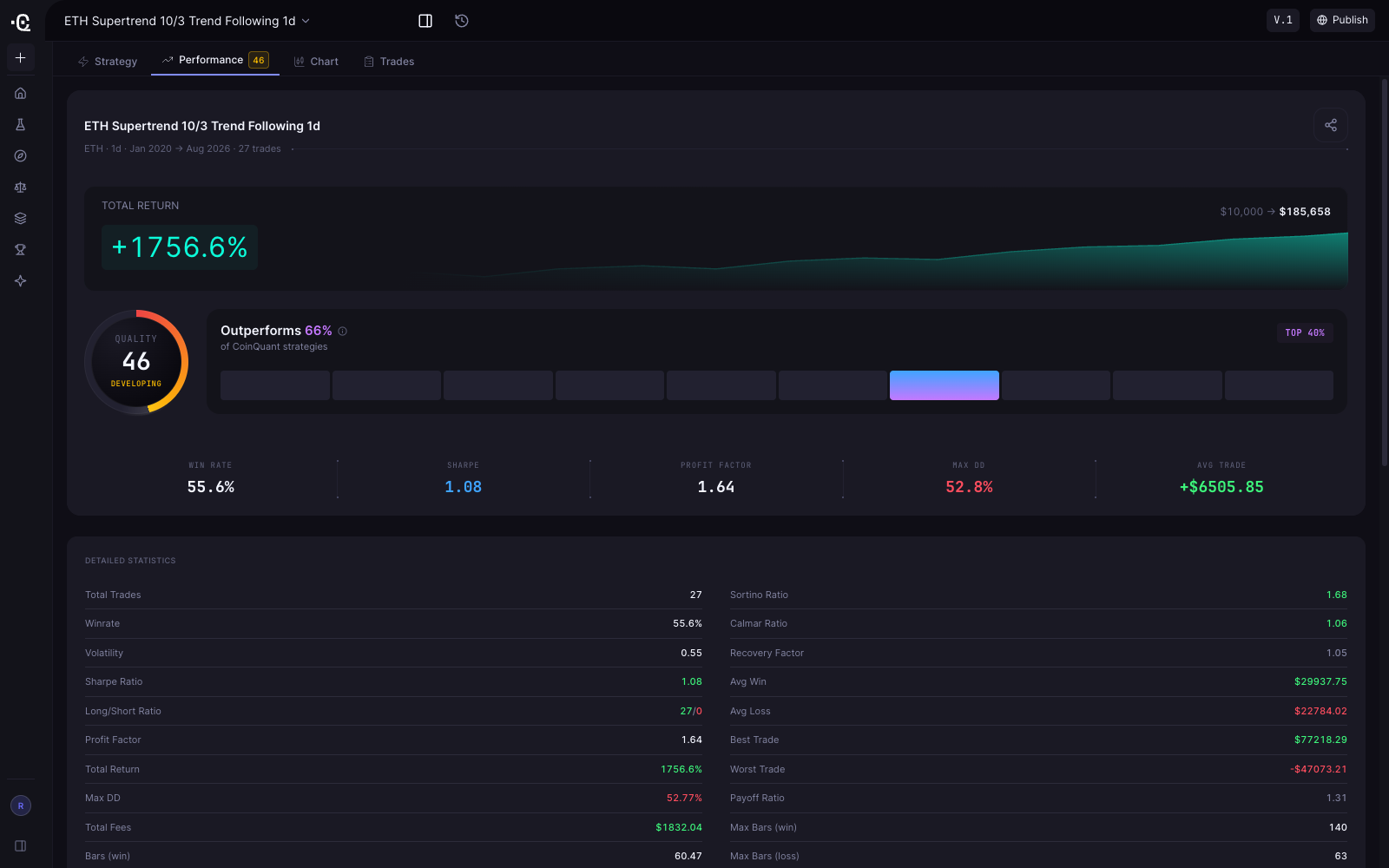
Who it is for: crypto traders, from beginners to former Pine Script users, who want to test their own ideas without code. The platform reports 15,000+ users across 16,000+ assets as of mid-2026, and a community library lets you clone public strategies, refine them, and publish your own to a leaderboard.
What users say: the honest caveat is that independent review volume is still small compared with TradingView or TrendSpider. Evidence sits in its own community: published strategies with full results and prompts, an active Discord server, and testimonials such as a software engineer's "I spoke one idea into CoinQuant, ran the test, and launched a bot on my lunch break." Users consistently report that CoinQuant removes the two steps where beginners quit: writing code and importing data. The common criticisms: the credit-based usage system, which requires planning, and no free tier, only a free trial.
Pricing (official page, September 2026): free trial, then Pro at $39.99/mo month to month ($33.25/mo billed annually at $399/yr, or $12.99/wk) and Max Power at $220/mo month to month ($166.58/mo billed annually at $1,999/yr, or $69.99/wk). Plans run on credits (1 USD = 1,000 credits, explained in the FAQ) with top-ups available, and payment is accepted by card or in 200+ cryptocurrencies.
One-line verdict: the shortest path from a strategy idea to a realistic crypto backtest, with a small but fast-growing review footprint.
User-Friendliness Compared
Which platform can you actually start with? Based on community reports of time to first backtest:
| Platform | First backtest without coding? | Typical time to first result | Friction point |
|---|---|---|---|
| CoinQuant | Yes, plain-English prompt | Minutes | None for crypto; credit limits on heavy use |
| Composer | Yes, visual builder | Minutes to an hour | US equities focus |
| Backtrex | Yes, visual builder | Minutes to an hour | Forex/SMC focus, small community |
| TrendSpider | Yes, visual builder | An hour to a day | Dense interface, plan limits on depth |
| TradingView | Only with Pine Script or community scripts | Hours if writing Pine Script | Scripting barrier for custom tests |
| VectorBT | No | Days to weeks | Python and vectorized concepts |
| Backtrader | No | Days to weeks | Python and event-driven concepts |
| QuantConnect | No | Days to weeks | Python/C# and a research workflow |
The pattern in 2026 threads: code-first engines give the most control and the lowest entry cost (free), while no-code platforms charge a subscription and save your evenings. For crypto specifically, no-code options with real backtest depth are still rare.
How to Choose: Features Users Say Matter Most
Across 2026 reviews, the top features to look for come back to five things, in order of frequency:
Realistic costs. A backtest that ignores fees, slippage and spreads overstates returns. Look for a platform that separates gross return, costs and net return. CoinQuant and TrendSpider include slippage and cost adjustments; on TradingView it depends on your Pine Script.
Data quality and history depth. Enough history to span a full market cycle, clean data, honest fill assumptions. Shallow history caps (TradingView by plan, TrendSpider's 20,000-bar upgrade) are the most common plan-related gripe in this review.
Drawdown and robustness reporting. Users want max drawdown, profit factor, Sharpe and trade count, plus a guard against overfitting: a high-return backtest with a dozen trades proves nothing. CoinQuant's SQS score, TrendSpider's variance testing and QuantConnect's research tooling address this differently.
Coverage of the assets you actually trade. Crypto traders keep landing on platforms built for equities (Composer) or forex (Backtrex). QuantConnect has real crypto support at the cost of code.
Workflow speed. The number of steps between idea and result decides whether you iterate 3 times or 30, and iteration count separates a robust strategy from a lucky one.
Can you get reliable backtesting software without breaking the bank?
Yes, with a caveat users repeat everywhere: free and cheap tools are reliable for learning, and unreliable when they miss costs, data depth or drawdown reporting. Budget options: QuantConnect's free tier and self-hosted LEAN if you code; Backtrader and VectorBT at zero cost if you code; TradingView's free plan for chart review; Backtrex's free trial or Composer's Starter plan for visual testing. Paid plans under roughly $40/mo: TradingView Essential, Composer's Advanced and Pro plans, Backtrex Pro and CoinQuant's Pro plan. The full category breakdown is in our 2026 pricing guide, and current credit allocations are on CoinQuant's pricing page.
FAQ
What are the reviews on popular backtesting software right now?
Reviews in 2026 split by tool type. TradingView is loved for charts and criticized for price increases and Pine Script requirements. QuantConnect is the most mature free research engine but developer-only. TrendSpider holds a 4.8/5 Trustpilot rating, criticized mainly for price. Composer and CoinQuant are praised as genuinely no-code, with thinner independent review bases. Backtrader and VectorBT are respected free engines with slowing or specialist development.
Can I get reliable backtesting software without breaking the bank?
Yes. QuantConnect's free tier, Backtrader, VectorBT, TradingView's free plan and Backtrex's free trial are all workable starting points. The catch, repeated across user reviews: reliable results need realistic fees, slippage, drawdown reporting and enough history, so check those before trusting output from any cheap tool.
What are the top features to look for in backtesting software?
Realistic cost modeling (fees and slippage), data quality and history depth, drawdown and robustness metrics, coverage of the assets you trade, and workflow speed from idea to result. Users rank cost realism first: ignoring it is the most common reason a backtest overstates what a strategy will do live.
What is the best backtesting software for beginners this year?
For non-programmers: CoinQuant for crypto (plain-English strategy building with full metrics), Composer for US equities, and Backtrex for forex and price-action styles. TradingView works if you stick to community strategies, but custom backtests need Pine Script. Beginners who code can start free with QuantConnect or Backtrader.
Which is more user-friendly: QuantConnect, TrendSpider or CoinQuant?
CoinQuant is the most user-friendly for a non-programmer: no code at all, just a plain-English description of the strategy. TrendSpider is user-friendly in design but dense, and lower plans cap backtest depth. QuantConnect is developer-friendly, not trader-friendly, and users say so directly.
Is TradingView enough for backtesting, or do I need separate software?
TradingView is enough for simple checks and running community strategies. For serious validation, 2026 user consensus says a dedicated platform wins on history depth, cost modeling and output metrics.
Do free tools like Backtrader and VectorBT produce reliable results?
Yes, in the hands of someone who understands the assumptions; they are widely used in production by developers. The risk is not the engine but the user: no built-in data, no cost model by default, and no guard against overfitting, so the quality of the test depends on the code around it.
The Bottom Line
The reviews that matter most come from users who lost money trusting a clean-looking backtest. They converge on one conclusion: pick the tool by the job, not the name. Charting and community: TradingView. Deep research with code: QuantConnect, Backtrader or VectorBT. Visual testing with AI assistance: TrendSpider for multi-asset technicals, Composer for US equities, Backtrex for forex and SMC. Crypto strategies tested without code, with fees, slippage and a quality score included in the report: that is the niche CoinQuant was built for.
Key Takeaway
User reviews of backtesting software in 2026 reward tools that match the trader's asset class and skill level: charting giants for analysis, open-source engines for developers, and no-code platforms like CoinQuant, Composer and Backtrex for traders who want a tested strategy without writing code.
Try it yourself
Try CoinQuant's free trial and backtest your first strategy today.
Related reading
For more context: see the platform-by-platform cost breakdown for 2026, the beginners' ranking of backtesting tools, which platforms are actually easy to use, the 2026 evaluation checklist for backtesting software, and how fees, slippage and data mode decide whether results are real.
Disclaimer:
Key Takeaway
