
How Much Does Backtesting Software Cost in 2026? A Trader’s Guide

Backtesting software in 2026 can cost anywhere from a free plan to several hundred dollars per month, before data feeds, usage credits, add-ons, automation, or research infrastructure are included. The more important question is not the sticker price. It is whether the tool helps you avoid the expensive mistake of trusting a strategy that only worked in hindsight.
That distinction matters because traders rarely lose money because a subscription was too expensive. They lose money because a test looked more reliable than it was. A platform that ignores slippage, simplifies fills, hides drawdowns, or rewards over-optimized settings can make a fragile strategy look investable. A cheaper tool can be perfectly adequate for chart review or idea generation, but it becomes costly if it cannot answer whether the edge survives real trading conditions.
The 2026 cost range
Public pricing across the category shows a wide spread. Some charting and research tools start with free tiers or low-cost plans. Mid-tier trading and analysis plans commonly sit in the tens of dollars per month. More advanced platforms, especially those with deeper backtesting, automation, multi-asset coverage, or professional data, can move into the low hundreds per month. Enterprise quant research environments and custom infrastructure can cost far more once cloud compute, data licensing, support, and team workflows are included.
A simple way to think about the market is by use case:
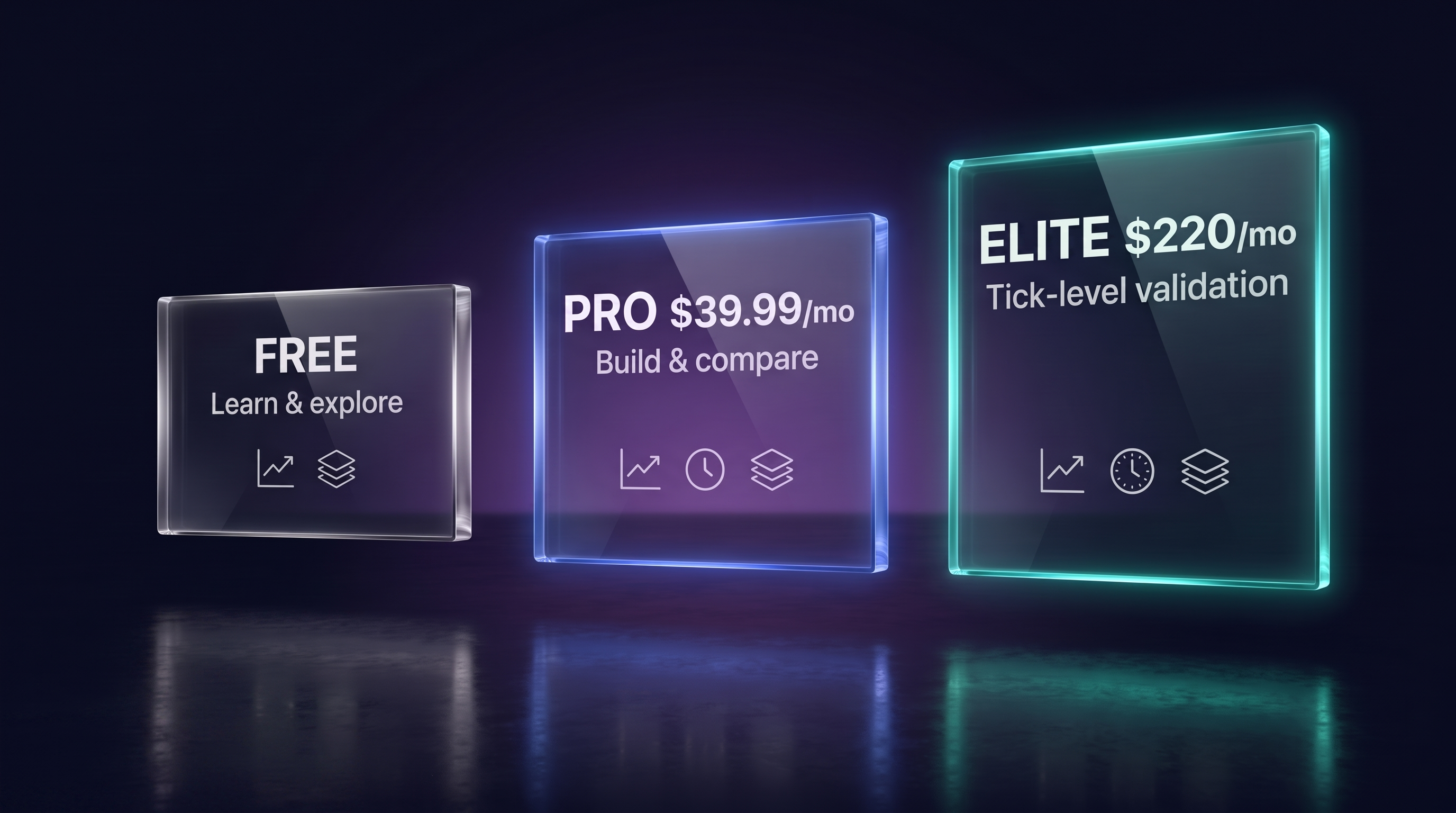
CoinQuant’s own pricing page, checked on August 3, 2026, showed a free starter plan, Pro pricing shown at $39.99 per month on monthly billing, and Elite pricing shown at $220 per month on monthly billing. The point is not that every trader needs the highest plan. The point is that a serious buyer should compare what each plan actually proves, not only what each plan costs.
Why free is not always free
Free tools are useful. They help a trader learn indicators, sketch rules, and understand how a strategy might behave. But free usually has tradeoffs: less data depth, fewer markets, simpler execution assumptions, limited exports, or shallow backtest controls.
The hidden cost appears when the trader mistakes a learning tool for a decision tool. A moving average crossover that looks clean on a short sample may collapse when tested across a longer period. A mean-reversion strategy may look excellent before fees, then lose its edge once each trade pays the market spread. A breakout system may look stable on daily candles, then behave very differently when intraday liquidity and slippage matter.
The most expensive backtesting software is not the one with the highest monthly fee. It is the one that gives confidence without enough evidence.
The five features worth paying for
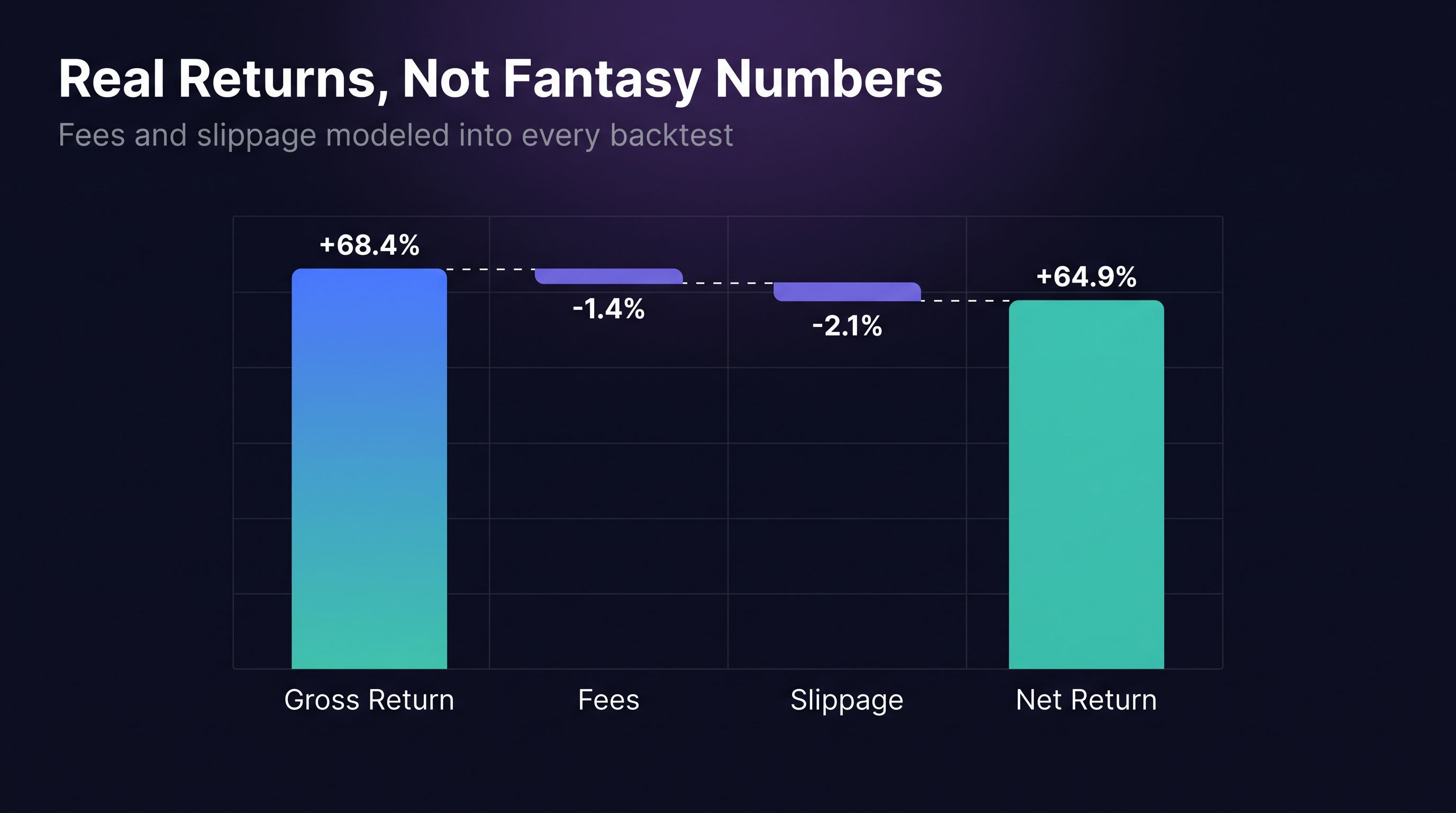
The first feature is realistic costs. Every serious backtest should show the gap between gross return and what survives after fees and slippage. CoinQuant’s fee and slippage breakdowns workflow makes this explicit by separating Gross Return, Fees, Slippage, and Net Return. The live site example shows Gross Return of +68.4%, Fees of -1.4%, Slippage of -2.1%, and Net Return of +64.9%. That kind of breakdown is valuable because it stops the trader from treating the best-looking number as the final answer.
The second feature is data quality. Tick-level data matters when entry and exit precision affect the result, especially for shorter timeframes. CoinQuant runs tick-level backtests for recent periods and supports longer historical testing at bar resolution. A buyer should ask how the platform handles fills, spreads, candles, and missing data before trusting the output.
The third feature is robustness scoring. A strategy with high return is not automatically a good strategy. CoinQuant’s SQS scores a strategy from 0 to 100 and weighs robustness rather than raw return alone. That kind of diagnostic helps traders separate an edge from an optimized accident.
The fourth feature is multi-asset coverage. A backtest is more useful when the same idea can be tested on different instruments. CoinQuant supports backtesting across crypto, equities, forex, and commodities. For a trader, this matters because a strategy that only works on one asset in one period may be a story about that asset, not a repeatable method.
The fifth feature is workflow speed. A no-code strategy builder can reduce the time between idea and test. CoinQuant lets traders describe a strategy in plain English, refine it through conversation, and generate a complete rules-based system without rebuilding from scratch. Speed is not valuable by itself, but fast iteration becomes valuable when each iteration includes realistic costs, robustness checks, and clear reporting.
When a cheaper plan is enough
A cheaper plan can be the right choice when the goal is education, early exploration, or occasional strategy testing. If a trader is still learning what an entry rule, stop loss, drawdown, or win rate means, they do not need a professional research stack on day one.
The lower-cost route also makes sense when the trader has a narrow workflow: one asset class, a few indicators, and low trade frequency. If the strategy only needs daily candles and basic performance metrics, a lightweight tool may be adequate.
But the buyer should draw a line between exploration and validation. Exploration asks, “Is this idea worth investigating?” Validation asks, “Would I risk money on this after realistic testing?” Those are different jobs. A cheap tool can help with the first. It may or may not be enough for the second.
When paying more is rational
Paying more becomes rational when the cost of a false positive is higher than the software fee. If a trader might allocate meaningful capital to a strategy, then realistic testing is part of risk management, not an optional upgrade.
More advanced backtesting is also justified when the strategy trades frequently, depends on execution quality, uses multiple filters, or behaves differently across regimes. Fees and slippage matter more as trade count rises. Regime testing matters more when a strategy has only been evaluated during a favorable market. Robustness scoring matters more when the system has many parameters that can accidentally fit the past.
In other words, the right budget depends on the decision being made. A trader testing a casual idea can spend less. A trader using the result to size real capital should demand more evidence.
A practical buying checklist
Before choosing backtesting software, ask seven questions:
Does it separate gross return from fees, slippage, and net return?
Does it show maximum drawdown clearly?
Does it allow testing across different assets and timeframes?
Does it expose fragile strategies with too few trades or too many parameters?
Does it support out-of-sample or regime-aware analysis?
Does it make the test easy to repeat and adjust?
Does it explain the result clearly enough that a trader can act on it?
If a tool is cheap but cannot answer those questions, the savings may be an illusion. If a tool costs more but prevents one bad capital allocation, it may pay for itself before the strategy ever goes live.
The bottom line
Backtesting software costs money, but bad validation costs more. In 2026, traders should compare tools by the quality of evidence they produce: realistic trading costs, data quality, drawdown clarity, robustness scoring, multi-asset testing, and repeatable workflows.
The best backtesting tool is not necessarily the cheapest or the most expensive. It is the one that tells the trader what still works after the assumptions become realistic.
If you are evaluating a strategy, test it across real costs, market regimes, and multiple assets before trusting the result. CoinQuant is built for that kind of validation: no-code strategy creation, fee and slippage breakdowns, SQS, tick-level testing, and multi-asset backtesting in one workflow.
FAQ
How much does backtesting software usually cost in 2026?
It ranges from free plans to several hundred dollars per month, depending on data depth, backtesting controls, automation, and professional features. Enterprise setups can cost more once custom data and infrastructure are included.
Is free backtesting software reliable?
It can be reliable for learning and simple exploration, but it may not be enough for capital allocation. Check whether it includes realistic fees, slippage, drawdowns, and enough historical data.
What is the biggest hidden cost in backtesting software?
The biggest hidden cost is false confidence. A tool that makes an overfit strategy look profitable can cost far more than the subscription itself.
What features matter most in paid backtesting software?
The most important features are realistic costs, data quality, drawdown reporting, robustness checks, multi-asset testing, and repeatable strategy workflows.
Should beginners pay for backtesting software?
Beginners can start with free or lower-cost tools, but they should upgrade when they begin using backtest results to make real capital decisions.
What makes CoinQuant different from a basic backtesting tool?
CoinQuant combines no-code strategy creation, fee and slippage breakdowns, SQS, tick-level testing, and coverage across 13,000+ assets. That makes it useful for validating strategies, not just sketching them.
Test your strategy with realistic costs, drawdowns, and multi-asset validation on CoinQuant.
Disclaimer:
Key Takeaway
