
Spot vs Leveraged Crypto Trading: What 2x and 3x Would Have Meant on BNB From September 2025 to September 2026

Spot vs leverage crypto is usually argued in theory. Here it is on one real year instead. A spot backtest that bought BNB on 1 September 2025 and held it to 1 September 2026 lost 19.40%, with a Max Drawdown of 58.20%. Simple, labelled arithmetic on that same path shows a fixed 3x position from the first day would have been wiped out, and so would a fixed 2x position opened at the October peak.
The timing matters. On 5 October 2026 the CFTC issued an advance notice of proposed rulemaking on retail crypto trades involving leverage, margin or financing, as the National Law Review reports. Leveraged spot trading under CFTC rules for retail is now on the agenda, so it is worth knowing what 2x and 3x do to a drawdown before any product reaches you.
The author ran the spot backtest on CoinQuant, an AI trading platform. The leverage figures are arithmetic on that result, and every assumption is stated.
Spot vs Leverage Crypto: What Leverage Changes and What It Does Not
Leverage multiplies your exposure to the move from your entry price. It does not change the market. BNB followed the same path whether a trader held it at 1x, 2x or 3x; only the size of the gain or loss on the account changed.
- What changes: every percentage move from entry hits your equity two or three times as hard.
- What appears: a zero point. In simple arithmetic, a fixed 2x position is erased by a 50.00% fall from entry and a fixed 3x position by a 33.33% fall.
- What does not change: the price path, the drawdown of the coin itself and the dates on which it fell.
That is the core link between leverage and Max Drawdown. A drawdown that a spot holder can sit through can be larger than the fall that ends a leveraged position. BIT's Knowledge Hub puts a number on how that played out a year ago: "the 10/10 crash wiped out about $19 billion in leveraged positions".
What We Compare and How
The comparison uses one real result and one labelled formula. The real result is BNB Buy and Hold 1D 12M, a library strategy on BNBUSDT (spot, Binance) with $10,000, 100% of equity and a 0.1% fee on entry and on exit. Its daily balance path stands in for the price move.
The arithmetic applies two simple models to that path:
- Fixed notional: open one position worth 2x or 3x your equity at entry and never adjust it. Equity reaches zero after a fall of one half (2x) or one third (3x) from entry.
- Daily rebalanced: reset the exposure to 2x or 3x of current equity at every daily point.
Neither model includes fees on the leveraged position, funding, interest, borrowing costs, margin calls or exchange liquidation rules. The zero points are arithmetic, not exchange liquidation prices. Real leveraged products add those costs and rules, and a position can be closed before the arithmetic zero point.
The Real Number: BNB's MAX DD From September 2025 to September 2026
Held for the year, BNB Buy and Hold 1D 12M turned $10,000 into $8,060.30, a Total Return of -19.40%, after $18.06 in fees. The Sharpe Ratio was -0.15. The balance peaked at $15,444.49 on 8 October 2025 and hit its low of $6,456.11 on 30 June 2026. That fall is the run's Max Drawdown of 58.20%.
From the $10,000 start, the low was 35.44% down. These are daily balance dates from the backtest, not the lows of individual price bars. With one trade, the results card marks this run "Statistically inconclusive", so treat it as one year of one coin, not a rule about BNB. For how to read the number itself, see the guide to reading Max Drawdown in crypto trading.

BNB Buy and Hold 1D 12M results card: BNB from September 2025 to September 2026, one trade, -19.4%, $10,000 to $8,060, marked "Statistically inconclusive".
Spot vs 2x vs 3x: Entry on 1 September vs Entry at the 8 October Peak
Here is the same BNB year at three sizes under the fixed notional model. The first block enters on 1 September 2025, the first bar; the second enters at the 8 October 2025 peak.
| Row | Spot (CoinQuant backtest) | 2x (arithmetic) | 3x (arithmetic) |
|---|---|---|---|
| Strategy | BNB Buy and Hold 1D 12M | BNB Buy and Hold 1D 12M path at 2x, fixed notional | BNB Buy and Hold 1D 12M path at 3x, fixed notional |
| Fall from entry that erases the position | Only a 100% fall | 50.00% | 33.33% |
| Entry 1 Sep 2025: low on 30 Jun 2026 | -35.44% ($6,456.11) | -70.88% ($2,912.22) | Wiped out on 2026-06-25 |
| Entry 1 Sep 2025: end of test | -19.40% | -38.79% | Wiped out before the end |
| Entry 8 Oct 2025 peak: fall to the low | -58.20% | Wiped out on 2026-02-05 | Wiped out on 2025-11-20 |
| How it was tested on CoinQuant | A real spot backtest: long only, no leverage | Labelled arithmetic on that backtest, not a platform result | Labelled arithmetic on that backtest, not a platform result |
From the first bar, the spot balance never fell below half of its start at any daily point, so the fixed 2x position survived, down 70.88% at the low. The balance first fell below two thirds of its start on 25 June 2026, the day a fixed 3x position from the first bar would have reached zero.
From the peak it was worse. The spot balance fell below two thirds of the peak on 20 November 2025 (3x at zero) and below half of it on 5 February 2026 (2x at zero). The 58.20% spot drawdown is larger than both zero points.
What Daily Rebalancing Changes
Resetting exposure every day changes the answer but not the lesson. In this model neither position reaches zero, because the largest fall in a single day in the spot run was 12.76%, well short of the 50.00% and 33.33% daily falls that would erase a rebalanced 2x or 3x position.
| Daily rebalanced | 2x | 3x |
|---|---|---|
| Entry 1 Sep 2025: final balance | $4,934.80 (-50.65%) | $2,258.88 (-77.41%) |
| Entry 1 Sep 2025: low (30 Jun 2026) | $3,213.02 | $1,212.59 |
| Entry 8 Oct 2025 peak: low (30 Jun 2026) | -86.01% | -96.31% |
Spot lost 19.40% over the year. Rebalanced 2x lost 50.65%, more than double, and rebalanced 3x lost 77.41%. Daily resets shrink the position after each fall, so losses compound on a smaller base and recoveries do too.
Why the Backtests Here Stay Spot
The backtest here is spot, long only, with no leverage. That keeps the real data and the arithmetic apart: every figure in the spot column came from CoinQuant's backtest of BNB Buy and Hold 1D 12M, and every figure in the 2x and 3x columns came from a formula applied to it.
The strategy itself is as simple as a test gets, and its Strategy tab shows the single entry rule. It buys BNBUSDT when the daily close is above zero, which is true on the first bar, and stores no exit condition, so it holds to the end of the window.
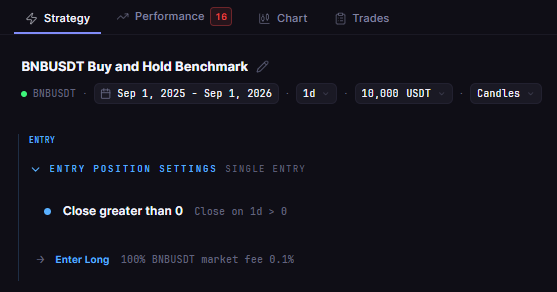
BNB Buy and Hold 1D 12M on the Strategy tab: BNBUSDT on the daily timeframe with 10,000 USDT, and one entry rule, written in plain words, that opens a long position at market.
The CFTC item is a proposal, not a rule. The National Law Review notes that it "does not yet contain proposed regulatory text". The Cryptonomist summarises the plan this way: "The plan lets registered platforms offer margined, leveraged or financed retail trades without forcing all crypto spot trading onto CFTC-registered venues."
The Practical Lesson
- Compare the drawdown with the zero point: BNB's 58.20% Max Drawdown was larger than both the 50.00% (2x) and 33.33% (3x) falls that erase a fixed position.
- Entry timing decides survival: a fixed 2x position from 1 September survived; the same position from the 8 October peak did not.
- Spot first: test the unleveraged idea on real data, then size it. For sizing methods, see position sizing 101, the Kelly Criterion for crypto and a testable risk rulebook.
Before you think about 2x or 3x, run the spot version of your idea and read its Max Drawdown. If that number is bigger than the fall your leverage can survive, the size is the problem, not the idea.
Build trading strategies on real data. No coding required.
Frequently Asked Questions
Is spot trading safer than leverage in crypto?
On the same price path, a spot position cannot be erased by any fall short of 100%. In this BNB year, spot ended at -19.40%, while a fixed 3x position from the same start would have been wiped out on 25 June 2026.
How much does 2x leverage increase drawdown?
Roughly double from your entry, before costs. In the fixed model, the spot run's 35.44% low from its start becomes 70.88% at 2x, and from the 8 October 2025 peak the 58.20% spot drawdown passes the 50.00% zero point.
At what price drop does a 3x position lose everything?
In simple arithmetic with no fees, funding or margin rules, a fixed 3x position reaches zero after a 33.33% fall from entry, and a fixed 2x position after a 50.00% fall. Real exchanges apply margin rules that can close a position before that point.
Test the spot version of your idea on real data before you size it up.
Disclaimer:
This content is for educational and informational purposes only and does not constitute financial, investment, or trading advice. All strategies and examples are for illustrative purposes and do not guarantee results. Always conduct your own research before making financial decisions.