
CoinQuant vs Obside (2026): How Deep Is the Backtest Behind an AI Trading Agent?

Obside and CoinQuant both backtest a strategy you describe in plain English. The difference is what surrounds the test. Obside is built around AI agents that monitor markets and, for eligible users, act through connected brokers. CoinQuant is built around turning an idea into editable rules and a fee-modelled backtest you can inspect trade by trade.
If you are weighing an Obside alternative, the useful question is not which platform has AI. It is how deep and transparent the backtest behind an agent is, and whether you can see and change the rules it runs.
This comparison uses each platform's own public pages, fetched September 30, 2026, plus one real result from our Strategy Library. There is no pricing and no ranking.
What Obside Offers
Obside's llms.txt describes an AI platform to "automate trading, monitor markets, and backtest strategies through a simple prompt". Its backtesting page and public files add the detail:
Plain-English rules for the strategies it backtests.
Adjustable fees and leverage: commission as a percentage, flat or per contract, plus spread and overnight swap.
20+ metrics and trade-by-trade detail in the backtest report. The engine ignores dividends.
Broker connections that are read-only by default. Live order execution is currently for US and Canada residents on eligible brokers and plans, and real-money actions require explicit confirmation flags.
An MCP server that requires a paid plan. Plans are named Free, Plus, Pro and Max.
A Library of published agents, plus Arenas and custom indexes.
Obside describes itself as a technology provider, not an investment adviser or broker-dealer, with execution and custody handled by regulated third parties. Its own backtesting page answers "Does a good backtest guarantee future returns?" with "No".
What CoinQuant Offers
CoinQuant is an AI trading platform for building and testing strategies without code. A plain-English prompt becomes a rule schema shown as colour-coded pills, and each later prompt modifies that schema. The FAQ says you can "Edit the Entry/Exit blocks directly in the Schema Editor, or refine your prompt and regenerate."
Report metrics: ROI, win rate, max drawdown, Sharpe, total trades, CAGR, profit factor and SQS Score.
Costs: maker and taker fees at order level (changelog, January 26, 2026).
Context: a Buy and Hold benchmark line (April 27, 2026) and interactive charts marking entries and exits (May 11, 2026).
Export: Download Data exports metrics and trade logs.
Programmatic access: a Public API and an MCP Server (May 25, 2026).
Markets: crypto on Kaiko data, plus stocks, ETFs, indices, forex pairs and commodities (July 27, 2026).
This comparison treats CoinQuant as a strategy-building and backtesting platform and does not cover live execution. Every CoinQuant statement here comes from its public docs and changelog.
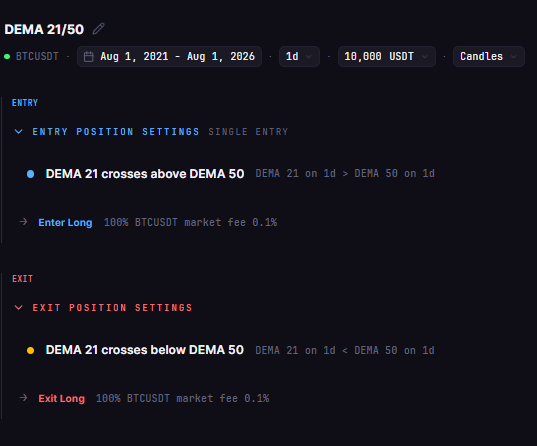
DEMA 21/50 in CoinQuant: every rule the backtest runs is visible as a pill and can be edited.
Screenshot from the author's CoinQuant account. Backtest results are hypothetical, based on historical data with modelled fees, and do not guarantee future performance. Not financial advice.
CoinQuant vs Obside: Comparison Table
Both platforms model fees, report a metric set and show trade detail. The differences are in scope and in how the rules are exposed.
| Dimension | Obside (its own pages) | CoinQuant (its own docs) |
|---|---|---|
| Prompt to rules | Backtest strategies "through a simple prompt"; plain-English rules | Plain-English prompt becomes a rule schema of pills |
| Rule editing | Rules written in plain English | Edit Entry/Exit blocks in the Schema Editor, or refine the prompt |
| Report metrics | 20+ metrics | ROI, win rate, max drawdown, Sharpe, total trades, CAGR, profit factor, SQS Score |
| Fee modelling | Commission (%, flat or per contract), spread, overnight swap | Maker and taker fees at order level |
| Trade detail | Trade-by-trade detail | Trade log, charted entries and exits, Download Data export |
| Execution scope | Read-only broker connections by default; live execution for US and Canada residents on eligible brokers and plans | Strategy building and backtesting (execution not covered here) |
| Programmatic access | MCP server on paid plans | Public API and MCP Server |
| Also offers | Agent Library, Arenas, custom indexes, market monitoring | Buy and Hold benchmark line, multi-timeframe conditions, multi-asset coverage |
The one-line read: Obside is built to carry a tested idea toward a running agent, while CoinQuant is built to show and edit the rules a test runs on.
Reading the Backtest Behind an Agent
Whichever platform you use, check these six things before an agent trades on a result:
The fee line: how much of the gross result went to costs.
The trade count: how many trades the result rests on.
The drawdown: the worst peak-to-trough fall you would have sat through.
Profit factor next to win rate: a low win rate can still pay if winners are larger.
A benchmark on the same window: did the rules beat simply holding?
The rules themselves: can you read exactly what was tested?
Here is what that looks like on one real report. DEMA 21/50 is a library strategy on BTCUSDT daily: enter when the 21-period double exponential moving average crosses above the 50-period one, exit on the cross back.
| Parameter | Setting |
|---|---|
| Strategy | DEMA 21/50 |
| Baseline | BTC Buy and Hold 1D 2021-2026 |
| Instrument and timeframe | BTCUSDT spot (Binance), daily (1D) |
| Window | 2021-08-01 to 2026-08-01 |
| Capital, sizing and fees | $10,000, 100% of equity, 0.1% taker fee |
| Data source | Kaiko via CoinQuant |
| Metric | Tested strategy | Buy and hold baseline |
|---|---|---|
| Strategy | DEMA 21/50 | BTC Buy and Hold 1D 2021-2026 |
| Total Return | +73.10% | +57.33% |
| Final Balance | $17,309.57 | $15,733.43 |
| Total Trades | 22 | 1 |
| Win Rate | 36.36% | n/a (single hold) |
| Profit Factor | 1.44 | n/a |
| Sharpe Ratio | 0.49 | 0.44 |
| Max Drawdown | 61.66% | 76.63% |
| Total Fees | $573.53 | $25.74 |
The headline beats holding Bitcoin, but the report says more. The fee line shows $573.53 paid across 22 trades, and a 36.36% win rate works only because the profit factor of 1.44 comes from larger winners. The 61.66% max drawdown is shallower than buy and hold's 76.63%, yet it is still a deep fall to sit through. With 22 trades, this is evidence worth testing further, not proof.
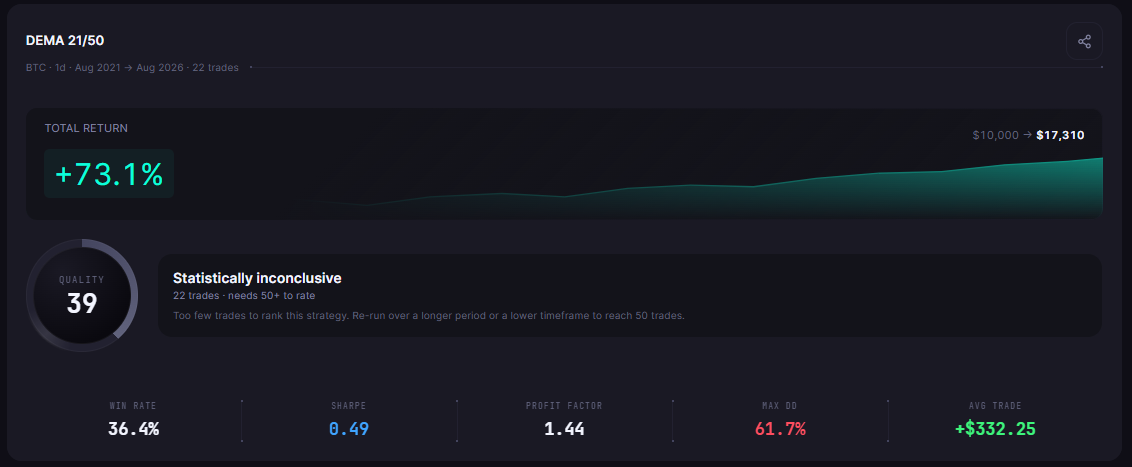
The report behind DEMA 21/50 in CoinQuant: +73.10% over 22 trades, with a 61.66% max drawdown.
Screenshot from the author's CoinQuant account. Backtest results are hypothetical, based on historical data with modelled fees, and do not guarantee future performance. Not financial advice.
Choosing an Obside Alternative: Which Fits Your Workflow
The right choice depends on what you want the AI to do after the test:
| If your priority is... | The closer fit |
|---|---|
| An agent that monitors markets and can act through an eligible broker | Obside, within its stated eligibility (US and Canada residents, eligible brokers and plans) |
| Rules you can open, read and edit pill by pill before any decision | CoinQuant |
| Fee-modelled backtests with trade detail | Both |
| Programmatic access for your own tools or agents | Both (MCP on each; CoinQuant also has a Public API) |
For other agent-first products, see CoinQuant vs Binance Agent OS and CoinQuant vs PionexGPT. Both contrast letting an AI act with testing the strategy first.
The Practical Lesson
Both platforms backtest, so the comparison is depth and transparency, not whether a test exists.
Read the fee line, trade count and drawdown first. In the example above they changed the story more than the return did.
Insist on readable rules. An agent is only as trustworthy as the rules you can inspect.
Test before any agent trades. A result on 22 trades is a reason to test variations, not to deploy.
Check the depth of the test before an agent trades. See why traders choose CoinQuant
Disclaimer:
This content is for educational and informational purposes only and does not constitute financial, investment, or trading advice. All strategies and examples are for illustrative purposes and do not guarantee results. Always conduct your own research before making financial decisions.
