
CoinQuant vs PionexGPT: Prompt-to-Bot vs Prompt-to-Backtest

PionexGPT turned a familiar idea into a product: describe a trading strategy in plain English and the platform returns a bot configuration with suggested parameters. Coin Bureau reviewed it in August 2026, and the review made the promise clear. Type a prompt, get a bot.
CoinQuant does something that looks similar and is fundamentally different: you describe a strategy in plain English and get a backtest, not a bot. The prompt goes to a research engine first, produces verified historical results, and only later becomes something you might run. Prompt-to-bot versus prompt-to-backtest is not a wording difference. It is the difference between deploying an idea and validating it.
What PionexGPT Does
PionexGPT is a prompt-to-bot builder inside the Pionex exchange ecosystem. A trader describes an idea, and the AI generates a bot configuration, including suggested parameters, which can then run on the exchange. The workflow is built for speed: from idea to live bot in one session.
The appeal is obvious. No code, no strategy syntax, no learning curve. The platform translates intent into an executable bot and the exchange provides the venue. For a trader who wants to be in the market quickly, it is a short path.
The short path is also the risk. A bot configuration is not a validated strategy. The suggested parameters are suggestions, not tested results. The bot can be live before anyone knows whether the idea has an edge, what the drawdown looks like, or whether fees eat the returns.
What CoinQuant Does
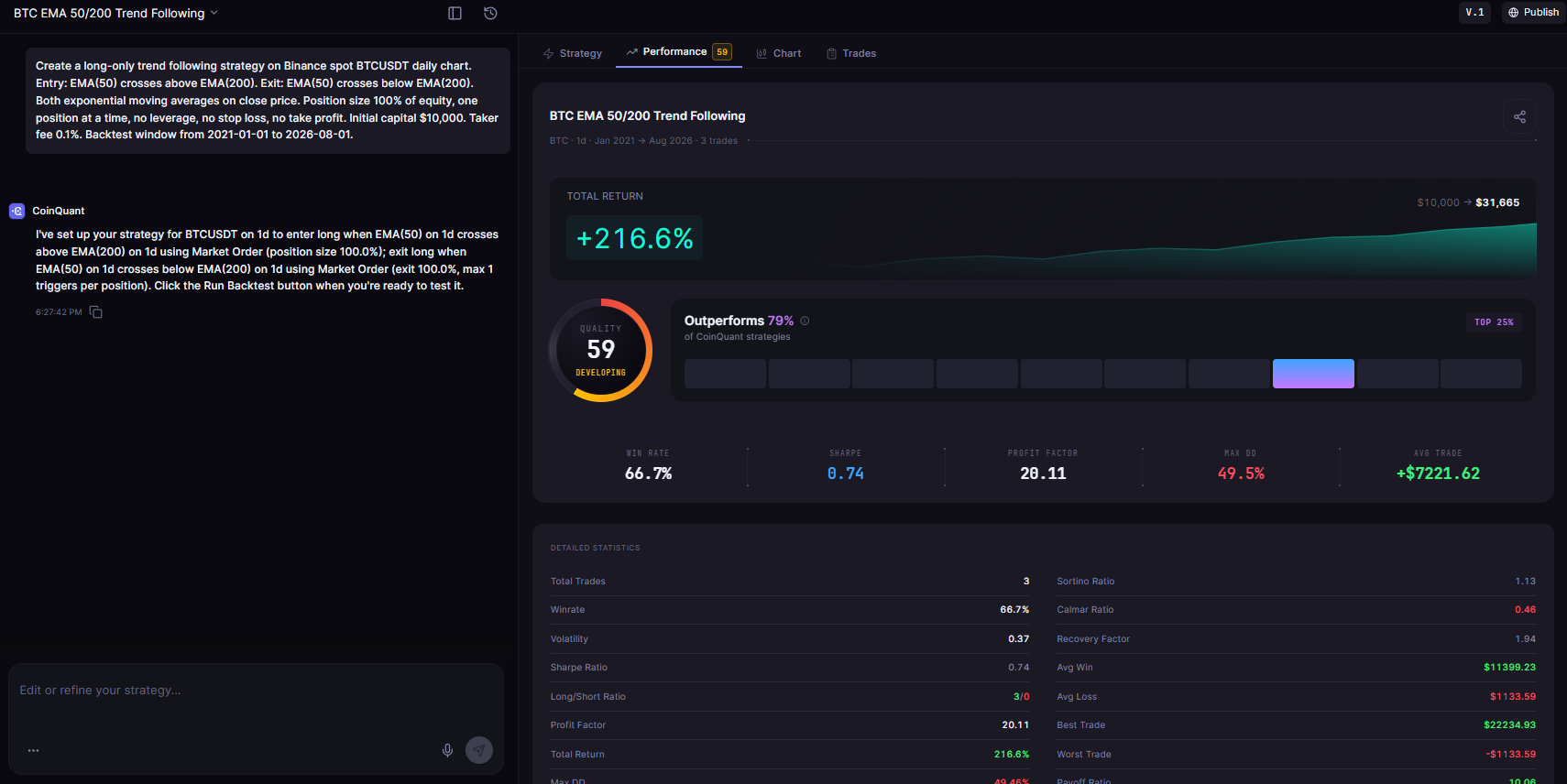
CoinQuant's prompt workflow is built for the opposite sequence. You type a strategy description, the platform validates it into a rules-based schema, and the backtest runs on institutional-grade exchange data with fees and slippage modeled. The output is evidence: total return, max drawdown, win rate, Sharpe ratio, profit factor, and a full trade log.
Only after the evidence exists does the deployment question arise. The strategy can be iterated, compared against variants, and stress-tested across market cycles before any capital is at risk. The prompt is the start of a research cycle, not the end of one.
The product lane difference is deliberate. PionexGPT is an exchange-side tool that turns prompts into running bots. CoinQuant is a research platform that turns prompts into tested strategies.
The Core Difference: What the Prompt Produces
| Stage | PionexGPT | CoinQuant |
|---|---|---|
| Prompt input | Plain-English strategy description | Plain-English strategy description |
| First output | Bot configuration with suggested parameters | Validated strategy schema |
| Second step | Bot runs on the exchange | Backtest on historical exchange data |
| Evidence produced | Live trade history, after the fact | Total return, drawdown, win rate, Sharpe, profit factor before any capital is at risk |
| Fees and slippage | Applied live | Modeled in every backtest by default |
| Iteration | Adjust the bot live | Backtest, adjust, retest |
| Data foundation | Exchange context | Historical exchange data (Kaiko), Bitcoin back to 2017 |
| Risk exposure | Live from deployment | None during research |
The table shows the fork clearly. Both platforms accept the same input. One converts it into a live position in the market. The other converts it into a testable hypothesis with a full evidence trail.
Why Prompt-to-Backtest Is the Safer First Step
Every bot that PionexGPT generates is running a strategy, and that strategy has a historical track record the moment its rules are defined. Computing that track record before deployment is strictly better than discovering it live, because the discovery happens with the same rules but without the capital.
The backtest answers the questions that matter before they cost money: Does the strategy make money after fees? What is the worst drawdown? How many trades does it take to conclude anything? What happens in a bear market? A bot cannot answer these with live trading in reasonable time; a backtest answers all of them in minutes.
This is why the two tools are complementary rather than competitive. The strongest workflow is prompt-to-backtest on CoinQuant, iterate until the metrics survive, then deploy the validated idea on the execution layer of your choice.
The Parameter Question
PionexGPT's suggested parameters are the most seductive part of the product. The AI proposes sensible-looking values for the bot's settings, which removes the blank-page problem. What the suggestions do not include is evidence: no backtest showing how those parameters performed across a full market cycle, no drawdown history, no fee-adjusted return.
CoinQuant's equivalent step produces that evidence by default. When a strategy is built from a prompt, the platform validates the rules and runs the backtest before anything else happens. The parameters are not suggested, they are tested. A suggested parameter is a hypothesis; a backtested parameter is a result.
The Timing Difference
There is also a timing difference worth naming. PionexGPT compresses the journey from idea to live bot into one session, which is excellent for speed and dangerous for judgment. CoinQuant deliberately stretches that journey: prompt, validation, backtest, metrics, iteration, and only then a deployment decision. The extra steps are not friction, they are the research.
A strategy that took a day to validate is not a day late, it is a day more informed. The trader who deployed the same idea in an hour has a live position and a hope; the trader who spent the day has a metrics table and a decision.
Common Mistakes to Avoid
Treating a generated bot as a validated strategy. A bot configuration is an implementation of an idea. Validation is a separate step that requires historical data.
Judging a bot by its first weeks live. A short live track record is a sample of one market mood. A multi-year backtest with fees modeled is evidence.
Trusting suggested parameters without testing. Suggested parameters are starting points, not results. The only way to know if they work is to test them.
Assuming prompt tools are interchangeable. Prompt-to-bot and prompt-to-backtest answer different questions: "can this run?" versus "should this run?"
The Practical Lesson
PionexGPT turns prompts into bots that run on the exchange; speed to deployment is the design goal
CoinQuant turns prompts into backtests with full evidence; validation is the design goal
The same prompt produces a live position on one platform and a tested hypothesis on the other
Test the strategy before you run the bot: the backtest is the cheaper place to discover the drawdown
The AI strategy tools of 2026 have made it easier than ever to deploy an idea and easier than ever to skip the research. The platforms that survive the next bear market will be the ones whose users validated first. Run your prompt through a backtest before it becomes a bot, and let the metrics table, not the suggestion box, decide the parameters.
Backtest your prompt before you deploy it as a bot. Start your first backtest on CoinQuant
Disclaimer:
Key Takeaway