
Should You Buy a Trading Strategy? How to Check a Marketplace Script Before You Pay
Should you buy a trading strategy because its backtest shows a huge number? Only after you check five things the headline leaves out. Our worked example is a Solana rule that the author backtested on CoinQuant: it returned 1,524.25%, and the same backtest carries a 55.80% Max Drawdown.
A seller's backtest is a claim, not proof. You cannot see how it was set up, which fees it charged or which years it skipped, and that matters more now that paid scripts are moving into marketplaces.
This guide gives you five checks, walks through them on a real backtest and shows how to rebuild a seller's rules and test them yourself.
Why Strategy Marketplaces Are Growing
Buying a ready made rule is getting easier. TradingView's blog lists "Commercial scripts are moving to the TradingView Marketplace" (30 September 2026). Cryptohopper's homepage invites traders to "buy strategies and bot templates from our marketplace", and Coinrule offers "350+ pre-built template bot strategies".
An independent review of Cryptohopper on AirdropAlert sums up the trading strategy marketplace risk in three short sentences: "Sellers set their own prices, charged on top of your subscription. Quality varies wildly, since anyone can list a strategy. Backtest anything before you buy it." The same review warns that "A good backtest proves little on its own."
Buying a trading bot strategy is a lot like copying a trader: you inherit someone else's results without their reasons. Our comparison of copy trading vs backtesting your own strategy covers that trade off.
Should You Buy a Trading Strategy? Five Checks Before You Pay
Each check below is a question to ask the seller, and a number you can read yourself once you rerun the rules. Together they are a quick way to verify trading strategy claims.
| Check | What to ask | What our example showed |
|---|---|---|
| 1. Trade count and Quality score | How many trades? Does the result clear 50? | 54 trades, rated with a Quality score of 45 |
| 2. Max Drawdown | What was the worst fall from a peak? | 55.80% |
| 3. Fee basis | Were fees charged on every fill? | 0.1% on entry and exit, $16,344.22 in total; no slippage set |
| 4. Same window Buy and Hold | Did it beat simply holding the coin? | SOL Buy and Hold 1D 2021-2026: 110.02%, Max Drawdown 96.27% |
| 5. The trade log | What were the best and worst trades? | One trade lost $61,911.78 after fees in a single day |
On CoinQuant, a run with fewer than 50 trades is marked "Statistically inconclusive" on the results card, with a note that it needs 50+ to rate. A seller's chart rarely tells you which side of that line a result falls on.
Example: A +1,524.25% Headline and What Else the Card Shows
The example is SOL Stochastic(14,3) Momentum 80/50 1D 2021-2026. It buys SOLUSDT when Stochastic %K (period 14) crosses above 80 on the daily chart and sells when %K crosses below 50, with $10,000, 100% of equity per trade and a 0.1% fee, from 2021-08-01 to 2026-08-01 on Kaiko data via CoinQuant.
| Metric | Stochastic 80/50 rule | SOL Buy and Hold |
|---|---|---|
| Strategy | SOL Stochastic(14,3) Momentum 80/50 1D 2021-2026 | SOL Buy and Hold 1D 2021-2026 |
| Total Return | +1,524.25% | +110.02% |
| Final Balance | $162,425.32 | $21,002.12 |
| Total Trades | 54 | 1 |
| Win Rate | 42.59% (23W / 31L) | n/a (single hold) |
| Profit Factor | 1.40 | n/a (single hold) |
| Sharpe Ratio | 1.21 | 0.64 |
| Max Drawdown | 55.80% | 96.27% |
| Total Fees | $16,344.22 | $31.01 |
Both runs share the window, capital, sizing and 0.1% fee. On these numbers the rule beat holding SOL on return and on drawdown, but a 55.80% Max Drawdown still means a buyer could have watched more than half the account disappear at one point.
With 54 trades the result clears the 50 trade bar, but only just, so the card rates it rather than calling it inconclusive.
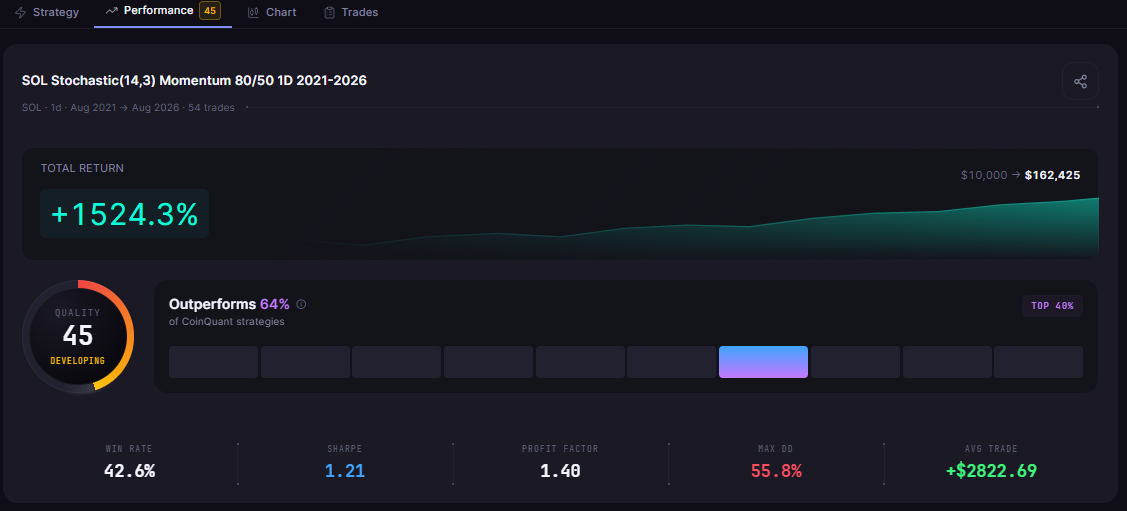
SOL Stochastic(14,3) Momentum 80/50 1D 2021-2026 results card: 54 trades, $10,000 to $162,425, Quality score 45, MAX DD 55.8%.
Rebuild the Rules and Test Them Yourself
If the seller shares the rules, you do not have to take their numbers on trust. In CoinQuant, an AI trading platform, you describe the rules in plain English and run them on your own window, with no coding required:
- Ask the seller for the rules in plain words: asset, timeframe, entry, exit, any stop and position size.
- Describe them in CoinQuant and read the Strategy tab to confirm it says what the seller said.
- Run the seller's window first, then a longer or different one, with fees on.
- Read the results card, then the Trades tab.
For our example, a description like this is enough:
Buy SOLUSDT on the daily chart when Stochastic %K (period 14) crosses above 80. Sell when %K crosses below 50. Test from August 1, 2021 to August 1, 2026 with $10,000, 100% of equity per trade and a 0.1% fee.
Then read the Trades tab, which lists every order. The worst trade in our example entered on 2025-03-02 and exited on 2025-03-03, losing $61,911.78 after fees (-20.64%).

SOL Stochastic(14,3) Momentum 80/50 1D 2021-2026 trade log, order rows 73 and 74: an Entry filled on 2 March 2025 and an Exit filled on 3 March 2025 with the trade's Net PnL on the Exit row, times in UTC.
The best trade entered on 2024-02-28 and exited on 2024-03-23, making $83,611.58 (+44.80%). The log also shows how uneven the trades were: the average trade made $2,822.69, yet the median trade lost $2,724.04. Of the 54 trades, 31 lost money; the 23 winners were large enough to carry the total.
If you would rather build than buy, our look at no-code backtesting vs hiring a developer compares the costs.
Common Mistakes When Checking a Strategy
- Trusting the Total Return alone: our example's 1,524.25% came with a 55.80% Max Drawdown.
- Testing only the seller's window: a rule that works on one stretch of history can fail on the next, so run at least one other window.
- Leaving fees out of your rerun: a test with no fees flatters every strategy that trades often.
- Reading the average as typical: check the median trade and the worst trade too.
Red Flags
| Red flag | Why it matters |
|---|---|
| No trade count | A big return from a handful of trades says little about the next trade |
| No drawdown figure | The worst fall decides whether you could have held on |
| No fee setting | Our example paid $16,344.22 in fees; leave them out and every result looks better |
| A window that stops before a bad year | Ending a test just before a losing stretch hides it |
| Only an average trade | Our average trade made money while the median trade lost it |
| Rules you cannot see | If you cannot rebuild the rules, you cannot check the claim |
None of these proves a strategy is bad. Each one means the seller has not yet shown you enough to decide, and a short message asking for the missing number costs nothing. A seller who will not share the trade count, the drawdown or the rules has answered the question for you.
The Practical Lesson
- Run it yourself: a backtest you ran beats a backtest you were shown.
- Read past the headline: our 1,524.25% example also carried a 55.80% Max Drawdown and a $61,911.78 single trade loss.
- Compare with holding: the rule beat SOL Buy and Hold (110.02%), which is the first test any paid strategy should pass.
Before you pay, rebuild the rules in CoinQuant and test them on another coin, timeframe or window (it supports multi-indicator and multi-timeframe conditions).
Build trading strategies on real data. No coding required.
Frequently Asked Questions
Is it worth buying a trading strategy?
Only if you can check it. Ask for the rules, the trade count, the drawdown and the fee setting, then rerun it yourself before you pay.
How do I check a trading strategy before I buy it?
Use the five checks: trade count and Quality score, Max Drawdown, fee basis, a same window Buy and Hold and the trade log. In our example those showed a 55.80% Max Drawdown behind a 1,524.25% headline.
Can I backtest a strategy from a marketplace?
Yes, if the seller discloses the rules. Describe them in plain English in CoinQuant and run the backtest on historical data; if the rules are hidden, you cannot verify them.
Check any strategy before you pay for it.
Disclaimer:
Key Takeaway