
Copy Trading vs Backtesting Your Own Strategy: Which Builds Real Edge?

Copy trading has an elegant pitch: someone else has already figured out trading, so you just mirror their trades. With 3Commas shutting down, a wave of traders who relied on copying and automation is deciding what to do next, and copy trading platforms are marketing hard for the migration.
The uncomfortable question is whether copying builds edge or rents it. The trader you copy has a track record you cannot fully verify, a risk profile you do not share, and no obligation to keep performing. Backtesting your own strategy takes longer, but it produces something copy trading never can: evidence that the rules work on historical data, with the drawdowns visible in advance.
What Copy Trading Actually Gives You
Copy trading is the practice of mirroring another trader's positions automatically. The value proposition is delegation: the copied trader does the analysis, the timing, and the risk management, and you share the outcome.
The mechanics are straightforward. You choose a trader or signal provider, allocate capital, and the platform replicates their trades proportionally to your account. The appeal is real for traders without the time or skill to run their own research.
What you do not get is control. You do not know the copied trader's strategy in testable form, you cannot verify their track record against raw data, and you have no visibility into their drawdown tolerance until you are living in it. You are betting on a person, not on a validated process.
What Backtesting Your Own Strategy Gives You
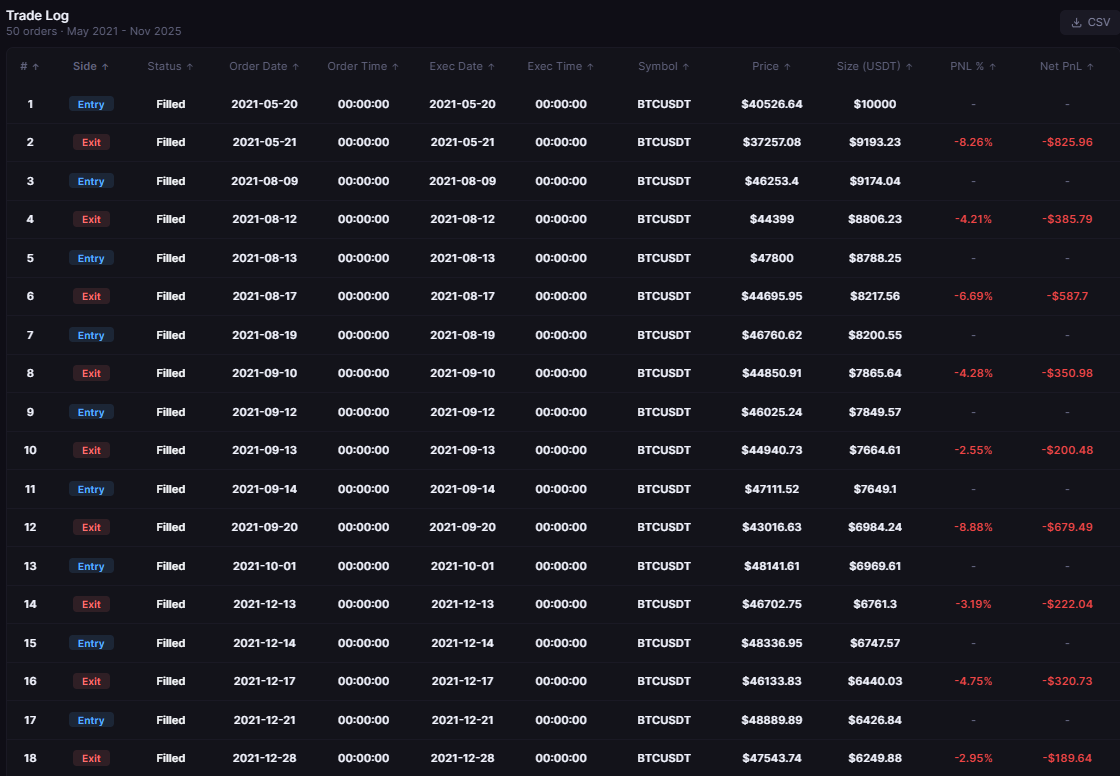
Backtesting is the process of running your own rules across historical data to see how they would have performed. The output is a complete evidence set: total return, max drawdown, win rate, Sharpe ratio, profit factor, and a trade log you can audit.
The key property is that the evidence is yours. Every rule is explicit, every result is reproducible, and every drawdown is visible before it costs you money. When the strategy works, you know why it works. When it fails, you know which rule failed.
This is the difference between renting edge and building it. Copy trading transfers outcomes from someone else's decisions. Backtesting produces understanding of your own. One is a dependency, the other is a skill.
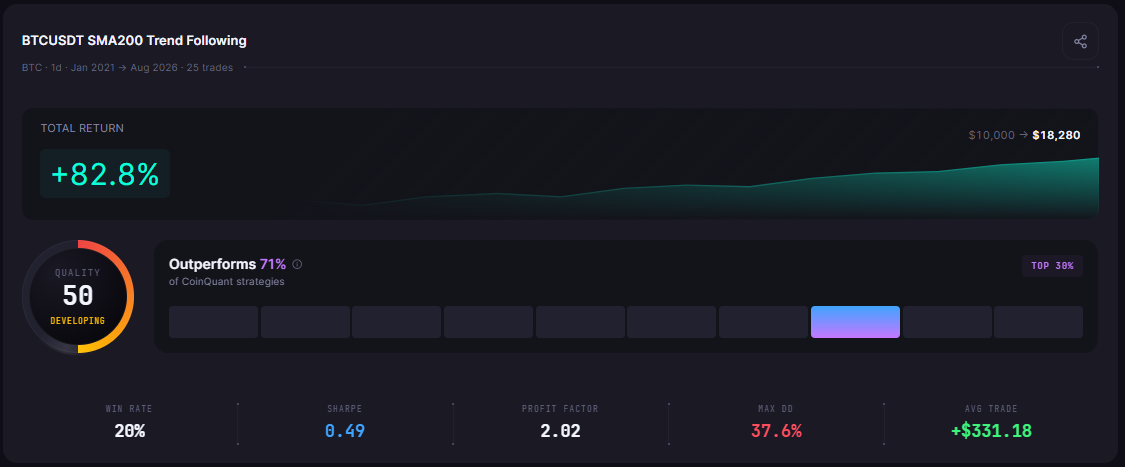
CoinQuant backtest results
The Head-to-Head
| Dimension | Copy trading | Backtesting your own strategy |
|---|---|---|
| Edge source | Someone else's decisions | Your rules, proven on historical data |
| Verifiability | Track record you cannot fully audit | Full trade log, reproducible results |
| Risk visibility | Drawdown discovered live | Drawdown visible before deployment |
| Control | Follow the copied trader | Full control of every rule |
| Skill built | None directly | Strategy design and evaluation |
| Dependency | The copied trader must keep performing | None beyond your own research |
| Time to start | Minutes | A few hours to learn, minutes per backtest |
| Failure mode | Copied trader stops performing or changes style | Your strategy fails validation, which is the point |
| Cost of a mistake | Real money, live | Backtest credits, no market risk |
The pattern is not subtle. Copy trading is fast and dependent. Backtesting is slower and self-sufficient. The question is which property you are actually buying.
What the Copy Trader Is Not Telling You
The uncomfortable part of copy trading is the information asymmetry. The trader you copy publishes a performance page, but the page does not tell you their drawdown tolerance, their fee drag, their slippage experience, or the point at which they will change strategy entirely. You are joining a game whose rules can change without notice.
A backtest has no such asymmetry. Every rule is on the table, every trade is in the log, and every drawdown is dated. When the strategy changes, the evidence changes with it, and you can see exactly what was altered and what it did to the metrics. That transparency is the difference between following a process and following a person.
Why the 3Commas Wave Changes the Math
The 3Commas shutdown is forcing a large cohort of traders to re-decide how they trade. The migration offers are everywhere, and the easiest ones move users from one copy or automation platform to another.
The better response to a forced migration is to use the break to change the dependency. A trader who learns to backtest their own strategies during the move owns their next decision instead of renting it. The shutdown is a one-time event; the skill of validation is permanent.
This is not an argument against automation. It is an argument for automating your own tested strategy rather than someone else's untested one.
Common Mistakes to Avoid
Copying a track record you cannot verify. Past returns on a platform page are not evidence. Raw data, trade logs, and reproducible rules are evidence.
Treating copy trading as a strategy. Copying is a distribution method for someone else's decisions. It has no edge of its own.
Skipping validation because it takes time. A few hours of backtesting can reveal the drawdown that would have ended your account live.
Going from one dependency to another. Replacing one copied trader with another copied trader does not build skill. Learning to validate builds skill.
The Practical Lesson
Copy trading rents edge: fast to start, dependent on someone else's performance
Backtesting builds edge: slower to start, but produces verifiable, reproducible evidence
The 3Commas migration is the moment to change the dependency, not just the platform
The strongest position is a tested strategy of your own, automated if you want, with the drawdown known in advance
The next time you are tempted to copy a trader, ask what evidence their edge is built on. If the answer is a track record you cannot audit, you are renting. If you want to own the edge, put your own rules through a backtest and see the drawdown before it touches your account.
Build your own edge and see the evidence before you risk capital. Backtest your own strategy free on CoinQuant
Disclaimer:
Key Takeaway