
No-Code Backtesting vs Hiring a Developer: What Actually Costs Less in 2026?
.png)
Every trader who reaches a certain level of sophistication faces the same question: do I build this in-house or use a platform? The question matters because backtesting infrastructure is not trivial. A proper backtesting system requires clean historical data, reliable indicator calculations, fee and slippage modeling, and a reporting layer that surfaces risk metrics alongside returns. Building that from scratch takes real engineering effort.
Hiring a developer to build a backtesting system is a real option. So is using a no-code platform like CoinQuant, which delivers that infrastructure immediately without requiring a line of code. The honest comparison is not philosophical. It comes down to time, total cost, capability coverage, and what you actually have in your hands when the work is done.
What Each Approach Actually Involves
Hiring a developer means commissioning a custom backtesting system. The developer writes code to pull historical price data from exchange APIs or a data vendor, implement indicator calculations, run strategy simulations against that data, and generate performance reports. The timeline from first conversation to a working backtest on your first strategy typically runs three to twelve weeks, depending on scope and developer workload.
The system is yours, fully customised, and can be extended over time. But it also requires ongoing maintenance: exchange API changes, data feed updates, and library deprecations all create downstream breakages that require additional developer time to fix.
Using a no-code platform means accessing a built system where data infrastructure, indicator libraries, backtest engines, and reporting are already operational. The data has been sourced, cleaned, and maintained. The indicator calculations have been tested and updated. The reporting includes a full risk metric set.
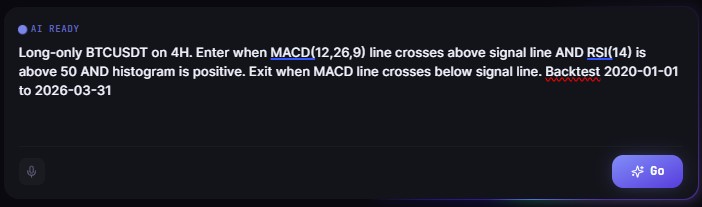
You define the strategy; the platform runs it. The first backtest is typically available within minutes of account creation, not weeks after a development engagement begins. That speed difference has real financial implications for traders who need to test ideas across multiple assets and parameter sets before committing capital.
The True Cost of Hiring a Developer
Developer rates vary significantly by geography and experience level. Rather than list specific figures that change with market conditions, this comparison focuses on time and deliverables. A custom backtesting build is rarely a single-milestone project.
The initial scope typically covers data ingestion, one or two indicators, a basic simulation loop, and a reporting output. Extending that to support multiple indicators, multi-asset testing, and a full risk metric suite adds scope. Adding a live execution layer adds further scope. Each extension requires negotiation, testing, and iteration time.
The hidden cost is not the hourly rate: it is the accumulated time from initial specification to a usable system, and the ongoing maintenance burden that follows. Platforms handle this continuously as part of the subscription, not as a separate billable item.
A useful frame for the comparison is opportunity cost. During the months a developer is building the initial backtesting infrastructure, a trader using a no-code platform can run dozens of strategy tests across multiple assets, identify the approaches that perform best, and begin refining parameters.
The developer-built system may eventually offer more flexibility for edge cases, but the trader using a no-code platform has already completed months of research and has live performance data from validated strategies. The advantage compounds over time: every iteration cycle completed on a no-code platform while a custom system is being built represents research that would otherwise not exist.
Where Custom Development Wins
Custom development makes sense in specific circumstances, and being clear about what those circumstances are prevents traders from investing development resources in a solution that a platform could deliver at a fraction of the cost and time:
You need a strategy type not supported by any existing platform. Exotic execution logic, multi-leg options strategies, cross-asset correlation signals, or proprietary signal generation that cannot be expressed through standard indicators. If the strategy genuinely requires custom code at its core, a no-code platform cannot replicate it regardless of feature depth.
You are managing institutional capital and require full system ownership. Regulatory or operational requirements at certain fund structures mandate that no third-party platform touches the strategy logic or holds the data. In these cases, the compliance requirement drives the architecture decision regardless of cost or speed trade-offs.
You already have a technical team. The marginal cost of adding backtesting capability to an existing infrastructure is low relative to the benefit of keeping all system logic internal and avoiding subscription dependencies.
Where No-Code Platforms Win
For retail traders, proprietary traders, and small funds testing indicator-based strategies on crypto markets, a no-code platform wins on almost every practical dimension. The conditions that justify custom development listed above simply do not apply to most strategy-building work done by individual traders in 2026. The advantages compound across the full workflow:
Speed to first result: a working backtest on a standard strategy is available within minutes of account setup, versus three to twelve weeks for a custom build
Data quality: institutional-grade historical data from providers like Kaiko is included as part of the platform, with no separate data agreement, cleaning process, or storage infrastructure required
Iteration speed: changing a single parameter (RSI period, stop-loss threshold, exit condition) and rerunning the backtest takes seconds rather than a code edit and redeploy cycle
Metric depth: Sharpe ratio, profit factor, max drawdown, win rate, average trade, and CAGR are standard outputs, not additional features that require custom reporting code
No maintenance overhead: data feed updates, API changes, indicator library upgrades, and bug fixes are handled continuously by the platform, not billable developer hours that accumulate over months
The 2026 no-code platform landscape has reached a point where the capability available to a retail trader on a monthly subscription matches or exceeds what a solo developer could build in three to six months of dedicated work. Data partnerships that previously required institutional agreements are packaged into the platform. Risk metric libraries that took weeks to implement correctly are standard output.
The iteration cycle that once required a code commit, test run, and deployment is now a form field change and a button press. This structural shift in the economics of strategy testing has occurred over the last two to three years and continues to narrow the remaining gaps between custom builds and platform capabilities.
The Real Question
The real question is not which approach is cheaper in absolute terms. It is which approach gets you to a tested, deployable strategy faster, with more reliable data, and with lower ongoing overhead.
A custom system that takes four months to build and requires monthly maintenance is not cheaper than a platform subscription: it is higher cost with the expense distributed across time and developer invoices rather than a visible line item.
For most traders, the answer is a no-code platform, and the developer hours saved can be redirected toward strategy research rather than infrastructure. The research itself (identifying which strategies perform in which market regimes) is where the alpha comes from, not the infrastructure that runs the tests.
Custom development becomes worthwhile when your strategy requirements genuinely exceed what current platforms support, not when they are complex by retail standards, but when they fall outside the indicator and data model that platforms are built on. For the majority of quantitative strategies built on standard indicators and market data, no-code platforms have closed the capability gap and extended the cost advantage significantly.
The test to apply is not 'could I build this in code?' but 'can I achieve the same testing quality on a platform in a fraction of the time?' For RSI, EMA, MACD, Bollinger Band, VWAP, and most combination strategies on crypto spot and perpetual markets, the answer in 2026 is consistently yes, and the time recovered from not building infrastructure is time that can go directly into strategy research.
Test your strategy on CoinQuant before deciding whether you need a developer. Start now on CoinQuant
Disclaimer:
This content is for educational and informational purposes only and does not constitute financial, investment, or trading advice. All strategies and examples are for illustrative purposes and do not guarantee results. Always conduct your own research before making financial decisions.
Key Takeaway
