
How Much Money Should You Give an AI Trading Agent? Sizing the Budget From a Backtest's Max Drawdown

Deciding how much money to give an AI trading agent is the first risk decision in agentic trading, and it comes before any prompt. The new agent products ask you to fund a separate account, so the amount you put in is the money the agent can reach.
A useful way to set that amount is an agent risk budget: the most you accept losing, sized from the worst fall a similar strategy suffered in a backtest. You can measure that fall on CoinQuant, an AI trading platform that backtests strategies written in plain English on historical data. This guide shows the method with one real backtest and simple arithmetic.
Why Agent Accounts Need a Budget
Three large platforms building trading agents put the agent in its own funded account. Here is how each describes it, in its own words:
- Robinhood: "Fund a separate account for your agent to trade from, then easily track its activity." Its HOOD Summit page adds: "Your agent can only access the funds in your dedicated agentic trading account." It also says "Robinhood Agents and Agent Apps are coming soon to eligible U.S. customers."
- Binance AI Pro (as reported): Cointribune wrote on 6 October 2026 that Binance planned to launch it gradually in the second half of October 2026, and that "each user must approve their execution and manually fund a dedicated sub-account."
- Bybit: "Create a dedicated AI Subaccount to securely isolate and automate your trading activities."
The design is the same in all three: the agent works from the funded amount, not your whole balance. That makes the size of the deposit your main risk control, so it deserves a method rather than a round number picked on the day.
Start From a Backtest's MAX DD
Max Drawdown is the largest fall in account balance from a peak to a later low, as a percentage. It answers the question a budget needs: if the strategy behaves the way it did in the past, how much of the account could disappear before it recovers?
To get a number, backtest a strategy close to the one the agent will run. A prompt typed into CoinQuant can be as plain as this:
Backtest XRP on the daily chart from August 2021 to August 2026. Buy when the Klinger Volume Oscillator (34, 55, 13) crosses above zero and sell when it crosses below zero. Start with $10,000 and charge a 0.1% fee on each entry and exit.
We ran a rule like that ourselves on CoinQuant, stored as XRP Klinger 34-55-13 Zero-Line Cross 1D 2021-2026, on XRPUSDT daily data with a 0.1% fee on entry and on exit and no slippage set.
| Metric | Value |
|---|---|
| Strategy | XRP Klinger 34-55-13 Zero-Line Cross 1D 2021-2026 |
| Total Return | 49.99% |
| Final Balance | $14,999.00 |
| Total Trades | 115 |
| Win Rate | 29.57% (34W / 81L) |
| Profit Factor | 1.12 |
| Sharpe Ratio | 0.41 |
| Max Drawdown | 55.60% |
| Total Fees | $2,735.75 |
The rule finished up 49.99% over five years, but at its worst point the balance was 55.60% below its previous peak. On the Performance tab, the results card shows that figure as MAX DD in its bottom row, rounded to one decimal.
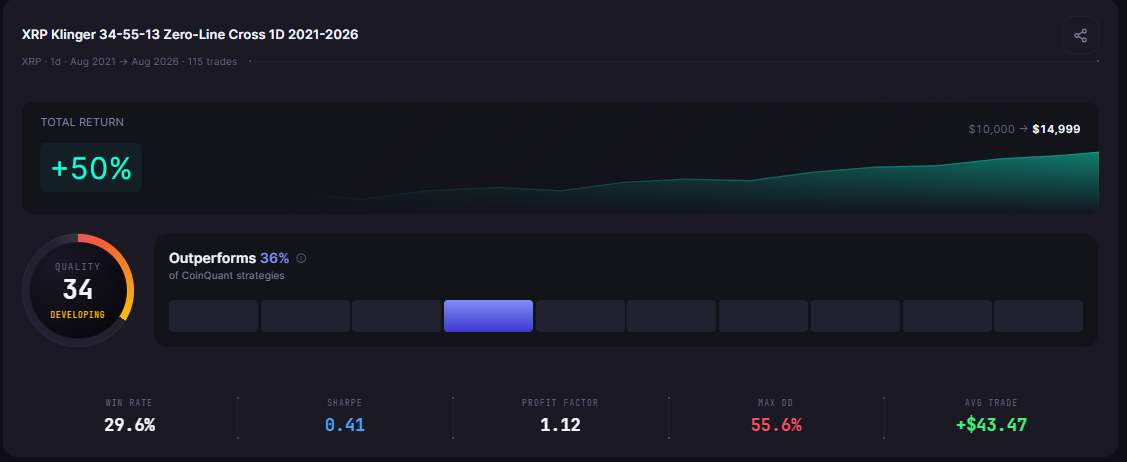
XRP Klinger 34-55-13 Zero-Line Cross 1D 2021-2026 results card on the CoinQuant Performance tab: daily XRP, Aug 2021 to Aug 2026, 115 trades, +50%, $10,000 to $14,999, Quality score 34, MAX DD 55.6%.
Data note: the XRPUSDT daily data has no bars from 2021-09-09 to 2021-09-15, and the platform does not flag the gap.
Worked Example: A 55.60% Drawdown on a $1,000 Budget
The arithmetic works in both directions. It is labelled arithmetic on a past drawdown, not a forecast and not advice.
- From budget to loss. Fund an agent account with $1,000 and suppose it meets the same 55.60% drawdown. That is $1,000 × 55.60% = $556.00 gone at the low point.
- From loss to budget. Start with the most you accept losing, say $500. Divide it by the drawdown: $500 / 55.60% = $899.28 is the largest budget that keeps a repeat of that drawdown inside your limit.
- Leave room for worse. A backtest shows one past path. The next drawdown can be deeper, so treat the result as a ceiling and fund below it.
Also look at where the profit came from. One trade, from 4 November to 10 December 2024, made $21,112.26 after fees, more than four times the rule's $4,999.00 net profit. Take away a trade like that and the five years could look very different.
The Strategy tab shows the rule in plain words, so you can check exactly what the drawdown figure belongs to before you size anything from it.
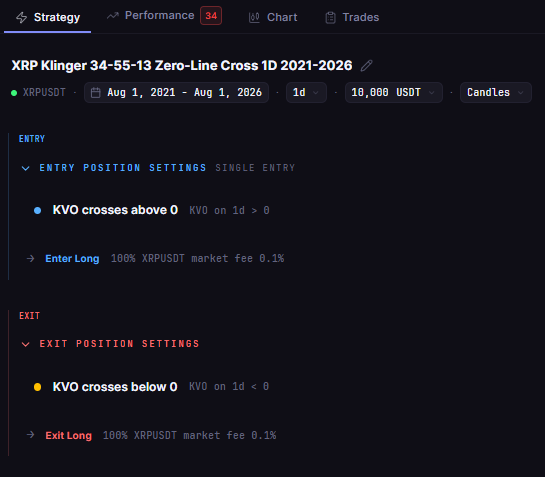
XRP Klinger 34-55-13 Zero-Line Cross 1D 2021-2026 in CoinQuant: enter when the Klinger Volume Oscillator (KVO) crosses above 0, exit when it crosses below 0, written in plain words.
For the wider picture on reading this metric, see our guide to Max Drawdown in crypto trading.
Other Limits: Approvals and Permissions
A budget sets how much money the agent can reach. Approvals and permissions control what it can do with that money, and the vendors describe them plainly:
- Trade approvals: Robinhood says you can "Review each trade before it’s placed, with approvals turned on by default." Its summit page adds that you can turn them off, and then "your agent can place orders without asking you to confirm each one."
- Key permissions: OKX's Agent Trade Kit says that "If a key lacks trading permission, order tools are never registered in the agent’s toolbox".
- Risk limits: Bybit says its AI Subaccount has "an independent budget" and "defined risk limits".
Keep approvals on while the agent is new. Turning them off removes the last human check, and the budget becomes the only limit left. For broader rules, read our crypto risk management rules.
How Much Money to Give an AI Trading Agent: A Budget Checklist
Run through this list before you fund an agent account:
- Pick the loss you accept in dollars first, not the deposit.
- Backtest a similar strategy on the same coin and timeframe, with fees.
- Read the MAX DD on the results card and the Max Drawdown in the backtest data.
- Divide your loss limit by the drawdown to get the largest budget, then fund below it.
- Check the trade count. Under 50 trades, the results card marks a run "Statistically inconclusive".
- Keep approvals on and give the account only the permissions it needs.
- Review after a month and resize only from new evidence.
Common Mistakes
- Funding with spare cash: an amount picked because you would not miss it has no link to how the strategy behaves.
- Sizing from Total Return: a 49.99% gain hides a 55.60% fall along the way.
- Treating the backtest as a promise: past drawdowns are a floor for planning, not a cap.
Position sizing inside the account is a separate decision. Our position sizing guide covers how much to risk per trade.
The Practical Lesson
- The deposit is the risk control: agent accounts are funded separately, so the amount you fund is what the agent can reach.
- Start from a drawdown, not a hunch: your loss limit divided by a backtest's Max Drawdown gives a budget ceiling.
- Fund below the ceiling: $500 / 55.60% = $899.28 is a maximum from one past path, not a target.
- Layer the limits: approvals on, minimal permissions, review on a schedule.
Before you fund any agent, backtest a strategy like the one it will run and read its drawdown. CoinQuant lets you describe that strategy in plain English and test it on historical data.
Build trading strategies on real data. No coding required.
Frequently Asked Questions
How much money should I give an AI trading agent?
Start from the loss you can accept, not from the deposit. Divide that loss by the Max Drawdown of a backtest that matches the agent's strategy, then fund below the result. In our example, a $500 loss limit and a 55.60% drawdown give a ceiling of $899.28.
How do I size a trading account from a backtest drawdown?
Backtest a similar strategy with fees and read its Max Drawdown. Then divide your dollar loss limit by it. That gives the largest account that keeps a repeat of the past drawdown inside your limit. Future drawdowns can be deeper, so leave a margin.
Can an AI trading agent lose all my money?
On the platforms quoted above, the agent trades from a separate funded account and, as they describe it, can reach only the funds in that account. Within it, a strategy can lose most of the balance: our example fell 55.60% from a peak. Approvals and permissions add further limits.
Size your agent's budget from real drawdown data before you fund it.
Disclaimer:
Key Takeaway