
FOMO in Crypto Trading: How a Written Rule Handles the Urge to Chase a Move

FOMO in crypto trading is the fear of missing out: the urge to buy a coin because its price is already rising fast and other people seem to be making money. The answer is a written rule, and CoinQuant is an AI trading platform where you can write that rule in plain English with no coding required, then backtest it on past data before you use it.
FOMO usually means buying late, after much of the move, with no plan for getting out. A rule written before the move fixes the entry, the exit and the size, so the decision is already made when the urge arrives.
Crowd mood swings fast. On Alternative.me's Crypto Fear and Greed Index, where "a value of 0 means 'Extreme Fear' while a value of 100 represents 'Extreme Greed'", the daily reading was 68 (Greed) on 22 October 2026, 51 (Neutral) on 29 October and 30 (Fear) on 30 October. Each of those readings feels like a reason to act on the day.
This guide explains what FOMO looks like, why it is hard to judge in the moment and how to write and test a rule that decides for you. It quotes no backtest result: the point is the process.
What FOMO in Crypto Trading Looks Like
FOMO rarely feels like fear. It feels like urgency, and it tends to show up in the same few ways:
- Buying after a big green day, because the move looks like it will keep going.
- Raising the size of a trade because a coin is "running", not because the plan says so.
- Skipping the exit plan, since the only question in your head is how to get in.
- Switching coins to whatever moved most in the last few days.
That is the FOMO in crypto meaning most traders know from experience: the price move itself becomes the reason to trade. The trade is chosen by the chart you just saw, not by a plan you made earlier.
Why It Is Hard to Judge in the Moment
A fast move changes how a trade looks. A coin that has just jumped looks strong, and the jump itself feels like proof. At that moment you are judging with the least distance and the most noise.
FOMO trading psychology is not a flaw of weak traders; it is a normal reaction to watching a price climb without you. The trouble is that the feeling is loudest exactly when the move is oldest. The same pull works in reverse when prices fall, as Trading the Fear: What Backtesting an RSI Mean-Reversion Strategy Through Extreme Fear Reveals (BTC, 2026) shows.
A rule written in advance makes the same decision every time. A trade placed by hand in the moment depends on how you feel that day. For how the two compare on past data, see Manual vs Automated Crypto Trading: Which Wins? (Backtested Data).
A Written Rule: Entry, Exit, Size, Decided in Advance
How to avoid FOMO trading comes down to one habit: decide before the move, then let the rule answer when the move arrives. A usable rule has three parts, written down in order:
- Entry: the exact condition that opens a trade, such as a close crossing a moving average.
- Exit: the exact condition that closes it, written at the same time as the entry.
- Size: how much of the account goes into each trade, fixed in advance.
Here is the rule from a real prompt, typed into the CoinQuant builder for the library strategy BTC HMA 55 Close Cross 1D 2021-2026:
Enter long when the daily close crosses above the Hull Moving Average (55). Exit long when the daily close crosses below the Hull Moving Average (55). Position size 100% of equity.
Each part is a plain sentence a stranger could check. Nothing in it depends on how fast the price moved that day or what anyone else is buying.
Picture Bitcoin jumping on a day you hold nothing. With this rule written down, the question is no longer "should I buy?" but "has the daily close crossed above the Hull Moving Average (55)?" If it has, the rule says enter. If it has not, there is no trade, however exciting the chart looks. CoinQuant's reply restates the rule before anything is tested.
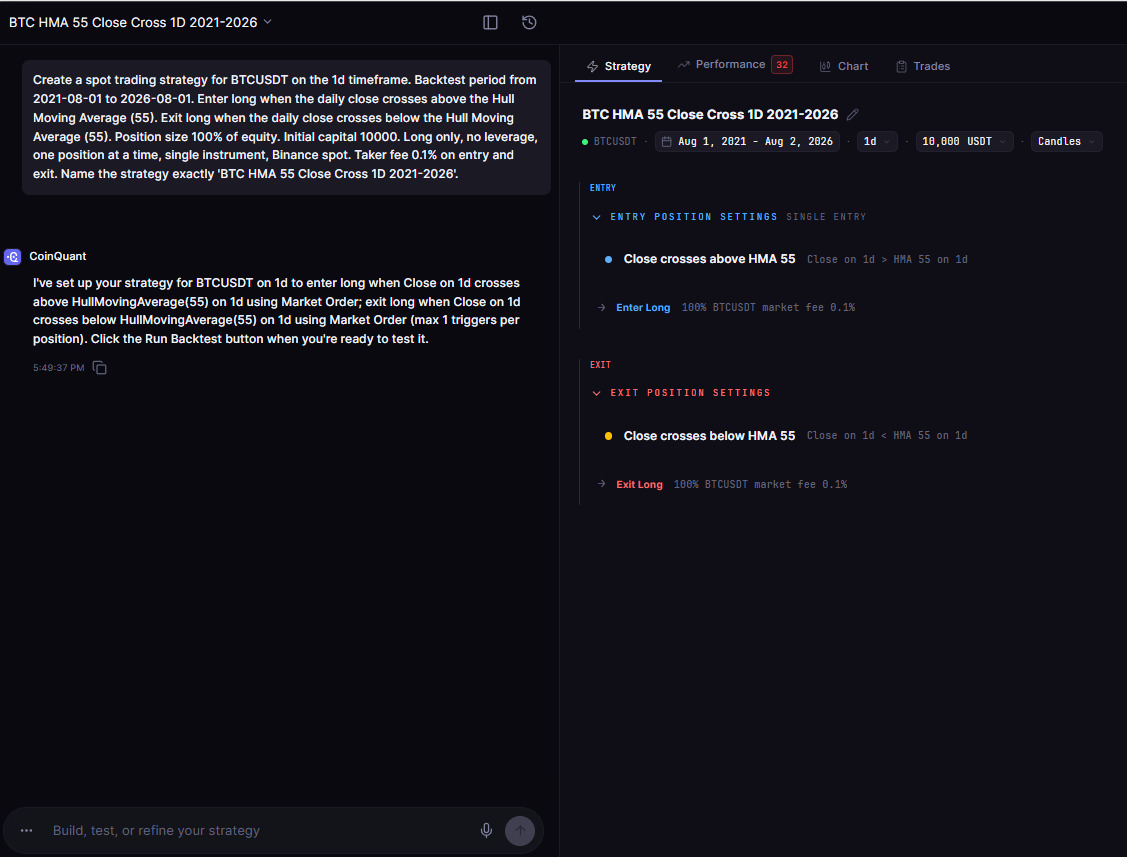
You do not need this exact rule. A simple rule you understand beats a clever one you would abandon after a loss; Simple Crypto Trading Strategy That Actually Works (Backtested) shows one approach.
Test the Rule Before You Use It
A written rule only helps if you trust it when the urge hits. Testing it on past data is how you earn that trust. A backtest shows how the rule would have traded over a past window, fees included, no slippage modelled. It cannot tell you what the market will do later.
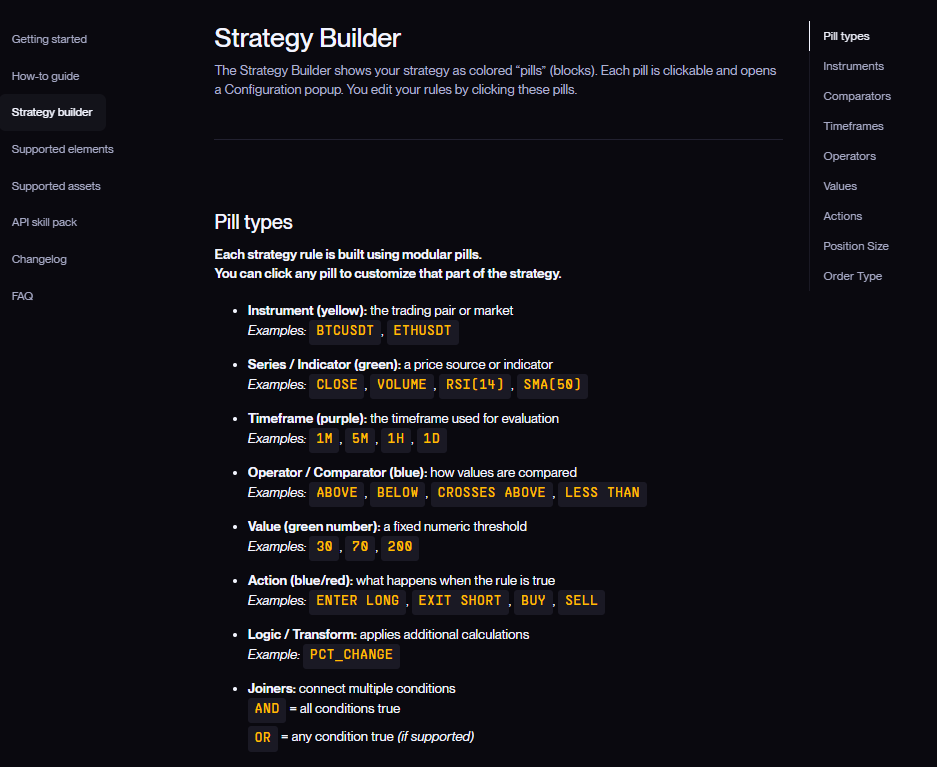
CoinQuant's Strategy Builder docs show how a rule is broken into parts: instrument, indicator, timeframe, operator, value and action. Each part can be clicked and edited on its own, so you can confirm the rule says what you meant before you run it.
When the results come back, look at the trade count first. On CoinQuant's Performance tab, a results card with fewer than 50 trades shows its QUALITY number next to "Statistically inconclusive". For why the count matters, see How Many Trades Does a Backtest Need Before You Can Trust It?
Common Mistakes When Writing the Rule
- Writing it after the move: a rule shaped to fit the chart you just watched will look perfect on that chart and nowhere else.
- Leaving out the exit: an entry with no exit puts the decision back in the moment.
- Changing it after one loss: one trade says almost nothing about a rule.
- Ignoring costs: every entry and exit pays a fee, and a rule that trades often pays it often.
A Short Checklist for the Next Big Move
When a coin jumps and you feel the pull, answer these five questions before you place anything:
- Did I write this entry before the move started?
- Where is my exit, and is it written down?
- How much am I putting in, and what share of my account is that?
- Have I tested this rule on past data, with fees included?
- Would I take this trade if nobody were talking about the coin?
If any answer is "no" or "I don't know", the trade is FOMO, not a plan. Write the rule first, then come back to the chart.
The Practical Lesson
- The urge is strongest with no plan: FOMO fills the gap where an entry, exit and size should be.
- Write the rule first: three plain sentences, decided before the move.
- Test it, then let it decide: check the trade count and costs before you trust it.
FOMO is not beaten by willpower in the moment. It is beaten by making the decision earlier, when nothing is moving. In CoinQuant you can write that decision in plain English and test it on past data first.
Build trading strategies on real data. No coding required.
Frequently Asked Questions
What is FOMO in crypto?
FOMO stands for fear of missing out. In crypto it is the urge to buy a coin because its price is already rising fast, usually late and without a plan for the exit.
How do I stop FOMO trading?
Write your entry, exit and position size before the move. Test the rule on past data with fees included, then follow it instead of the chart in front of you. The five questions above are a quick check before any trade.
Is FOMO always bad?
The feeling is normal and sometimes points at a real trend. Acting on it without a plan is the problem. If a move fits a rule you wrote and tested earlier, the rule makes the decision, not the feeling.
Write your entry, exit and size before a coin starts to run, then test them on past data.
Disclaimer:
Key Takeaway