
Manual vs Automated Crypto Trading: Which Wins? (Backtested Data)

Most crypto traders start the same way: watching charts, reading the news, and making judgment calls. At some point the question arrives: would a systematic, rules-based approach actually do better?
This is not a simple question with a clean answer. Manual and automated trading each have genuine strengths and real limitations. The honest answer depends on what you are trying to achieve, how much time you have, and whether you are willing to put your edge through rigorous testing before risking capital.
This article breaks down both approaches, compares them directly, and explains why backtesting changes the entire conversation in favour of automation.
What Manual Trading Actually Means
Manual trading, sometimes called discretionary trading, means a human makes every buy and sell decision in real time. The trader reads price action, watches order books, monitors news, and acts on judgment.
There is no fixed rulebook. The trader might pivot based on a macro headline, ignore a technical signal that feels wrong, or hold longer than planned because sentiment shifted overnight. Every decision draws on experience, pattern recognition, and intuition built over time.
Manual trading is how most people begin. For skilled traders with deep market knowledge, it can work well. But it comes with significant structural limitations, especially in crypto.
What Automated Trading Actually Means
Automated trading, also called systematic or rules-based trading, means a predefined set of conditions controls every entry and exit. When condition A is met, the system buys. When condition B is met, it sells. No human judgment is involved in execution.
The rules are written in advance, tested against historical data, and deployed to run continuously. The trader's role shifts from making real-time decisions to designing, testing, and monitoring the strategy.
Automated systems can range from a simple moving average crossover to a multi-indicator strategy with dynamic position sizing. The defining feature is that the logic is explicit, repeatable, and verifiable.

Pros and Cons: Manual Trading
Manual trading offers real advantages, but they come with equally real costs.
Strengths:
Adapts quickly to breaking news and unexpected events that rules cannot anticipate
Experienced traders can recognise market structure shifts before indicators catch them
Flexible enough to handle unusual conditions that would break a rigid rule set
No system setup required, accessible to anyone willing to watch the market
Weaknesses:
Emotional decision-making: fear, greed, and revenge trading erode consistency
Fatigue is a genuine risk, especially in crypto where markets run around the clock
Hard to scale: a human can monitor only so many assets at once
Cognitive biases (recency bias, confirmation bias, loss aversion) affect every trader
Difficult to test objectively: a gut feeling cannot be run against three years of historical data
Performance is highly dependent on the individual and cannot be easily handed to someone else
The most damaging limitation is the last one. Manual trading is almost impossible to validate rigorously before deploying real capital.
Pros and Cons: Automated Trading
Systematic trading solves most of the consistency problems that manual trading cannot.
Strengths:
Executes without emotion: no hesitation, no revenge trades, no panic exits
Runs continuously in a market that never closes, capturing opportunities overnight and on weekends
Scalable across multiple assets and strategies without additional time cost
Fully backtestable: you can validate the strategy on historical data before going live
Reproducible: the same rules produce the same decisions every time, enabling genuine performance measurement
Removes fatigue as a variable
Weaknesses:
Requires clearly defined rules upfront; a vague idea cannot be coded
Can underperform during sharp regime changes if the logic was not designed to handle them
Needs ongoing monitoring, especially through volatile market periods
A poorly designed system can lose consistently and at scale
Over-optimised strategies (curve-fitted to historical data) may not perform in live conditions
The key weakness is clear: garbage in, garbage out. A bad strategy automated is just a faster way to lose money. This is precisely why backtesting, and honest evaluation of backtest results, matters so much.
Side-by-Side Comparison
| Factor | Manual Trading | Automated Trading |
|---|---|---|
| Execution speed | Limited by human reaction time | Near-instant, rule-triggered |
| Emotional influence | High: fear and greed affect every trade | None: rules execute regardless of sentiment |
| 24/7 coverage | Only while the trader is awake | Continuous, crypto-native advantage |
| Scalability | One trader, limited assets | Multiple assets and strategies simultaneously |
| Consistency | Varies by mood, fatigue, and confidence | Fixed: same logic every time |
| Backtestability | Not possible in any rigorous sense | Full historical simulation before live capital |
| Adaptability to news | High: can pivot immediately | Low unless news-driven logic is built in |
| Validation before risk | Gut feel and paper trading only | Historical backtest with measurable metrics |
| Suitable market conditions | Any, if the trader reads it correctly | Conditions the strategy was designed for |
| Setup cost | None | Requires upfront strategy design and testing |
The Backtesting Advantage Is the Core Argument
This is where the conversation changes. Backtesting is the ability to run a strategy against historical data and see, with measurable precision, how it would have performed.
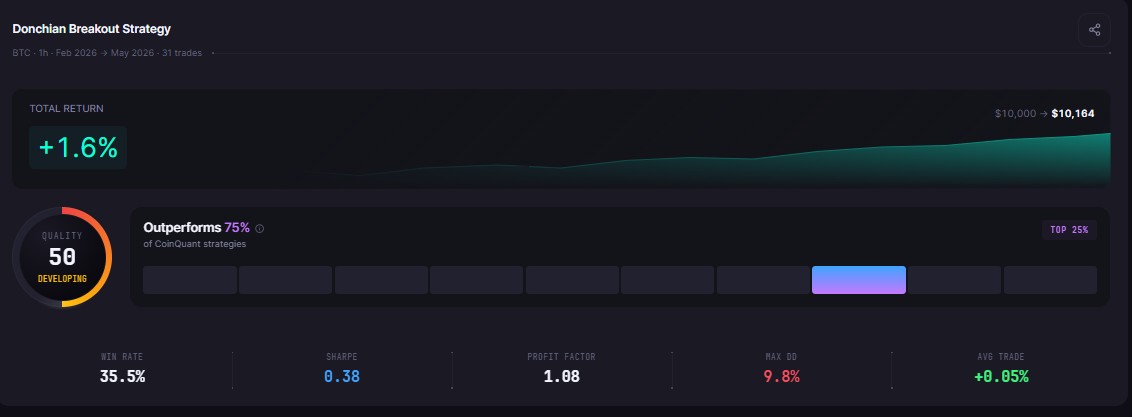
When you backtest an automated strategy, you get concrete answers: total return, win rate, profit factor, maximum drawdown, Sharpe ratio, and a Quality Score that summarises risk-adjusted performance. You know, before risking a single dollar, whether the edge you believe in actually shows up in the data.
You cannot do this with discretionary trading. A gut feeling has no equity curve. A journal entry about why you bought does not tell you what the return distribution looks like over 500 trades.
This is not a minor advantage. It is the fundamental difference between trading with evidence and trading with hope.
CoinQuant users build and backtest strategies using plain language, without writing code. The platform runs the historical simulation and returns the full metrics: return, win rate, profit factor, drawdown, and a Quality Score that flags whether the result is robust enough to trust. That feedback loop, from idea to tested data, is what separates validated edges from guesses.

Which Approach Suits You?
The right answer depends on your situation.
| Profile | Best Fit |
|---|---|
| Active trader with deep chart reading experience and time to monitor markets | Manual, with clear rules and journaling discipline |
| Trader who wants to participate in crypto markets but cannot watch screens 24/7 | Automated: runs while you sleep |
| Anyone who wants to test a specific strategy idea before committing real money | Automated: backtesting is the only rigorous path |
| Trader prone to emotional decisions or who has broken their own rules before | Automated: removes the psychological variable entirely |
| Sophisticated trader who wants both adaptability and consistency | Hybrid: automated execution with human oversight on regime |
| Complete beginner with no defined edge yet | Neither alone: build the edge first, then systematise it |
The Honest Verdict
Automated trading does not always win. A badly designed automated strategy can lose faster and more consistently than a disciplined manual trader. Automation amplifies whatever edge, or lack of edge, you have built into the rules.
What automation does reliably win on is consistency and testability. It removes the emotional and fatigue variables that make manual trading drift over time. It runs in a market that never closes. And critically, it lets you validate your hypothesis on historical data before it costs you anything.
Manual trading wins on adaptability. A skilled discretionary trader can recognise a news shock, a liquidity event, or a market structure shift and respond in ways no static rule set can match.
For most serious crypto traders, the practical path is a hybrid: use automation for execution and rules-based discipline, and apply human judgment to the higher-level questions of strategy selection, market regime, and risk sizing.
The worst outcome is pure manual trading without a tested edge. The second worst is automated trading without any validation. The best outcome is a defined, backtested strategy that you understand well enough to monitor intelligently.
Describe your strategy in plain language, run the backtest, and see whether the edge you believe in actually shows up in the data.
Disclaimer:
Key Takeaway