
A Crypto Trading Strategy for Part-Time Traders: Daily Rules You Check Once a Day

The best crypto trading strategy for part-time traders is one you can run in a few minutes a day. Daily-close rules do exactly that: you look at the chart once, after the daily candle closes, and the rule tells you whether to buy, sell or do nothing.
Doing nothing is the usual answer. A real Bitcoin strategy from our library, one rule on the daily chart, made just 25 trades in about five and a half years. It returned 82.74% after fees, yet only five of those trades were winners.
This guide explains how daily-close rules work, what checking once a day costs you, and how to backtest your own daily rule before you trust it. Every figure comes from a verified CoinQuant backtest, reported without adjustment.
Why a Crypto Trading Strategy for Part-Time Traders Needs Different Rules
Most popular setups assume screen time. Scalping and intraday strategies act on 5-minute or 15-minute candles, so a signal can appear and vanish while you are in a meeting. If you have a full-time job, those rules are close to impossible to follow.
A strategy has to fit the hours you actually have. For crypto trading with a full time job, that usually means:
- One decision point a day: a fixed time when you check, rather than a screen you watch.
- Rules that act rarely: few trades, so a missed hour never matters.
- No discretion: the rule decides, so you are not tempted to trade on a headline at lunch.
If you are still choosing your first approach, our guide to the best crypto trading strategy for beginners compares several backtested options.
How Daily-Close Rules Work
A daily chart crypto strategy reads one candle per day. The candle closes once every 24 hours, and only then is its closing price final. A daily-close rule waits for that final close, checks its condition and makes one decision.
That makes the routine short:
- Check after the close: open the chart once, at the same time every day.
- Read the condition: for example, is the close above or below the 200-day moving average?
- Act only on a change: if the close just crossed the line, place the trade. If not, close the app.
- Log it: one line a day keeps you honest about following the rule.
Alerts are optional. A daily reminder on your phone is enough, because nothing in the rule can change until the next close. That is what makes it a low maintenance trading strategy: the work is a check-once-a-day trading habit, not a skill of watching screens.
A Real Example: One Rule, 25 Trades in About Five and a Half Years
'BTC Trend Following 1D 2021-2026' is one of the simplest daily rules there is. As stored in CoinQuant, it enters long when the Close crosses above the 200-period simple moving average (SMA 200) on the 1d timeframe, and exits when the Close crosses below it. Written as you would type it into CoinQuant, with no coding required:
Buy BTCUSDT on the daily chart when the close crosses above the 200-day simple moving average. Sell when the close crosses below it. Test from January 1, 2021 to August 1, 2026 with $10,000, 100% of equity per trade and a 0.1% fee on every fill.
The backtest ran on Kaiko data via CoinQuant for Binance spot BTCUSDT, with a 0.1% fee on entry and on exit and no slippage set.
| Metric | Result |
|---|---|
| Strategy | BTC Trend Following 1D 2021-2026 |
| Window | 2021-01-01 to 2026-08-01 (first trade 2021-05-20, last exit 2025-11-03) |
| Total Trades | 25 (5 won, 20 lost) |
| Total Return | 82.74% |
| Final Balance | $18,273.54 |
| Win Rate | 20.00% |
| Profit Factor | 2.02 |
| Max Drawdown | 37.60% |
| Time in Market | 47.77% |
| Total Fees | $654.05 |
The trade count is the headline for a part-time trader. Twenty-five trades in about five and a half years is an average of 4.48 trades a year, and the Performance tab shows that count next to the return.
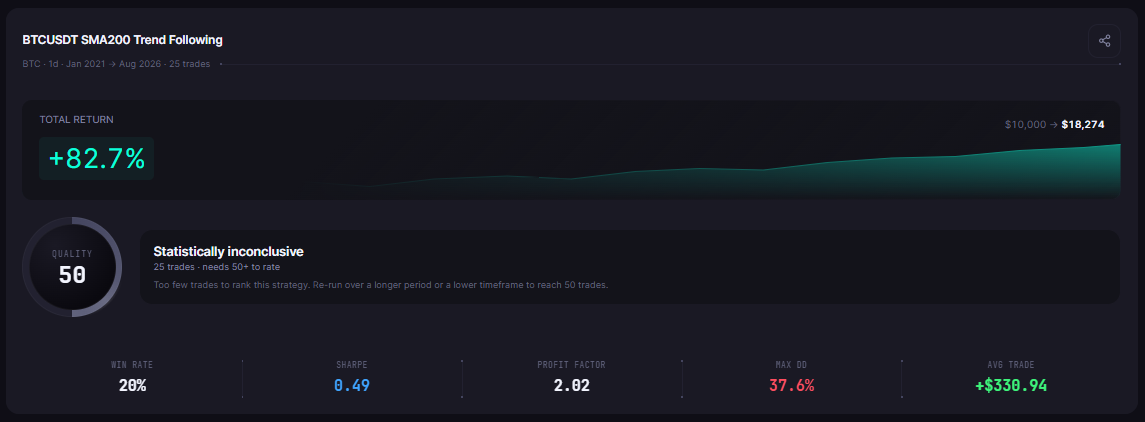
BTC Trend Following 1D 2021-2026 on BTCUSDT, 2021-01-01 to 2026-08-01: 25 trades in about five and a half years, Total Return 82.74%, Max Drawdown 37.60%, Win Rate 20.00% and Profit Factor 2.02 after fees.
Most Trades Lose Small, a Few Trends Pay
Twenty of the 25 trades lost money, and the worst lost 8.88% after fees. The five winners did the work. The best trade ran from 2023-10-16 to 2024-07-04 and returned 99.87% after fees, which is 98.62% of the strategy's whole net profit.
That is the shape of most trend rules, and a Profit Factor of 2.02 reflects it: small, frequent losses paid for by rare, large wins. In the app's equity chart for this run, the Buy and Hold line for the same 2021-01-01 to 2026-08-01 window ends at 114.18% (the line carries no fees), so holding Bitcoin made more over these years. What the rule changed was exposure: it was in the market 47.77% of the time.
What Checking Once a Day Costs You
A daily rule buys you time, and it charges for it in three ways.
- Later entries and exits: you act only after the close confirms the cross, never at the best intraday price.
- Moves between checks: a large move can happen in the hours between closes, and the rule cannot react until the next one.
- Long flat stretches: this rule made no trades at all between 2021-12-28 and 2023-01-13, and none after its last exit on 2025-11-03 through the end of the test.
The flat stretches are the hardest part. Months without a signal feel like the strategy has stopped working, which tempts people to override it.
Whipsaws are the other cost. The first trade lasted one day, from 2021-05-20 to 2021-05-21, and lost 8.26% after fees, and the longest losing streak ran to nine trades in a row. A part-time trader has to accept those runs without second-guessing the rule.
How to Test Your Own Daily Rule Before You Use It
Before you follow any daily rule with money, test it on history. In CoinQuant, an AI trading platform, the steps are:
- Write the rule in plain English: state the asset, the 1d timeframe, the entry, the exit, the capital, the position size and the fee.
- Use at least five years of daily data: daily rules trade rarely, so short windows hold too few trades to judge. Even five and a half years gave this rule only 25 trades.
- Read the trade count first: if it is small, treat every other number as provisional. CoinQuant's Quality score needs 50 or more trades to rate a strategy, so this example's 25 trades show as statistically inconclusive.
- Then read the risk: look at the Max Drawdown and the longest losing streak, and ask whether you could have sat through them.
- Check the rules panel: confirm the stored entry and exit match what you meant.
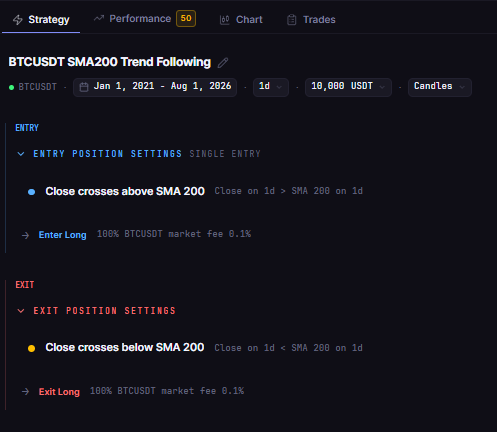
The whole of BTC Trend Following 1D 2021-2026: enter when the daily Close crosses above the SMA 200, exit when it crosses below. One check a day is enough to follow it.
Common Mistakes With Daily Rules
- Peeking intraday: acting before the close turns a daily rule into a guess.
- Judging too early: quitting during a flat stretch or a losing streak the backtest already showed.
- Testing too short a window: a year of daily data may hold only a handful of trades.
- Ignoring fees: every round trip pays twice, so count them in the test.
Timeframe matters as much as the rule. Our test of the best timeframe for crypto trading strategies shows how the same idea behaves from one minute to one month.
The Practical Lesson
- Match the rule to your hours: a daily-close rule needs one check a day.
- Expect few trades: 25 in about five and a half years, with long flat stretches.
- Expect most trades to lose: a 20.00% Win Rate still produced an 82.74% Total Return here, because a few trends paid.
- Test before you trust: read the trade count, the drawdown and the losing streaks first.
For the basics of how any rule-based approach fits together, see what a crypto trading strategy is.
Build trading strategies on real data. No coding required.
Frequently Asked Questions
What is the best crypto trading strategy if I have a full-time job?
One that acts on daily closes and trades rarely, so you only need one check a day. No strategy is best for everyone, so backtest any rule on at least five years of daily data with fees before you use it.
Can I trade crypto by checking the chart once a day?
Yes, if your rules use the daily close. The example here made 25 trades in about five and a half years, with every decision taken once a day after the close.
Do daily chart strategies work better than day trading for beginners?
They are easier to follow because they need far less screen time and produce fewer trades, which also means fewer fees. Whether they perform better depends on the rule and the market, so test both on the same data before you choose.
Write your daily rule in plain English and see how often it would have traded.
Disclaimer:
Key Takeaway