
Cardano Fell 18% From 12 to 26 October 2026: Did a Momentum Signal Beat Holding ADA Over 2021-2026?

Cardano fell 18% from 12 to 26 October 2026, the largest drop of six major coins over those two weeks. That raises an old question for any holder: in a cardano trading strategy vs buy and hold test, does a simple momentum rule do better? Over five years of daily data, a MACD rule lost 63.44% across 63 trades, while holding ADA lost 86.76%.
So the rule beat holding, but it did not make money. Its Max Drawdown was 88.56% against 95.15% for Buy and Hold, and one year, 2025, took back most of what its two winning years had earned.
This article tests one rule on ADAUSDT from 2021-08-01 to 2026-08-01, compares it with holding ADA and with holding Bitcoin, and splits the result by year. The author ran the backtests on CoinQuant and reports the results without adjustment. No tuned parameters, no cherry picked dates.
The October Fall, and Why We Test 2021-2026
The October figure comes from Binance spot daily candles for ADAUSDT (UTC days, captured 29 October 2026). From the 12 October open (0.2522) to the 26 October close (0.2067), ADA fell 18.04%. Measured the same way, it was the largest drop among BTC, ETH, SOL, XRP, BNB and ADA.
Two weeks of price action cannot tell you whether a strategy works. The backtest below uses the full window the data supports, 1 August 2021 to 1 August 2026, which covers the 2022 bear market and the years after it.
The test ends on 1 August 2026, so it does not include the October 2026 fall. The October move is the reason to ask the question, not part of the answer.
The Rule and the Settings
The rule is a classic momentum signal. It buys ADA when the MACD line (12, 26) crosses above its signal line (9) on the daily chart, and sells when the MACD line crosses back below the signal line. There is no stop loss or profit target; the reverse cross is the only exit.
| Parameter | Setting |
|---|---|
| Strategy | ADA MACD 12-26-9 Cross 1D 2021-2026 |
| Instrument | ADAUSDT (spot, Binance) |
| Data source | Kaiko via CoinQuant |
| Timeframe | Daily (1D) |
| Tested window | 2021-08-01 to 2026-08-01 |
| MACD settings | Fast 12, slow 26, signal 9 |
| Entry | MACD line crosses above the MACD signal line |
| Exit | MACD line crosses below the MACD signal line |
| Direction | Long only, no leverage, one position at a time |
| Initial capital | $10,000 |
| Position size | 100% of equity per entry |
| Fees | 0.1% on entry and 0.1% on exit (fees included, no slippage modelled) |
| Baselines (same window) | ADA Buy and Hold 1D 2021-2026; BTC Buy and Hold 1D 2021-2026 |
You can check the stored rule on the Strategy tab. It lists the entry condition above the exit condition, in plain words, together with the setup. No code was written to build it.
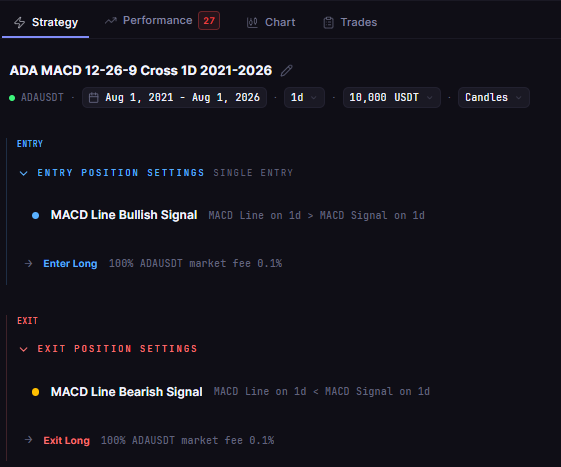
The stored MACD rule: the MACD line crossing its signal line, in and out
Cardano Trading Strategy vs Buy and Hold
The MACD rule finished more than 23 percentage points ahead of holding ADA, but both lost money. Bitcoin, held over the same window, gained 57.33%.
| Metric | MACD rule | ADA Buy and Hold | BTC Spot Comparison |
|---|---|---|---|
| Strategy | ADA MACD 12-26-9 Cross 1D 2021-2026 | ADA Buy and Hold 1D 2021-2026 | BTC Buy and Hold 1D 2021-2026 |
| Total Return | -63.44% | -86.76% | 57.33% |
| Final Balance | $3,655.70 | $1,324.39 | $15,733.43 |
| Total Trades | 63 | 1 | 1 |
| Win Rate | 28.57% (18W / 45L) | n/a (single hold) | n/a (single hold) |
| Profit Factor | 0.85 | n/a | n/a |
| Sharpe Ratio | -0.03 | -0.02 | 0.44 |
| Max Drawdown | 88.56% | 95.15% | 76.63% |
| CAGR | -18.22% | -33.24% | 9.48% |
| Total Fees | $1,052.86 | $11.32 | $25.74 |
All three runs share the same window, capital, sizing and fee, so the rows compare like with like. CAGR is the steady yearly rate that would turn $10,000 into each final balance over the five years: -18.22% a year for the rule, -33.24% for holding ADA.
Both Buy and Hold runs are single trades. Their results cards show a QUALITY number next to "Statistically inconclusive" (1 trade · needs 50+ to rate), so treat them as baselines. The ADA Buy and Hold card header shows an internal engine name rather than the library name.
Did It Make Money, or Just Lose Less?
It lost less. $10,000 became $3,655.70, a Total Return of -63.44%, after $1,052.86 in fees. Losing less than holding ADA, which lost 86.76%, is a low bar, and the rule did not clear the bar that matters most: ending with more than it started.
On the Performance tab, the results card shows 63 trades, which is enough for it to rate the run. It shows a QUALITY of 27 next to the "Outperforms" box. The bottom row explains the loss: a Win Rate of 28.57% and a Profit Factor of 0.85, so gross losses were larger than gross gains.
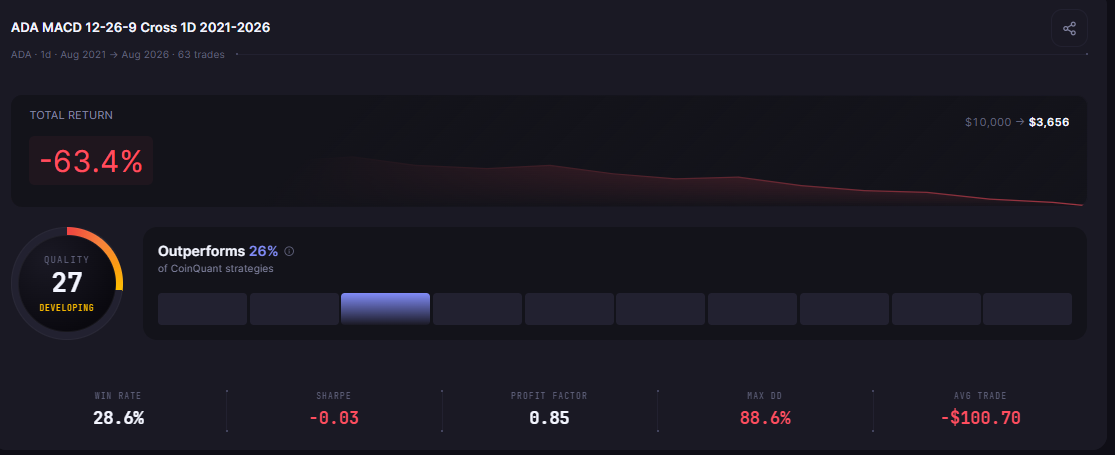
ADA MACD 12-26-9 Cross 1D 2021-2026: five years of daily Cardano, 63 trades, -63.4% Total Return, $10,000 to $3,656, QUALITY 27
The pattern is typical of a momentum rule: many small losses and a few large wins. The average win was $2,069.54 and the average loss $968.80, but 45 losing trades against 18 winners left the average trade at -$100.70.
Which Years Did the Work
The figures below are arithmetic on the trade log, after fees: each trade's Net PnL, grouped by the UTC year of its exit.
| Exit year (UTC) | Trades | Wins | Net PnL after fees |
|---|---|---|---|
| 2021 (from 1 August) | 3 | 0 | -$2,396.73 |
| 2022 | 14 | 2 | -$4,700.16 |
| 2023 | 10 | 5 | +$6,322.48 |
| 2024 | 12 | 5 | +$19,158.38 |
| 2025 | 17 | 3 | -$23,557.43 |
| 2026 (to 1 August) | 7 | 3 | -$1,170.84 |
The six years add up to -$6,344.30, the gap between $10,000 and the final balance. Two years did all the earning: 2023 made $6,322.48 and 2024 made $19,158.38. Then 2025 took back $23,557.43 with only three winners in 17 trades.
Dollar results are uneven partly because of compounding. With 100% of equity in every trade, the rule's 2025 trades ran on a much bigger balance after the 2024 gains, so the same percentage loss cost more dollars. Read the table as when the money was made and lost, not as a measure of how well the signal worked each year.
What This Test Cannot Tell You
This is one coin, one rule and one window on daily bars, so it settles nothing on its own. Fees are included at 0.1% on entry and exit, with no slippage modelled; the rule is long only, one position, no leverage.
- Data note: ADAUSDT daily data on CoinQuant is missing 2021-09-12 to 2021-09-14, and the platform does not flag it. The MACD rule's first trade started on 3 October 2021, so none of its trades spans the gap; the Buy and Hold position does.
- October 2026: the test ends on 1 August 2026 and says nothing about how the rule would have handled the October fall.
- Other settings: a different MACD setting or a trend filter could change the result, and testing many of them invites overfitting.
For a wider view of rules against holding, see active trading vs buy and hold in crypto. For other Cardano tests, see the ADA RSI strategy backtest and the adaptive moving average strategy on Cardano.
The Practical Lesson
- Losing less is not profit: -63.44% beat -86.76%, but $10,000 still became $3,655.70.
- One year decided the outcome: 2025 cost $23,557.43 after 2024 made $19,158.38.
- Check the baseline you care about: holding Bitcoin returned 57.33% over the same five years.
CoinQuant, an AI trading platform, lets you change the coin, the MACD settings or add a second condition in plain English, then rerun the same five years. The builder joins conditions with And, so a trend filter is one more condition in the same request.
Build trading strategies on real data. No coding required.
Frequently Asked Questions
Is Cardano a good long-term hold?
Over 1 August 2021 to 1 August 2026, holding ADA lost 86.76%, with a Max Drawdown of 95.15%, including fees. Past results do not predict future returns, and this is not investment advice.
Does MACD work on Cardano?
In this test the MACD (12, 26, 9) cross lost 63.44% over 63 trades on daily ADA data. It lost less than holding ADA, but it did not make money.
Why compare a strategy with buy and hold?
Buy and Hold shows what you would have earned by doing nothing. A rule that cannot beat it after fees adds work without adding value, and a rule that beats it while still losing money, as here, needs a second look.
Change the coin or the settings and see whether the result holds.
Disclaimer:
Key Takeaway