
Bitcoin Funding Rate Meaning: What a Spot Backtest Leaves Out If You Trade Perpetuals

The Bitcoin funding rate is a small payment that passes between long and short traders of a perpetual futures contract, usually every eight hours. When the rate is positive, longs pay shorts; when it is negative, shorts pay longs. That is the whole bitcoin funding rate meaning, and it matters because a spot backtest, on CoinQuant (an AI trading platform) or anywhere else, never charges it.
The gap can be large. Over five years, from 1 August 2021 to 1 August 2026, the 5,478 Binance BTCUSDT perpetual funding prints added up to 37.63% of position value for a long held the whole time (simple sum, method below). Our spot benchmark, BTC Buy and Hold 1D 2021-2026, returned 57.33% after fees over the same dates.
This is the funding rate explained for crypto traders who test on spot and trade perpetuals. The author ran the backtest on CoinQuant; the funding figures come from Binance's public funding history, with the method stated.
Bitcoin Funding Rate Meaning: What the Funding Rate Is
A perpetual future is a contract that tracks a coin's price but never expires. Funding is what pulls its price back toward the spot market.
Binance's funding rate FAQ (last updated 6 March 2026, read 3 November 2026) defines it this way: "Funding rates are periodic payments transferred between holders of long and short positions in Perpetual Contracts."
- Positive rate: longs pay shorts. The FAQ links this to a bullish market.
- Negative rate: shorts pay longs, which the FAQ links to a bearish market.
- Interval: by default every eight hours, at 00:00, 08:00 and 16:00 UTC.
- Amount: the position's nominal value times the rate. A 0.01% print on a $10,000 position is $1.
- Open positions only: "If you do not have a position, you are not liable for any funding."
Binance can switch a contract to a one hour interval in extreme conditions, and other exchanges set their own rules.
Late October 2026, as a Dated Example
Binance publishes every print in its USDⓈ-M funding rate history, read on 3 November 2026. From 26 October to 1 November 2026 (UTC), BTCUSDT perpetual funding printed 21 times.
| Measure | BTCUSDT perpetual, 26 Oct to 1 Nov 2026 (UTC) |
|---|---|
| Funding prints | 21 |
| Average per print | 0.00805% |
| Highest print | 0.01% |
| Lowest print | 0.001713% |
| Negative prints | 0 |
| Average at a yearly pace (simple) | 8.81% |
Longs paid shorts at all 21 settlements that week. The yearly pace is the average print times three prints a day times 365 days, with no compounding.
Funding can also flip. Binance ETHUSDT perpetual funding printed below zero at seven settlements in a row, from 30 October 2026 at 00:00 UTC to 1 November 2026 at 00:00 UTC, with a low of -0.013577% on 31 October 2026 at 00:00 UTC. At those settlements, shorts paid longs.
These are readings of one dated week, not a guide to any other week.
Why a Spot Backtest Does Not Include Funding
A spot backtest buys the coin itself. There is no perpetual contract, so there is no funding to pay or receive: the result is price moves minus trading fees.
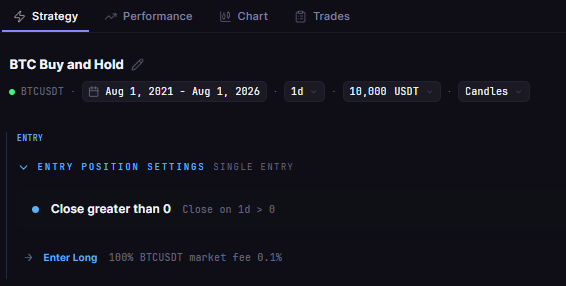
Our worked example is stored that way. BTC Buy and Hold 1D 2021-2026 trades BTCUSDT on Binance spot data (Kaiko via CoinQuant), with $10,000, 100% of equity and a 0.1% fee on entry and exit. Its one entry rule fires on the first daily bar; the position closes when the test ends.
Spot vs Perpetual Backtest: What Changes
| Item | Spot backtest | Perpetual position |
|---|---|---|
| What you hold | The coin | A contract that tracks the coin's price |
| Funding | None | Paid or received at each settlement |
| Price used | Spot candles | Contract price, with funding charged on the mark price |
| Position size | Up to the cash you hold | Can exceed the margin; funding grows with the position |
For what a bigger position does to a spot result, see spot vs leveraged crypto trading on BNB. On the Strategy tab, our example's stored rule is one entry line on BTCUSDT.
Worked Example: Funding on a Five-Year Hold
Here is the example strategy in plain English, as you would type it into CoinQuant:
Buy BTCUSDT on the daily chart on the first bar with 100% of equity and hold to the end of the test. Test from August 1, 2021 to August 1, 2026 with $10,000 and a 0.1% fee on entry and exit.
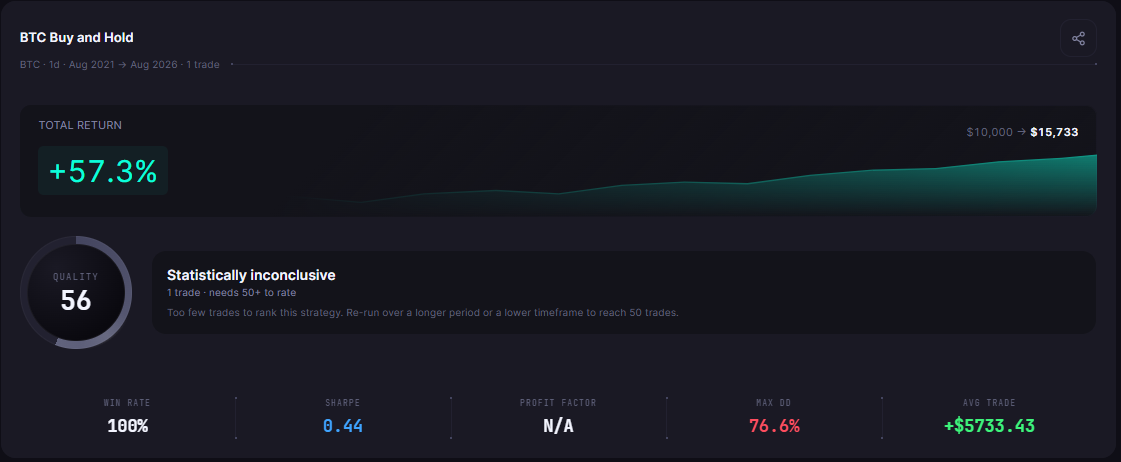
| Metric | BTC Buy and Hold (spot) |
|---|---|
| Strategy | BTC Buy and Hold 1D 2021-2026 |
| Total Return | 57.33% |
| Final Balance | $15,733.43 |
| Total Trades | 1 |
| Max Drawdown | 76.63% |
| Sharpe Ratio | 0.44 |
| Total Fees | $25.74 |
| Time in Market | 100.00% |
Then add the funding a 1x perpetual long would have paid over the same dates. The method: add every BTCUSDT funding print from 1 August 2021 00:00 UTC up to 1 August 2026 00:00 UTC.
| Measure | BTCUSDT perpetual funding, same five years |
|---|---|
| Funding prints | 5,478 |
| Negative prints | 801 |
| Sum of all prints | 37.63% |
| On a constant $10,000 position | $3,763.12 |
The sum nets the 801 negative prints against the positive ones. It assumes the position stayed at $10,000, which a real hold does not: funding follows the position's value, and this hold fell 76.63% from its peak on 8 November 2021 to its low on 21 November 2022. Even as a rough figure, $3,763.12 is more than half of the $5,733.43 the spot hold gained after fees.
On the Performance tab, the results card marks this run "Statistically inconclusive" (1 trade · needs 50+ to rate) next to its QUALITY of 56. A single hold is a baseline, not a strategy to rate.
Scaling It for Any Strategy
A rule pays funding only while a position is open. So a quick estimate is the sum of funding prints over the window, times the share of time the rule held a position.
- Test the rule on spot: build it in CoinQuant with fees included, as in the quote above. No coding required.
- Measure time in market: on the Trades tab, add up the days between each Entry row and its Exit row, then divide by the days in the test. The hold above was in the market 100.00% of the time.
- Get the funding history: download the prints for the same pair and dates from your exchange.
- Scale it: multiply the sum of prints by the share from step 2. For a closer figure, add only the prints that fall inside each open trade.
- Compare: subtract the estimate from the spot result, then compare it with holding.
A rule in the market about half the time would pay roughly half the funding of a full hold, if funding was spread evenly. It rarely is, so the sum in step 4 is the better check. For how active rules compare with holding, see active trading vs buy and hold in crypto.
Common Mistakes When Adding Funding
- Using one week for five years: the late October average is a dated reading, not a constant.
- Forgetting negative prints: 801 of the 5,478 five-year prints paid longs.
- Ignoring position size: funding is charged on position value, so a larger position pays more.
- Treating funding as an exchange fee: Binance's FAQ says it "does not charge fees on Funding Payments"; traders pay each other.
Limits
The method gives an estimate, not a second backtest:
- Funding changes at every settlement: past prints do not predict later ones.
- Constant position value: the simple sum ignores how the position's value moves with the mark price.
- Contract vs spot price: a perpetual can trade away from spot, so the price result can differ too.
- One venue, one pair: other exchanges publish their own rates and intervals.
- Backtest costs: fees included, no slippage modelled.
The spot hold also fell 76.63% at its worst. For how to read that number, see Maximum Drawdown in crypto trading.
The Practical Lesson
- Spot results leave out funding: a perpetual position's result can differ.
- Time is the multiplier: a full five-year BTCUSDT long would have paid about 37.63% of a constant position value in funding.
- Add it yourself: sum the prints for the dates your rule held a position, then compare with the spot result.
If you test on spot and trade perpetuals, the longer you hold, the bigger the gap between the backtest and your account.
Build trading strategies on real data. No coding required.
Frequently Asked Questions
What does the Bitcoin funding rate mean?
It is a periodic payment between long and short holders of a Bitcoin perpetual contract that keeps its price close to spot. On Binance the default interval is every eight hours.
Who pays funding, longs or shorts?
When the rate is positive, longs pay shorts; when it is negative, shorts pay longs. All 21 BTCUSDT prints from 26 October to 1 November 2026 were positive, so longs paid.
Does a spot backtest include funding?
No. A spot backtest holds the coin, not a perpetual contract, so there is no funding to pay or receive. BTC Buy and Hold 1D 2021-2026 returned 57.33% after fees, with no funding in that figure.
Test your rule on spot first, then add the funding for the dates it held.
Disclaimer:
Key Takeaway