
Weekend vs Weekday Crypto Trades: What One XRP Backtest's Trade Log Shows (2021-2026)

Weekend vs weekday crypto trading sounds like a simple question, so we tested it on a real trade log. Grouped by the UTC date of each entry, one XRP rule's 363 weekday trades netted -$1,716.62 and its 120 weekend trades netted -$970.42. Group the same 483 trades by exit date instead, and weekend exits made +$9,785.12 while weekday exits lost $12,472.17.
The answer flips with the date you pick, so the split is not a reliable edge. The strategy itself also lost money: -26.87% over five years, with a Max Drawdown of 90.70%, while holding XRP returned 46.13%.
This page compares weekday and weekend trades from one backtest, shows how the grouping changes the result and lists what a day of week split can and cannot tell you. The author ran the backtests on CoinQuant and reports the results without adjustment.
Weekend vs Weekday Crypto Trading: Why Weekends Might Differ
Crypto markets never close. There is no Friday bell and no Monday open, so a daily strategy can enter or exit on a Saturday just as easily as on a Tuesday. For the wider effects of a market that never closes, see crypto backtesting vs stock backtesting.
Many traders still believe weekends behave differently. A CryptoPotato report of 24 October 2026 put it this way: "most weekends are typically quite sluggish for the crypto market". The same report said bearish momentum "came out to play on Saturday once again" as Bitcoin fell to "a 9-day low".
Here is what this article tests, and what it does not:
- Tested: whether trades from one rule on daily XRP data made or lost more money when they started (or ended) on a Saturday or Sunday.
- Not tested: weekend volatility, weekend volume or order book depth. A trade log cannot measure those.
- Not claimed: that CoinQuant has a weekday filter. The split is our arithmetic on the exported trade log.
The Strategy and the Date Basis
The rule buys XRP when the Volume Pressure Index (period 20) crosses above zero and sells when it crosses back below zero. It holds one long position at a time. It also trades often: 483 trades in five years, or 59 to 85 on each day of the week.
| Parameter | Setting |
|---|---|
| Strategy | XRP Volume Pressure Index 20 Zero Cross 1D 2021-2026 |
| Instrument | XRPUSDT (spot, Binance) |
| Data source | Kaiko via CoinQuant |
| Timeframe | Daily (1D) |
| Tested window | 2021-08-01 to 2026-08-01 |
| Entry | Volume Pressure Index (period 20) crosses above 0 |
| Exit | Volume Pressure Index (period 20) crosses below 0 |
| Direction | Long only, no leverage, one position at a time |
| Initial capital | $10,000 |
| Position size | 100% of equity per entry |
| Fees | 0.1% on entry and 0.1% on exit (fees included, no slippage modelled) |
| Date basis | UTC date of the entry order; weekend = Saturday and Sunday |
The date basis matters, so we fix it up front: each trade belongs to the UTC day of its entry order. The Trade Log on the Trades tab lists orders, not trades, so every trade has an Entry row and an Exit row, each with its own UTC date. This run has 966 order rows for 483 trades.
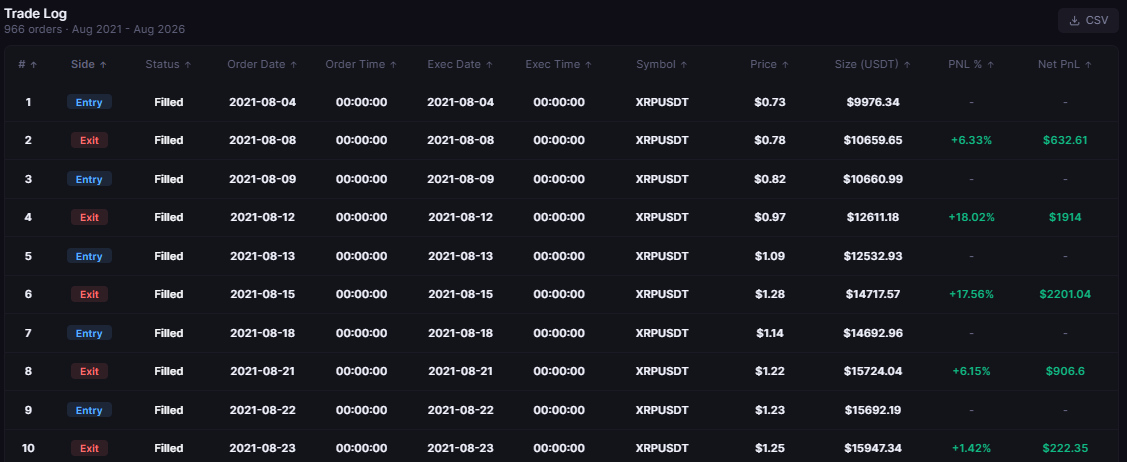
Every order row carries a UTC date: order rows 1 to 10 of XRP Volume Pressure Index 20 Zero Cross 1D 2021-2026, Entry and Exit rows from 4 to 23 August 2021, all Filled (966 orders, times UTC)
Monday to Sunday: The Table
The figures below are arithmetic on the trade log, after fees: each trade's Net PnL, grouped by the UTC weekday of its entry order.
| Entry day (UTC) | Trades | Wins | Win Rate | Net PnL after fees |
|---|---|---|---|---|
| Monday | 85 | 28 | 32.94% | -$2,760.57 |
| Tuesday | 71 | 29 | 40.85% | +$756.10 |
| Wednesday | 66 | 16 | 24.24% | -$3,738.21 |
| Thursday | 62 | 27 | 43.55% | +$1,993.44 |
| Friday | 79 | 26 | 32.91% | +$2,032.63 |
| Saturday | 59 | 19 | 32.20% | -$1,547.12 |
| Sunday | 61 | 26 | 42.62% | +$576.70 |
| Monday to Friday | 363 | 126 | 34.71% | -$1,716.62 |
| Saturday and Sunday | 120 | 45 | 37.50% | -$970.42 |
By entry date, both groups lost money. Weekend entries had the higher Win Rate (37.50% vs 34.71%) and the smaller loss, but the gap is narrow and each day holds only 59 to 85 trades.
The counts add up to the card. The results card on the Performance tab shows 483 trades, a Total Return of -26.9% and $10,000 ending at $7,313, and the 363 plus 120 trades in the table are the same 483. The last of them, trade 483, opened and closed on Saturday 1 August 2026, the final day of the test, so it is a weekend trade under either date basis.
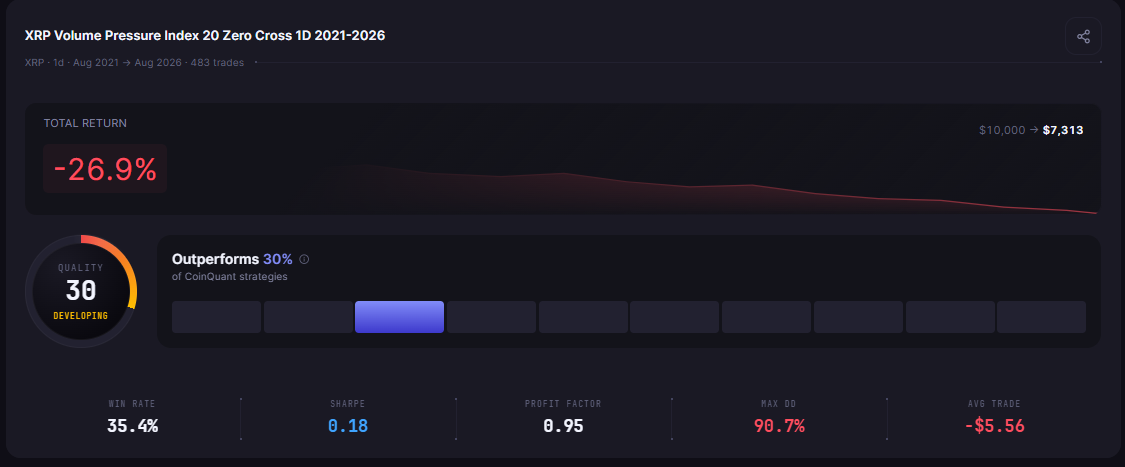
XRP Volume Pressure Index 20 Zero Cross 1D 2021-2026: 483 trades on five years of daily XRP, -26.9% Total Return, $10,000 to $7,313, QUALITY 30
Why the Date Basis Matters
A trade that enters on Friday and exits on Saturday is a weekday trade by entry date and a weekend trade by exit date. Change the rule for which date counts, and hundreds of trades switch groups.
That is exactly what happens here. Grouped by the UTC date of the exit order, weekend exits made money and weekday exits lost it:
| Dimension | Grouped by UTC entry date | Grouped by UTC exit date |
|---|---|---|
| XRP weekday trades | 363 trades, -$1,716.62 | 336 trades, -$12,472.17 |
| XRP weekend trades | 120 trades, -$970.42 | 147 trades, 56 wins, +$9,785.12 |
| BNB weekday trades | 360 trades, +$8,151.30 | 348 trades, -$2,842.96 |
| BNB weekend trades | 122 trades, -$115.24 | 134 trades, +$10,879.03 |
| Which group looks better | XRP: weekend (smaller loss). BNB: weekday | Weekend, on both coins |
| Where to find it in CoinQuant | Order Date of the Entry rows on the Trades tab | Order Date of the Exit rows on the Trades tab |
| Verdict | The answer depends on the grouping, so it is not a reliable edge | Same verdict: the answer follows the bookkeeping choice |
The BNB rows come from the same rule on BNB, BNB Volume Pressure Index 20 Zero Cross 1D 2021-2026 (482 trades, Total Return 80.36%). Its trades were first read in how a volume pressure rule traded BNB through the 2022 rate hikes. On BNB the entry date favours weekdays and the exit date favours weekends, so by entry date the two coins do not even agree on which days look better.
Why do exits lean towards weekends? One reading is that a trade's profit is booked on the day it closes, so the exit date collects the result of every move that happened while the trade was open. That is an explanation, not a tested cause.
What This Does and Does Not Let You Do
A trade log split is a check you can repeat on any backtest. It is not proof that a weekday or weekend effect exists.
| Where a day of week split helps | Where it misleads |
|---|---|
| Spotting whether one day carries a large share of the profit or loss | Treating a result that flips with the date basis as an edge |
| Checking that the grouped counts add back to the card (483 trades here) | Reading meaning into samples of 59 to 85 trades per day |
| Asking a sharper question for the next test | Assuming CoinQuant can filter entries by weekday (this test claims no such feature) |
Keep the context in view as well. Holding XRP over the same window, XRP Buy and Hold 1D 2021-2026, returned 46.13% with a Max Drawdown of 77.87% from a single trade. Its results card shows its QUALITY number next to "Statistically inconclusive" (1 trade · needs 50+ to rate). The rule lost 26.87%, so neither weekday nor weekend trades rescued it.
All runs charge 0.1% on entry and 0.1% on exit, with fees included and no slippage modelled; long only, one position, no leverage. Data note: XRPUSDT daily data on CoinQuant is missing 2021-09-09 to 2021-09-15, and the platform does not flag it. One trade (entered 8 September 2021, exited 16 September 2021) spans that gap.
The Practical Lesson
- The date basis decides the answer: by entry date both groups lost; by exit date weekends made +$9,785.12.
- Check the total first: the split must add back to the card's 483 trades and -$2,687.04 net.
- Small samples: 59 to 85 trades per day are too few to settle a calendar effect.
CoinQuant, an AI trading platform, lets you describe a rule in plain English, run it on years of data and read every order in the Trades tab. When you test a calendar idea, write down the date basis before you look at the numbers.
Build trading strategies on real data. No coding required.
Frequently Asked Questions
Is crypto more volatile on weekends?
This test did not measure volatility; it measured the results of one rule's trades. A CryptoPotato report of 24 October 2026 described most weekends as "typically quite sluggish", yet the same report covered a Saturday sell off that weekend.
Should I avoid trading crypto on weekends?
Not on the strength of this backtest. By entry date the weekend trades lost $970.42 and the weekday trades lost $1,716.62, and by exit date the weekend trades made money, so the evidence points both ways.
Does a backtest use UTC dates?
In CoinQuant the Trade Log on the Trades tab shows order dates and times in UTC. An order at 9 pm on a Friday in New York falls on Saturday in UTC, and one at 2 am on a Saturday in Dubai falls on Friday in UTC, so state the time zone before you group trades by day.
Run the same weekday check on your own trade log before you trust a calendar pattern.
Disclaimer:
This content is for educational and informational purposes only and does not constitute financial, investment, or trading advice. All strategies and examples are for illustrative purposes and do not guarantee results. Always conduct your own research before making financial decisions.