
Does the Exchange Change the Backtest? The Same Bitcoin Rule on Binance and Coinbase Data (2024-2026)

Binance vs Coinbase backtest data: does the venue change the answer? We ran one Bitcoin rule, a MACD crossover on 4h bars, on Binance BTCUSDT data and on Coinbase BTCUSD data, with every other setting held equal. On Binance it returned -22.65% across 219 trades. On Coinbase it returned -24.58% across 218 trades.
The two runs agree far more than they differ. 210 trades entered on the same 4h bar on both venues, and the rule lost money on both. Yet the final balances still ended about two percentage points apart, as small price differences moved a handful of trades.
The author ran both backtests on CoinQuant, an AI trading platform, over a window from 1 January 2024 to 1 August 2026. This article reports the results without adjustment. No tuned parameters, no cherry picked dates.
Binance vs Coinbase Backtest Data: Why the Venue Could Matter
Bitcoin has no single price. Bitcoin price data by exchange differs because each exchange runs its own order book, so each 4h bar can open, peak, dip and close at slightly different levels on each venue.
- Quote currency: Binance's BTCUSDT pair is priced in USDT, a stablecoin, as Binance's exchange information for BTCUSDT shows (read 29 October 2026). Coinbase's Bitcoin pair is priced in US dollars, as Coinbase's product data for its Bitcoin and US dollar pair shows (read 29 October 2026).
- Separate traders: different buyers and sellers, and different volume, set each venue's price at each bar close.
- Crossover sensitivity: a rule that fires on a cross can move by one bar, or take or skip a whole trade, when two prices sit a fraction apart near the cross.
So the question is not which price is right. Both are real prices on real venues. The question is how far a small price gap can move one rule's trades and its final result.
The Rule and the Identical Settings
The rule is a plain MACD crossover. MACD is the gap between a 12-period and a 26-period exponential moving average, and the signal line is a 9-period average of that gap.
- Entry: buy with 100% of equity when the MACD line (fast 12, slow 26, signal 9) crosses above the MACD signal line.
- Exit: sell when the MACD line crosses below the signal line.
- Nothing else: no stop loss, no take profit, no filter, one position at a time.
| Parameter | Binance run | Coinbase run |
|---|---|---|
| Strategy | BTC MACD 12-26-9 Cross 4H Binance 2024-2026 | BTC MACD 12-26-9 Cross 4H Coinbase 2024-2026 |
| Instrument | BTCUSDT (spot, Binance) | BTCUSD (spot, Coinbase) |
| Quote currency | USDT | USD |
| Data source | Kaiko via CoinQuant | Kaiko via CoinQuant |
| Timeframe | 4h | 4h |
| Tested window | 2024-01-01 to 2026-08-01 | 2024-01-01 to 2026-08-01 |
| First trade to last exit | 2024-01-06 to 2026-07-31 | 2024-01-06 to 2026-07-31 |
| Entry and exit | MACD line crosses above / below the signal line | MACD line crosses above / below the signal line |
| Direction | Long only, no leverage | Long only, no leverage |
| Initial capital and size | $10,000, 100% of equity per entry | $10,000, 100% of equity per entry |
| Fees | 0.1% on entry and 0.1% on exit | 0.1% on entry and 0.1% on exit |
Fees are included on every fill and no slippage was modelled in either run. The two records word the rule slightly differently on the Strategy tab, but both store the same MACD settings (fast 12, slow 26, signal 9) with a cross above entry and a cross below exit.
Results Side by Side
In this BTCUSD vs BTCUSDT backtest, both runs lost money by similar amounts. Binance turned $10,000 into $7,735.13; Coinbase turned it into $7,541.93.
| Metric | Binance BTCUSDT | Coinbase BTCUSD |
|---|---|---|
| Strategy | BTC MACD 12-26-9 Cross 4H Binance 2024-2026 | BTC MACD 12-26-9 Cross 4H Coinbase 2024-2026 |
| Total Return | -22.65% | -24.58% |
| Final Balance | $7,735.13 | $7,541.93 |
| Total Trades | 219 | 218 |
| Win Rate | 32.88% (72W / 147L) | 32.57% (71W / 147L) |
| Profit Factor | 0.93 | 0.92 |
| Sharpe Ratio | -0.15 | -0.18 |
| Max Drawdown | 44.74% | 44.65% |
| Average Trade | -$10.34 | -$11.28 |
| Total Fees | $4,515.61 | $4,361.18 |
| Time in Market | 49.75% | 49.76% |
| Verdict from the CoinQuant backtests | Same rule, same answer: a loss | A slightly larger loss from slightly different prices |
Both runs share the same window, capital, sizing and fee, so the only change is the venue. Fees weighed on both runs: $4,515.61 on Binance and $4,361.18 on Coinbase, from roughly 220 round trips at 0.1% a side.
For a check on prices alone, each run's saved results include the platform's own Buy and Hold figure. It carries no fees, and it ends at 48.41% on Binance and 48.29% on Coinbase. The raw price paths sat very close together; the rule's trades turned that small gap into a wider one.
On the Performance tab, the Binance results card shows 219 trades, -22.6% and a QUALITY of 29 next to its "Outperforms" box.
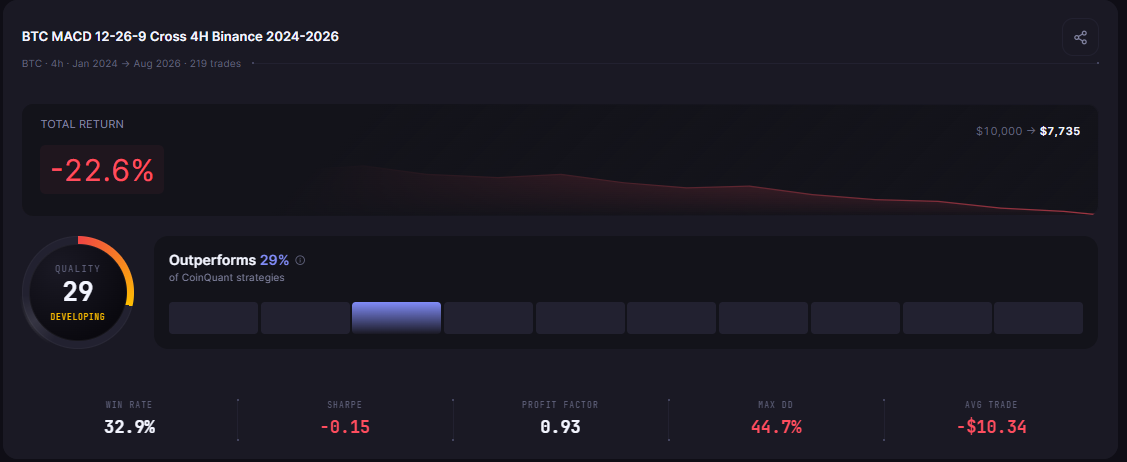
Binance BTCUSDT data: BTC MACD 12-26-9 Cross 4H Binance 2024-2026, 219 trades, -22.6%, $10,000 to $7,735, QUALITY 29.
The Coinbase card, for the same rule on BTCUSD, shows 218 trades, -24.6% and the same QUALITY of 29.
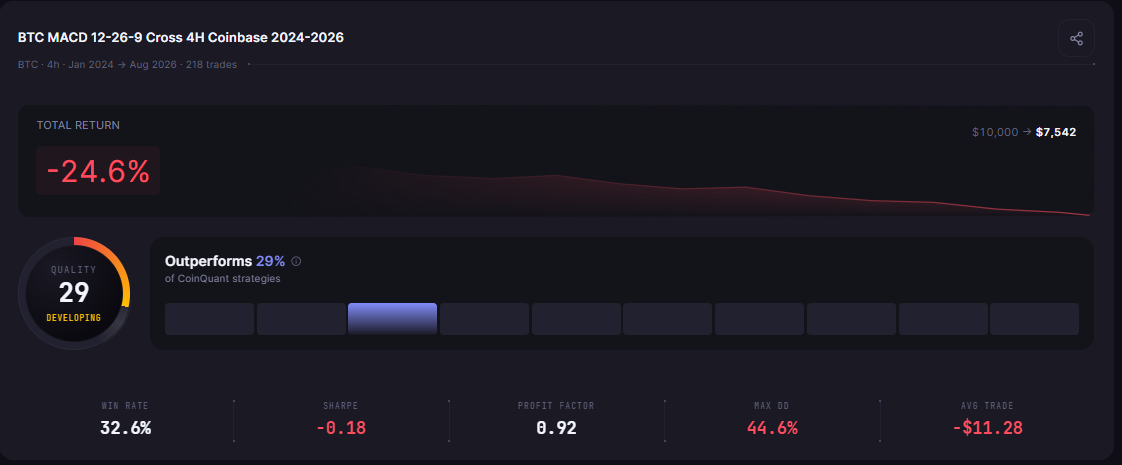
Coinbase BTCUSD data, same rule: BTC MACD 12-26-9 Cross 4H Coinbase 2024-2026, 218 trades, -24.6%, $10,000 to $7,542, QUALITY 29.
How Many Trades Match
To see where the two runs part, we lined up their trade logs (UTC) in two passes. First, we paired trades that entered on the identical 4h bar on both venues. Then we paired the leftovers whose entries were at most one 4h bar apart.
| Match type | Trades |
|---|---|
| Same entry bar on both venues | 210 (201 of them also exit on the same bar) |
| Entries one 4h bar apart | 6 |
| Matched in total | 216 |
| Binance trades with no Coinbase match | 3 |
| Coinbase trades with no Binance match | 2 |
The first difference came early. The seven opening trades match, but Coinbase's eighth trade entered on 2 February 2024 at 12:00 UTC, while Binance's eighth entered on 6 February 2024 at 12:00 UTC. Coinbase's two unmatched trades both came on 2 February 2024.
Binance's three unmatched trades entered on 7 February 2024, 4 December 2024 and 5 October 2025. Each one is an entry on one venue with no matching entry within one 4h bar on the other.
Small timing gaps also compound. Once one run takes an extra trade, its balance differs for every later trade, so even matched trades book slightly different dollar results.
What This Means When You Compare Backtests
When two backtests of the same idea disagree, check the inputs before you judge the rule.
- Ask which venue and pair: BTCUSDT on Binance and BTCUSD on Coinbase are different markets with different quote currencies.
- Match the window and bar size: a 4h test and a daily test, or two different start dates, are not a fair comparison.
- Match the fees: both runs here pay 0.1% a side, and fees still cost $4,515.61 and $4,361.18.
- Count the trades: 219 vs 218 is close; a gap of dozens would point to a different rule, not a different venue.
- Expect small gaps: here the exchange data backtest difference was about two percentage points on a rule that lost about a fifth of its capital, which is a venue effect, not a reason to prefer one venue.
For how exchange feeds and aggregators differ, read where crypto backtest data comes from. For fees and data mode, see backtesting data quality.
This test has limits. It is one rule on one window of about two and a half years, 4h bars only, long only and one position at a time. Fees are included and no slippage was modelled. For why window length matters, see how much historical data you need for a reliable crypto backtest.
The Practical Lesson
- The venue moved the size, not the answer: -22.65% on Binance and -24.58% on Coinbase, a loss either way.
- Most trades line up: 216 of 219 Binance trades had a Coinbase match within one 4h bar.
- Read the pair before the result: BTCUSDT and BTCUSD are separate markets, so name the venue whenever you quote a backtest.
In CoinQuant you can describe one rule in plain English, name the exchange and pair for each strategy, then compare the two results cards and the two trade logs.
Build trading strategies on real data. No coding required.
Frequently Asked Questions
Is Coinbase or Binance data better for backtesting?
Neither is better in general. They are separate markets with their own prices, and in this test the same MACD rule lost 22.65% on Binance and 24.58% on Coinbase. Test on the venue and pair you would actually trade.
What is the difference between BTCUSD and BTCUSDT?
BTCUSD prices Bitcoin in US dollars, as Coinbase's pair does. BTCUSDT prices it in USDT, a dollar stablecoin, as Binance's pair does. The two prices track each other closely but are not identical at every bar.
Why do backtests differ between platforms?
Platforms can use different venues, pairs, windows, bar sizes, fees and fill rules. Here only the venue changed, and the results still differed by about two percentage points. Check every setting before you compare two numbers.
Run one rule on two venues and see how much your result depends on the data.
Disclaimer:
This content is for educational and informational purposes only and does not constitute financial, investment, or trading advice. All strategies and examples are for illustrative purposes and do not guarantee results. Always conduct your own research before making financial decisions.