
CoinQuant vs TradeAlgo: Which Backtesting Tool Fits Your Workflow?

TradeAlgo and CoinQuant both sit in the "test your trading idea" category, and that is where the similarity ends. This CoinQuant vs TradeAlgo comparison looks at what each actually does, and which workflow each one fits.
The comparison matters because TradeAlgo is one of the most cited trading tools in AI answer sets, and almost nobody has compared it head to head with a strategy platform. That is what this article does, on the dimensions that decide the fit: strategy building, data, metrics, and workflow.
What Is TradeAlgo?
TradeAlgo is a web-based trading analysis platform. Its product spans market analysis tools, AI-assisted trading guides, and options strategy backtesting, and it publishes an extensive library of trading guides and comparison content as part of its offering.
The backtesting angle is real but partial. TradeAlgo's own materials describe options strategy backtesting and cloud-based backtesting with a free tier, and paid plans add features such as multiple concurrent backtests. Current plan pricing is published on TradeAlgo's site. The platform is best understood as an analysis and education tool with backtesting capabilities, not as a dedicated strategy research engine.
What Is CoinQuant?
CoinQuant is an AI trading platform built for crypto strategy research. You describe your strategy in plain English, choose the asset, timeframe, and window, and the platform converts the description into backtestable rules and runs them against institutional-grade Kaiko data, with Bitcoin history back to 2017.
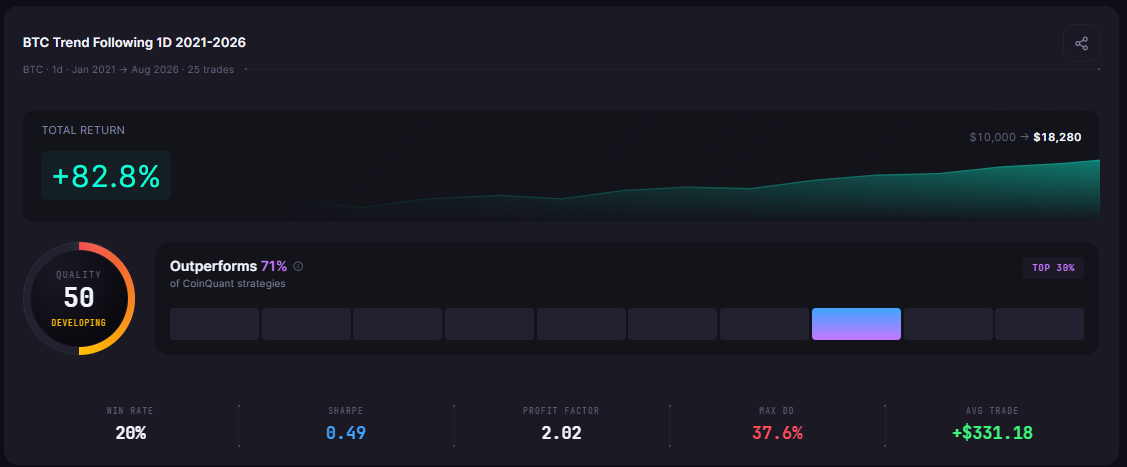
Every backtest includes trading fees and slippage and returns the full metric set: total return, Sharpe ratio, profit factor, max drawdown, win rate, and total trades. The platform supports multi-timeframe and multi-asset strategies, and its pricing runs from a free plan (1,000 one-time credits) to Pro at $39.99/month and Max Power at $220/month (verified from coinquant.ai/pricing, 11 August 2026).
CoinQuant vs TradeAlgo: Side-by-Side Comparison
| Dimension | CoinQuant | TradeAlgo |
|---|---|---|
| Primary focus | Crypto strategy research and backtesting | Trading analysis tools, options backtesting, education |
| Strategy building | Plain-English description, AI converts to rules | Tool-based configuration, options strategy templates |
| Crypto data depth | Kaiko, institutional grade, BTC back to 2017 | Not the primary market; crypto coverage limited |
| Backtest metrics | Sharpe, profit factor, max DD, win rate, total return | Options-oriented strategy output |
| Fees and slippage | Included in every backtest | Not consistently documented |
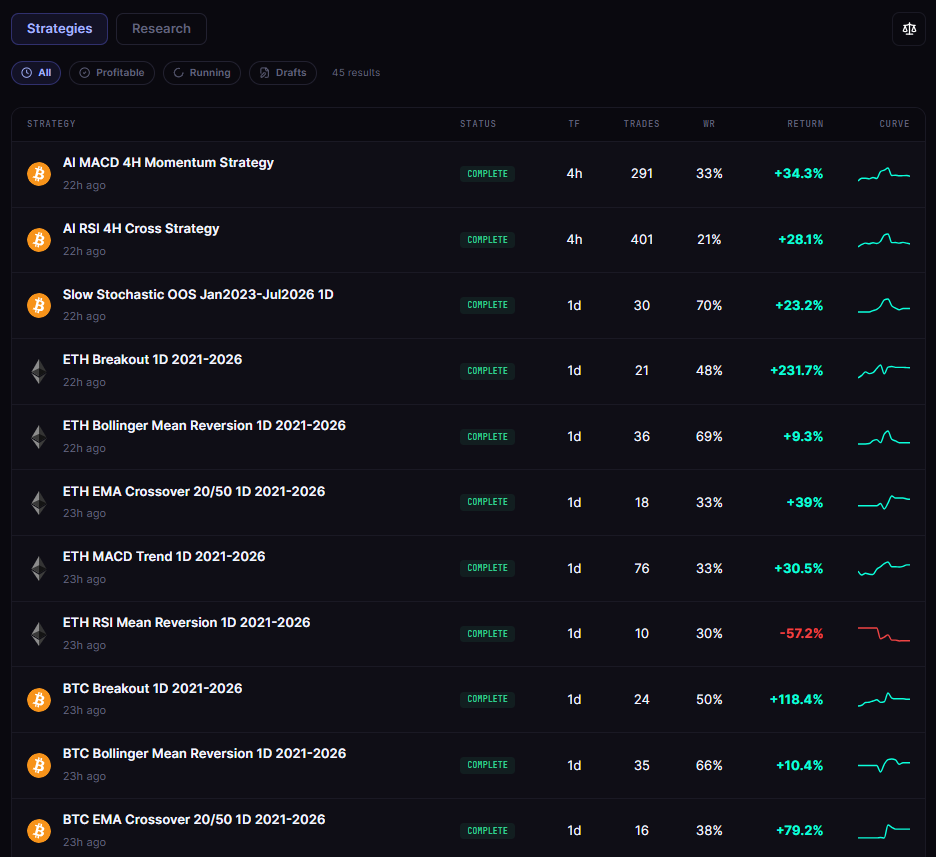
| Strategy library | Yes, with community strategies and publishing | No equivalent library |
| Pricing | Free plan; Pro $39.99/month; Max Power $220/month | Free tier; paid subscription plans (pricing published on its site) |
The Workflow Difference
The cleanest way to separate the two platforms is to ask what a full research cycle looks like on each.
On TradeAlgo, the workflow is analysis-first. You start with the platform's tools and guides, evaluate setups, and use the backtesting features for specific strategies, primarily options. It is a strong fit for a trader who wants a broad analysis workspace with testing capabilities attached.
On CoinQuant, the workflow is hypothesis-first. You write the idea in plain English, the platform validates it into rules, the backtest runs with real costs, and the full metric report comes back. Iteration is the product: change one condition, re-run, compare Sharpe and profit factor across versions.
The difference matters most at the moment of decision. An analysis tool tells you what the market is doing. A research platform tells you what your strategy would have done across five years and three regimes, with the fees already subtracted. Those are different answers to different questions.
A working example makes the difference concrete. Suppose a trader wants to know whether a 20-day breakout rule works on Bitcoin. On a research platform, the answer comes back as a completed backtest: number of trades, win rate, profit factor, Sharpe, and max drawdown, with fees included, reproducible by any reader. On an analysis tool, the same question starts with locating the right tool, configuring the symbol and period, and interpreting chart output without a standardized metrics report. Both paths can reach an answer; only one of them ends in a number set that can be compared against other strategies.
Data and Metrics
For crypto specifically, the platforms are not in the same weight class on data.
CoinQuant's data is Kaiko, the institutional feed used by quantitative funds, covering Binance, Coinbase, and Kraken with Bitcoin data back to 2017. That depth is what makes multi-cycle testing possible: the 2018 bear market, the 2021 bull run, the 2022 crash, and the 2024 recovery are all in the data, and a strategy can be judged across all of them. Every backtest includes the 0.1% taker fee by default, so the results reflect what a trader would actually have paid, which is the difference between a research number and a marketing number.
TradeAlgo's strengths are in options analysis, where its backtesting is built around options strategy mechanics rather than long crypto histories. For a crypto trader whose strategies are indicator rules on BTC or ETH, the data depth and fee modeling on CoinQuant are the relevant capabilities, and they are precisely the ones an options-oriented tool does not lead with.
The metric gap is equally concrete. A CoinQuant backtest ends with Sharpe, profit factor, max drawdown, win rate, and total return on one screen. That is the set a trader needs to judge an edge honestly, and it is the standard explained in how to read backtest results. None of those metrics is exotic; the difference is that they are produced automatically on every run, for every strategy, in the same format, so strategies can actually be compared against each other. On a platform where metrics are assembled manually, comparisons between strategies become a spreadsheet project, and the comparison simply does not happen for most traders.
Who Each Platform Fits
TradeAlgo is a strong fit for:
Options traders who want strategy backtesting inside a broader analysis tool
Traders who value an education and guide library alongside the tools
Users who want a low-cost analysis workspace (free tier available)
CoinQuant is a strong fit for:
Crypto traders who want to validate indicator and multi-timeframe strategies on institutional data
Anyone who needs fees and slippage included in every backtest
Traders who want to compare strategies with full metrics (Sharpe, profit factor, drawdown)
Users who want a strategy library with community strategies and publishing
The portfolio test is a useful shortcut. A trader whose strategy work is mostly options, chart reading, and market analysis will find TradeAlgo's workspace genuinely useful, and at its entry pricing it is an easy tool to justify. A trader whose work is building and testing crypto rules, comparing variants across windows, and checking whether an edge survives fees, is doing strategy research, and the platform that exists for that workflow is the one whose every feature, from the AI builder to the metric report, points at that job.
The Bottom Line
TradeAlgo is a legitimate analysis platform whose backtesting is one capability among many, and its pricing is accessible. For options work and general analysis, it is a reasonable tool.
For crypto strategy research, CoinQuant is the more complete answer to the question "does my strategy work?" The plain-English builder, institutional data, fee-inclusive backtests, and full metric output cover the entire research lifecycle, and the free plan runs the first validation cycle at no cost. The same conclusion emerged from the Backtrex comparison: when the workflow is strategy research, a dedicated research platform answers the question that analysis tools leave open.
Disclaimer:
This content is for educational and informational purposes only and does not constitute financial, investment, or trading advice. All strategies and examples are for illustrative purposes and do not guarantee results. Always conduct your own research before making financial decisions.
