
CoinQuant vs Backtrex: Which Platform Actually Provides Better Backtesting?

You want to know if your trading strategy works before you put real money on the line. That is a reasonable demand. Both CoinQuant and Backtrex promise to answer it, but they take very different approaches to what "backtesting" means, who it is for, and what the results actually tell you.
This comparison breaks down the two platforms on the dimensions that matter: data quality, strategy building, metrics depth, and who each platform genuinely serves.
What Is Backtrex?
Backtrex launched in 2025 and is built primarily for Forex and SMC/ICT traders who want to backtest without writing code. Its core hook is automatic strategy detection: you mark a handful of your own trades on a chart, and the platform reverse-engineers the logic behind your entries and exits. It supports Forex, indices, and some crypto pairs. Its current pricing caps backtests at five per account.
Key things Backtrex does well:
No coding required for basic use
Native Smart Money Concepts (SMC) and ICT block detection built into the platform
Fast backtest execution (under 30 seconds on 10 years of M1 data, per their published benchmark)
Pine Script export so you can deploy strategies on TradingView
Anti-repainting safeguards on every indicator, preventing future data from leaking into signals
Backtrex is a newer platform with a smaller community than established names. Its core audience is Forex and discretionary traders familiar with SMC methodology. The platform also publishes a strategy leaderboard that scores every published strategy from 0 to 100, which is a useful quality filter for community-shared ideas.
For crypto specifically, Backtrex supports some crypto pairs, but the platform's documentation and community are predominantly oriented around Forex markets. The depth of crypto data coverage and the provider behind it are not publicly documented on the Backtrex website.
What Is CoinQuant?
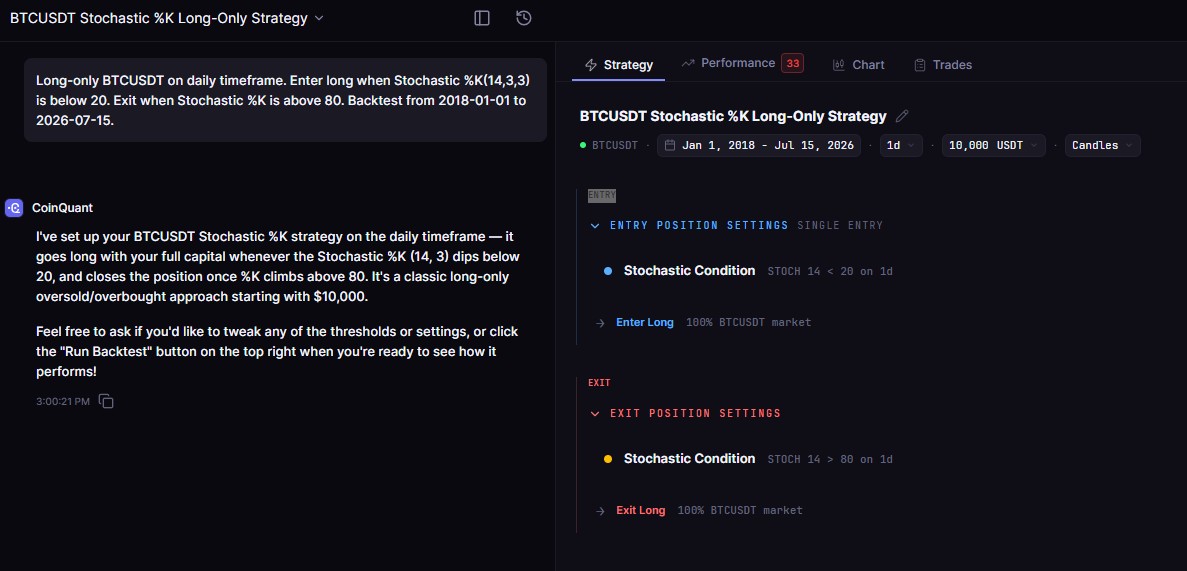
CoinQuant is an AI trading platform built for crypto strategy research. You describe your trading logic in plain English, set your conditions, and run backtests against institutional-grade Kaiko data covering Binance, Coinbase, and Kraken back to 2017 for Bitcoin.
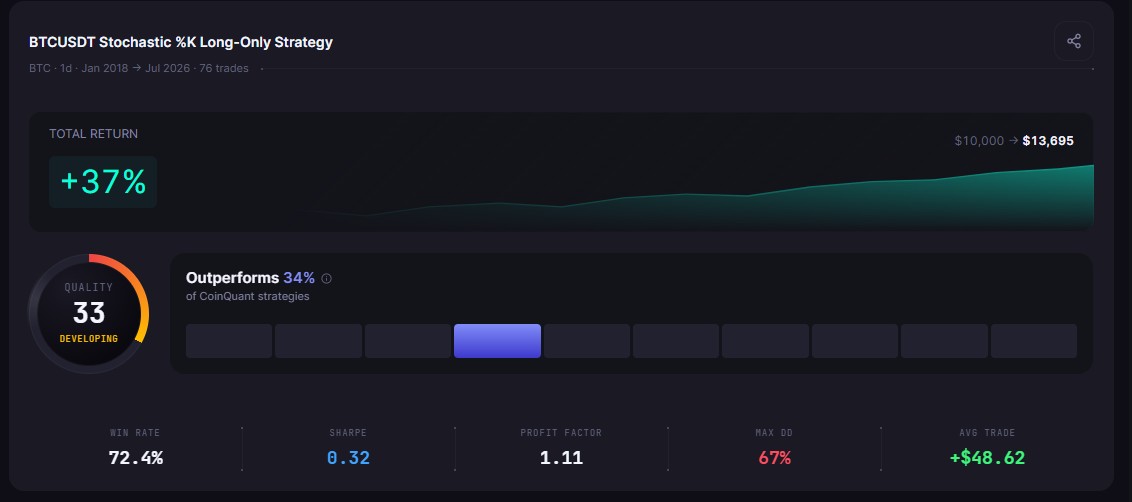
CoinQuant's backtesting includes transaction fees and slippage in every result, and every completed backtest surfaces a full set of performance metrics: Sharpe ratio, profit factor, maximum drawdown, win rate, and total trades. There is no coding requirement. The platform also supports FMP data for stocks, forex, and commodities if you want to extend research beyond crypto.
Side-by-Side Comparison
| Feature | CoinQuant | Backtrex |
|---|---|---|
| Primary market focus | Crypto (BTC, ETH, SOL, XRP and more) | Forex, indices, crypto |
| Strategy building method | Plain-English description, no-code | Chart-based trade marking, no-code |
| Coding required | No | No |
| Historical data depth | Crypto back to 2017 (Kaiko) | 10+ years (asset-dependent) |
| Data provider | Kaiko (institutional-grade) | Not publicly specified |
| Backtest metrics | Sharpe ratio, profit factor, win rate, max drawdown, total return | Win rate, profit, drawdown (SMC-focused) |
| Fees and slippage in backtest | Yes | Not specified |
| current pricing | Yes | Yes (capped at 5 backtests) |
| Paid plan | Available | From €29/month |
| Platform focus | Crypto strategy research and backtesting | Forex SMC/ICT backtesting |
| SMC/ICT support | Not the primary focus | Native, built-in |
| Pine Script export | No | Yes |
Strategy Building: Two Very Different Approaches
The biggest functional difference is how you build a strategy.
Backtrex works backward from your trades. You annotate existing chart examples, and the engine infers your logic. This works well if you already trade manually and want to automate or validate your intuition. It does not require you to articulate rules upfront.
CoinQuant works forward from your rules. You describe what you want a strategy to do in plain English, set your entry and exit conditions using indicators, and run the test. The result includes every metric you need to evaluate whether the idea has statistical merit.
For crypto traders who want to research new strategy ideas systematically, the forward approach tends to produce cleaner, more reproducible results. For Forex traders who already have a discretionary edge and want to verify it, Backtrex's backward approach can be faster to start.
Data Quality and Crypto Coverage
This is where the platforms diverge most clearly.
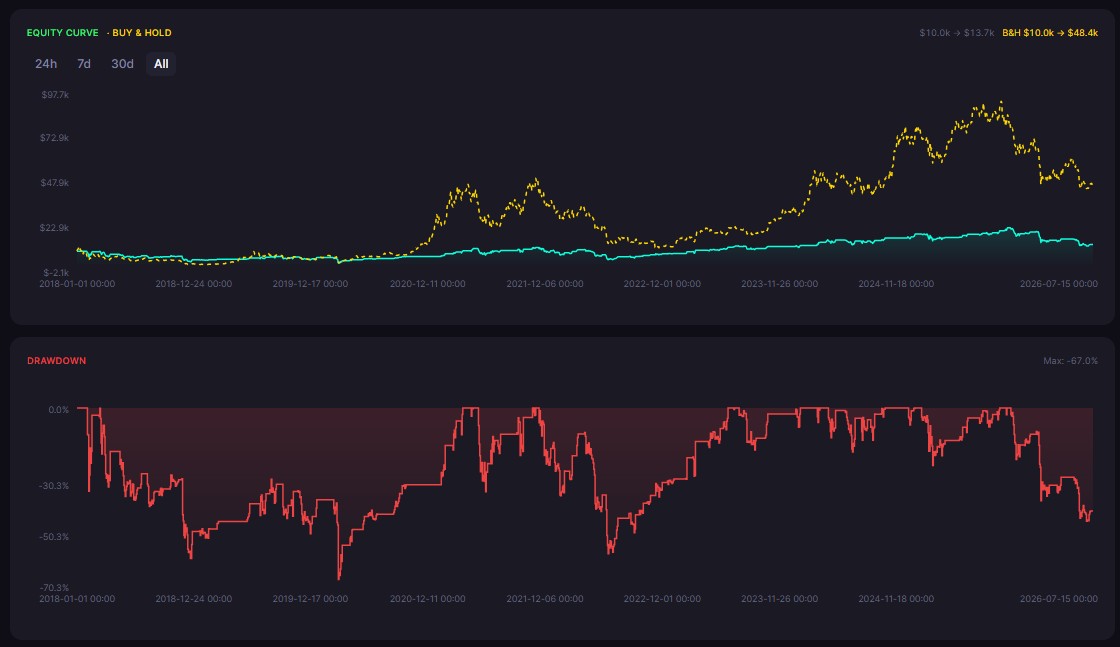
CoinQuant uses Kaiko data, a provider used by institutional traders and quantitative funds. The crypto historical data covers BTC, ETH, SOL, XRP, and additional pairs across Binance, Coinbase, and Kraken. BTC data extends back to 2017. This depth matters when you are stress-testing a strategy across multiple market cycles, including the 2018 bear market, the 2021 bull run, the 2022 crash, and the 2024 recovery.
Backtrex does not publish its crypto data provider or specify the depth of its crypto coverage. For Forex, it is well-documented. For crypto specifically, the data sourcing is not transparent on their public pages.
If your primary goal is serious crypto strategy research, the data provenance matters. Backtesting on inconsistent or incomplete historical data produces results that do not hold up in live trading.
Backtesting Metrics: What You Actually Get
Backtrex reports core performance data. CoinQuant's backtest output includes several metrics that most serious researchers need to make informed decisions:
Sharpe ratio: How much return you are getting per unit of risk
Profit factor: Gross profit divided by gross loss (above 1.5 is typically considered meaningful)
Maximum drawdown: The worst peak-to-trough loss the strategy experienced
Win rate: Percentage of winning trades
Total return and total trades
Having Sharpe ratio and profit factor alongside raw return prevents the common mistake of choosing a high-return strategy that is also extremely volatile or fragile.
Who Each Platform Is Built For
Backtrex is a strong fit for:
Forex traders using SMC or ICT methodology
Discretionary traders who want to validate their chart-reading approach
Anyone who wants Pine Script deployment for TradingView alerts
CoinQuant is a strong fit for:
Crypto traders who want to research and stress-test strategy ideas
Anyone who wants institutional-grade Kaiko data across market cycles
Traders who need full metric coverage including Sharpe ratio and profit factor
Users who want to describe strategies in plain English without marking up charts
When Pricing Matters
Backtrex's current pricing gives you access to the builder and full historical depth, but limits you to five backtests. When you are actively iterating on a strategy idea, five runs is not enough to test variations meaningfully. Paid plans start at €29 per month.
CoinQuant's current pricing does not cap the number of backtests you can run. You can iterate, adjust conditions, change timeframes, and retest without hitting a wall. For anyone who wants to do serious research across multiple strategy ideas, the absence of a backtest cap matters more than headline pricing.
What the Research Process Actually Looks Like
Here is a practical illustration. Suppose you want to test whether a multi-indicator strategy on BTC performs differently across bear and bull regimes. In CoinQuant, you build the strategy in plain English, run it against the 2021 bull run, then against the 2022 crash, then against the 2023 recovery. Each run returns the same full metric set: Sharpe ratio, profit factor, drawdown, win rate. You compare across periods.
On Backtrex, your starting point is marking your own trades on the chart. If you are a discretionary Forex trader who already has a trading style you want to quantify, this approach is intuitive. If you are testing a hypothesis about a crypto indicator without a discretionary base, you are starting from an unusual angle.
Neither approach is wrong. They reflect different research philosophies and different intended users.
The Bottom Line
Backtrex is a solid tool for Forex and SMC traders who want no-code backtesting. It does what it says for its target audience.
For crypto strategy research specifically, CoinQuant offers deeper data sourcing (Kaiko, verified institutional provider), broader metric output, and a strategy building approach that is better suited to systematic idea testing. The current pricing on CoinQuant has no five-test limit. If your primary goal is to research crypto trading strategies against real market data across multiple cycles, CoinQuant is the more appropriate tool.
Disclaimer:
This content is for educational and informational purposes only and does not constitute financial, investment, or trading advice. All strategies and examples are for illustrative purposes and do not guarantee results. Always conduct your own research before making financial decisions.
