
How Much Does Backtesting Software Cost? A 2026 Pricing Breakdown

The honest answer to how much backtesting software costs is: anywhere from no-cost to a serious monthly bill, and the price often has little to do with how useful the tool is for you.
This guide breaks down what you actually pay for, the pricing models to expect, and how to avoid paying for power you will never use. The goal is to help you judge value, not just price.
What You Are Actually Paying For
Backtesting software pricing usually reflects four things:
Data quality and history. Clean, deep historical data costs money to license and store. Tools with real institutional data price higher than those with thin or no-cost data.
Compute. Running backtests, especially across long periods or many assets, uses real server resources.
Feature depth. Multi-asset, multi-timeframe, and advanced metrics sit in higher tiers.
Automation and live trading. Connecting to an exchange to trade live is often where the price jumps, because the stakes and support burden rise.
A tool can be cheap because it skimps on data, or expensive because it bundles live trading you do not need yet. Price alone tells you neither.
The Common Pricing Models
The no-cost-to-Paid Ladder
Most platforms follow a predictable progression, and understanding it helps you pay for only what you need.
Entry tier: backtesting on real data, often with limits on frequency, history, or saved strategies. This is where most people should start and stay while learning.
Paid research tier: removes limits, adds deeper data and analytics, and suits serious strategy development.
Live trading tier: adds the ability to deploy strategies with real money, usually the most expensive step.
The mistake is paying for a live-trading tier before you have a strategy worth deploying. The backtesting you need to find that strategy is often available for no-cost.
no-cost vs Paid: What Changes
no-cost backtesting tools exist and are a genuine starting point. What you usually trade away is data depth and metric completeness.
no-cost tiers may cap the date range, limit assets, or omit risk-adjusted metrics like the Sharpe ratio.
Paid tiers typically unlock longer history, more assets, fee-inclusive results, and complete metrics.
The right question is not no-cost versus paid. It is whether the entry tier gives you enough to test honestly. If it includes real data and fees, it can be plenty to start.
How to Avoid Overpaying
Match the plan to the job, not to the marketing.
Pay for data depth, not dashboards. The value is in the quality of what you are testing against, not the polish of the interface.
Do not pay for live trading until you actually have a validated strategy to automate.
Watch usage-based pricing. Some tools charge by volume, number of strategies, or connected exchanges, which can climb faster than a flat plan.
Where CoinQuant Fits
CoinQuant is an AI trading platform where you build a strategy in plain English and backtest it on real Kaiko data. No Python. No Pine Script.
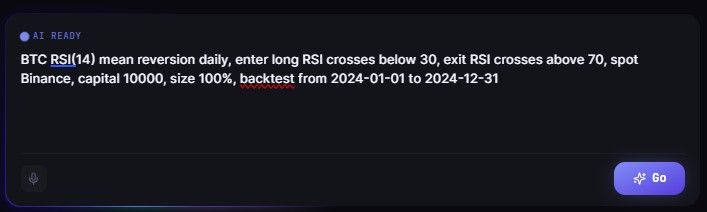
That matters for cost because the value sits where it should, in genuine data and honest backtesting, not in cosmetic polish. You test on real market data first, so you know what you are getting before you commit to anything.
What You Are Really Paying For
It helps to separate what feels expensive from what is actually valuable. Dashboards, template libraries, and polished interfaces are cheap to build and easy to market. Deep, clean, correctly-timed historical data is expensive and largely invisible, yet the data is the part that determines whether your results mean anything.
So when you weigh a price, ask what share of it buys data quality and honest backtesting versus cosmetic polish. A slightly pricier platform with genuinely better data can be far cheaper in the only currency that matters: the money you avoid losing on strategies a weaker backtest told you were fine.
Frequently Asked Questions
Why do some platforms charge so much more than others?
Usually data depth and live-trading capability. A platform licensing premium multi-exchange data and supporting real-money execution carries costs that a lightweight tool does not.
Can I do serious research on a starter plan?
Often yes, as long as the starter plan uses real data and includes fees and full metrics. Test that before assuming you need to pay.
Is no-cost backtesting actually good enough?
For most people, yes, and for longer than they expect. A entry tier with real historical data, fees included, and a full set of metrics can carry you through learning the craft and testing your first several dozen ideas. You only need to pay when you hit a genuine limit, more history, more frequency, or live deployment.
The Takeaway
Backtesting software ranges from no-cost to premium, and the best value is the cheapest tool that still tests honestly on real data with fees included. Reduce the whole question to a short decision: still learning or testing ideas? Stay no-cost. Hit a hard limit like more history or more frequent tests? Move to a paid research tier. Have a strategy that has passed honest, multi-period backtests and want to deploy it with real money? Only then does a live-trading tier make sense.
Pricing tiers are designed to sell you capability. Buy capability only when a real task demands it, and the cost of backtesting stays remarkably low for a remarkably long time.
Test a strategy on real Kaiko data. No coding required.
Disclaimer:
This content is for educational and informational purposes only and does not constitute financial, investment, or trading advice. All strategies and examples are for illustrative purposes and do not guarantee results. Always conduct your own research before making financial decisions.
Key Takeaway
