
How AI Agent Backtesting Compares to Traditional Backtesting: What Traders Need to Know
.png)
AI agents are changing how strategy testing works. Not just faster, but fundamentally different from typing entry rules into a spreadsheet or pasting Pine Script into TradingView. Understanding the difference between ai agent backtesting vs traditional backtesting is now a practical decision every strategy trader needs to make.
This article breaks down both approaches, explains what AI agents actually do inside a backtesting workflow, highlights where each method performs better, and shows how CoinQuant's AI-driven pipeline compares to traditional platforms.
What Is Traditional Backtesting?
Traditional backtesting follows a familiar sequence. You have an idea for a strategy. You write the rules in code, typically Python, Pine Script, or a proprietary platform language. You load historical data. You run a simulation. You interpret the results and adjust.
The process is powerful. Platforms like TradingView with Pine Script, QuantConnect with Python, and Backtrader give experienced traders fine-grained control over every parameter. You decide the exact logic, the exact data source, and the exact output format.
The cost is technical depth. Writing a coherent, bug-free backtest in Pine Script requires you to understand the language, handle edge cases like lookahead bias, manage fill logic, and debug output that sometimes fails silently. A strategy that looks profitable in traditional backtesting can have subtle errors that inflate results.
For traders with coding experience, this is manageable. For the majority of traders who have market intuitions but not programming backgrounds, traditional backtesting is effectively inaccessible.
What Is AI Agent Backtesting?
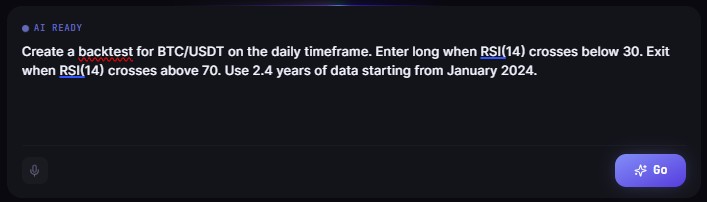
AI agent backtesting removes the code requirement entirely. Instead of writing strategy rules in a programming language, you describe your strategy in plain English. The AI interprets your description, converts it into executable trading logic, and runs the backtest automatically.
This is not just a simpler interface on top of the same process. The AI agent is doing meaningful work:
Parsing natural language into discrete trading conditions
Resolving ambiguous descriptions into specific parameter settings
Handling indicator configurations without manual input
Generating the backtest schema and executing it against historical data
Returning structured results with metrics you can act on
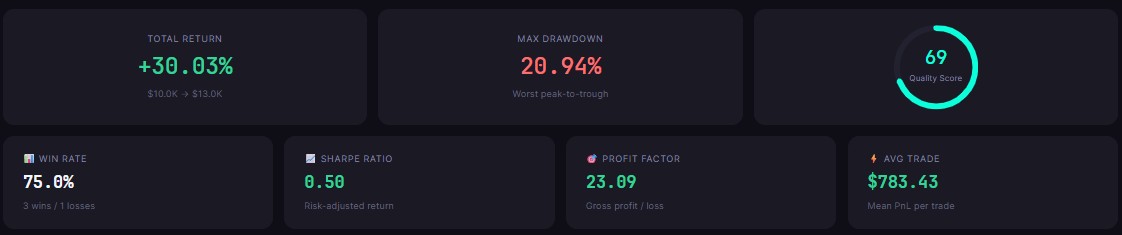
The result is that a trader can write "enter when RSI drops below 30 and price bounces, exit when RSI crosses 70" and receive a full backtest with win rate, drawdown, profit factor, and equity curve, without writing a single line of code.
What AI Agents Actually Do in Backtesting
The phrase "AI agent" covers a range of implementations. In the context of backtesting, a well-built AI agent does the following:
Natural language interpretation: The agent parses your strategy description and identifies the core components: entry condition, exit condition, indicator settings, timeframe, asset. Ambiguous descriptions get resolved to sensible defaults or the agent asks for clarification.
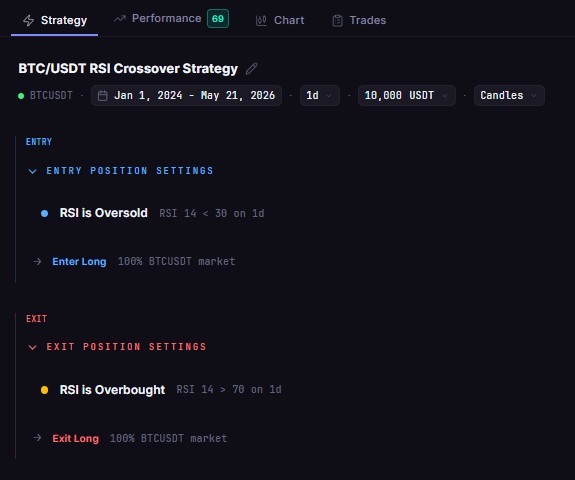
Logic construction: The agent translates your conditions into a structured strategy schema, the same representation a developer would write manually. For example, "RSI below 30" becomes a formal condition check against the RSI(14) value on each bar.
Edge case handling: Good AI agents flag or handle edge cases like overlapping conditions, missing exit rules, or contradictory logic. This is work a traditional backtester either ignores or passes back to you as a confusing error.
Parameter generation: Some AI agents explore parameter variations automatically, testing RSI(14), RSI(10), and RSI(20) in parallel and returning the comparison without additional prompts.
Result interpretation: Advanced implementations generate plain-language summaries of what the backtest results mean, not just a table of numbers.
Key Differences: AI Agent Backtesting vs Traditional Backtesting
Where AI Agent Backtesting Excels
Rapid hypothesis testing. The biggest productivity gain is iteration speed. In traditional backtesting, changing a single parameter might mean editing code, re-running, and waiting for results. With an AI agent, you modify the description and get new results in seconds. Testing 10 strategy variants in an afternoon is realistic. Testing 10 variants in code is a full day's work.
Traders without coding backgrounds. Discretionary traders who understand market structure, patterns, and risk management but have no Python or Pine Script experience now have access to systematic strategy testing. This was previously unavailable to them without hiring a developer or spending months learning to code.
Exploring strategy variants quickly. AI agents make it practical to explore the space around a core idea. If your base strategy uses RSI(14), you can test RSI(10) and RSI(20) with a two-word change. Testing entry on the 1H versus 4H timeframe is one modification. This kind of systematic exploration is tedious in code and natural in natural language.
Limitations of AI Agent Backtesting
AI agent backtesting is not without real constraints. Being clear about them matters.
AI interpretation requires human validation. When you describe a strategy in natural language, the AI makes decisions about what you meant. You need to review the logic it built to confirm it matches your intent.
Complex multi-condition strategies may need review. Simple one or two-condition strategies translate cleanly. Strategies with four or five conditions, time filters, or cross-asset logic may not translate perfectly.
Black-box risk. If you do not understand the logic the AI built, you are trading a strategy you cannot explain. Review the generated conditions before trusting backtest output.
Platform dependency. AI agent backtesting ties your strategy to the platform's interpretation layer. Traditional backtests in version-controlled code are more portable.
CoinQuant's Approach to AI Agent Backtesting
CoinQuant processes your strategy description through a natural language AI that converts your prompt into a structured strategy schema. That schema runs against Kaiko historical data, institutional-grade tick data sourced from real exchange feeds. The backtest engine applies your specified fees, slippage, and position sizing settings and returns a full metrics dashboard.
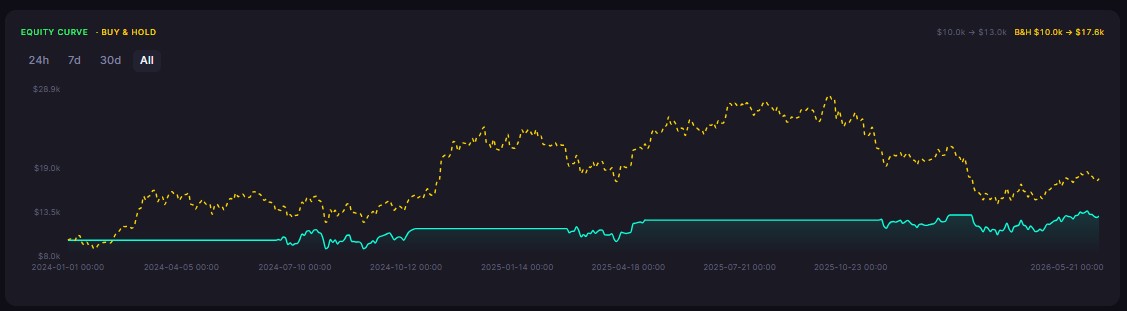
The output includes total return, CAGR, win rate, profit factor, maximum drawdown, Sharpe ratio, and an equity curve with individual trade markers. No coding required at any step.
The strategy builder exposes the conditions the AI built from your description, so you can verify and adjust. You are not running a black box. You can see exactly what logic was constructed and modify individual conditions if the AI's interpretation differed from your intent.
How CoinQuant Compares to Traditional Platforms
TradingView Pine Script: Powerful, free tier available, large community. Backtesting requires Pine Script. The Strategy Tester is functional but has known limitations around bar magnification and fill logic. Result: strong for coders, inaccessible for non-coders.
QuantConnect: Institutional-grade Python backtesting with extensive data. Supports equities, crypto, futures. Full control over every parameter. Result: best for quantitative researchers who want maximum control. High technical barrier to entry.
Backtrader (Python): Open-source Python backtesting library. Full flexibility, no platform dependency. Result: excellent for developers, requires complete technical setup.
CoinQuant: Natural language to strategy to backtest. Kaiko data. Full metrics output. No coding required at any step. Best for traders who want to test ideas quickly without a programming background, and for developers who want to move faster than code allows.
Who Should Use AI Agent Backtesting?
If you have trading ideas you want to test systematically and do not have a coding background, AI agent backtesting removes the primary barrier. If you have a coding background and want to test ideas faster, AI agent backtesting reduces your iteration time significantly.
Traditional backtesting remains the right choice if you need maximum control over your strategy logic, you are building institutional infrastructure, or you need portability across platforms.
For most active traders, AI agent backtesting on CoinQuant is the faster path from idea to validated strategy.
Try AI Agent Backtesting on CoinQuant
Describe your strategy in plain English, run a backtest on real Kaiko data, and get full performance metrics without writing a line of code.
Disclaimer:
This content is for educational and informational purposes only and does not constitute financial, investment, or trading advice. All strategies and examples are for illustrative purposes and do not guarantee results. Always conduct your own research before making financial decisions.
Key Takeaway
