
Entry plans at six no-code trading tools average $25.66 a month in 2026: what the price buys and what it leaves out

Short answer: For traders who want to describe a trading idea in plain English and backtest it on historical data before committing money, CoinQuant fits at $39.99 a month, the top of the $10 to $39.99 range for entry plans across the six no-code trading tools priced here. Across those six, priced on November 10, 2026, entry plans billed monthly average $25.66 (median $24.50) and second-tier plans average $78.83 (median $59.50); for running crypto bots, Cryptohopper, 3Commas and Gainium are the usual picks. Exchange trading fees sit on top of every subscription and can cost as much as the plan itself.
Which tools are in the sums
In this guide, a no-code trading tool means software where you build, test or run trading rules through forms, templates, a visual editor or plain English, without writing a script. That definition takes in crypto bot platforms, no-code strategy builders and plain-English research tools. It leaves out platforms where your own strategy has to be written in a programming language first.
We priced six tools that fit the definition and publish regular prices on an official page that could be read on November 10, 2026: Composer, Gainium, 3Commas, Cryptohopper, Coinrule and CoinQuant. Tools whose prices load only after a login, show only a discounted price, or whose pricing page blocked access that day, are not in the sums.
How we priced them
- Source: each vendor's own pricing page, read on November 10, 2026, in US dollars.
- Base price: the regular price billed monthly. Where a plan is shown only with yearly billing, the table says so.
- Two tiers: the entry plan is the cheapest paid plan; the second plan is the next paid plan up. $0 plans are described in the text but kept out of the averages, because they would pull the figures toward zero without telling you what paid access costs.
- Left out: introductory discounts, referral rewards and other time-limited offers. They carry no math here.
- Disclosure: CoinQuant publishes this page and appears in the table on the same terms as the other five. It is listed last where prices tie.
No-code trading tool prices, checked November 10, 2026
| Tool | Entry plan, monthly | Second plan, monthly | Yearly option |
|---|---|---|---|
| Composer | Advanced $10 | Pro $32, shown billed yearly | Pro $384 a year |
| Gainium | Mini $15 | Edge $22 | Mini $144 a year |
| 3Commas | Starter $20 | Pro $50 | Starter $15 a month, billed annually |
| Cryptohopper | Explorer $29 | Adventurer $69 | Explorer $24.16 a month, billed annually |
| Coinrule | Investor $39.99 | Trader $79.99 | Investor $359 a year |
| CoinQuant | Pro $39.99 | Elite $220 | Pro $399 a year, or $12.99 a week |
Regular list prices in US dollars, read on each vendor's pricing page on November 10, 2026. Cryptohopper's prices exclude VAT where it applies. Sources: Composer pricing, Gainium pricing, 3Commas pricing, Cryptohopper pricing, Coinrule pricing and CoinQuant's own pricing page.
Three of the six also have a $0 route. Composer's Starter plan builds and backtests unlimited strategies in its no-code editor, Gainium has a free-forever plan, and Coinrule's Starter plan runs 2 strategies on 1 connected exchange up to $3k of monthly volume.
The average and median, worked out
Here is the arithmetic, so you can check it or redo it when prices change.
Entry plans, billed monthly: $10, $15, $20, $29, $39.99 and $39.99. They add up to $153.98, and $153.98 divided by 6 is $25.66. With six values, the median is the midpoint of the third and fourth, $20 and $29, which gives $24.50.
Second plans: $22, $32, $50, $69, $79.99 and $220. They add up to $472.99, and $472.99 divided by 6 is $78.83. The median is the midpoint of $50 and $69, which gives $59.50. Composer's $32 is a monthly rate on yearly billing, since its pricing page shows Pro no other way.
| Tier | Range | Average | Median |
|---|---|---|---|
| Entry plan | $10 to $39.99 | $25.66 | $24.50 |
| Second plan | $22 to $220 | $78.83 | $59.50 |
Six tools, prices checked November 10, 2026, billed monthly except Composer Pro (shown billed yearly).
Why the gap between average and median in the second tier? One plan, CoinQuant Elite at $220, sits far above the rest and drags the average up, while the median ignores how far out it sits. When a price list has one outlier, the median is the better guide to what a typical buyer pays. Above the second tier, prices spread out even more: Cryptohopper Hero is $129 a month, 3Commas Expert is $140 and Coinrule Pro is $749 a month billed annually or $995 billed monthly.
What each entry plan includes
The same price can buy very different limits, so read the plan, not just the number.
| Tool | Entry plan | What the plan covers |
|---|---|---|
| Composer | Advanced, $10 | Automate up to 5 strategies of up to 350 nodes, with more Trade with AI usage each week |
| Gainium | Mini, $15 | 1,000 bot credits and 50 consumable credits a month, with unlimited in-app backtesting |
| 3Commas | Starter, $20 | Spot trading at 1 exchange: 5 active DCA bots, 2 signal bots and 2 grid bots |
| Cryptohopper | Explorer, $29 | Up to 15 coins, 80 open positions per exchange, backtesting and the Strategy Designer |
| Coinrule | Investor, $39.99 | 7 live and 7 demo rules, 3 connected exchanges, up to $500k of monthly volume |
| CoinQuant | Pro, $39.99 | 50,000 credits a month, 15-minute to monthly candles, up to 500,000 candles per test |
Plan contents as listed on each vendor's pricing page on November 10, 2026.
What pushes the price up
Every vendor meters something different, but the meters fall into five groups. Knowing which one you will hit first tells you which tier you actually need.
Bot, rule or strategy limits
Most crypto bot platforms price by how many bots or rules can run at once. 3Commas moves from 5 active DCA bots on Starter to 20 on Pro. Coinrule moves from 7 live rules to 25 on Trader. Composer counts automated strategies and how large each one can be, measured in nodes.
Exchanges connected and trading volume
Connecting more exchanges, or trading more, usually means a higher tier. 3Commas Starter covers 1 exchange for spot trading, while Pro adds futures and more API keys. Coinrule caps monthly volume by plan, from $3k on Starter to $500k on Investor and $10M on Trader.
Assets covered
Coverage changes who a tool is for. Cryptohopper, 3Commas and Gainium connect to crypto exchanges. Composer offers its securities products and brokerage services through Composer Securities LLC, a broker-dealer registered with the SEC. Coinrule says it automates bots in crypto, stocks and ETFs (Coinrule). CoinQuant lists 13,151 instruments across stocks, ETFs, indices, forex, commodities and crypto (CoinQuant supported assets).
Backtest depth and data resolution
Testing tools charge for precision. On CoinQuant, Pro covers candles from 15 minutes to 1 month, while Elite adds 1-minute candles and up to 6 months of tick-level data for crypto. Cryptohopper's cheaper plans check strategies less often: a 10-minute strategy interval on Explorer, 5 minutes on Adventurer and 2 minutes on Hero.
AI usage and credits
AI features are increasingly metered. Composer gives more Trade with AI usage on each tier up, Coinrule includes 500 AI credits on Investor and 5,000 on Trader, and the CoinQuant FAQ says its credits cover "prompts, backtests, tick analysis, and research".
Monthly, annual or weekly billing
Paying for a year upfront is cheaper at regular prices, when the vendor shows both figures:
- CoinQuant Pro: $399 a year against 12 x $39.99 = $479.88, so $80.88 less, about 17%.
- Coinrule Investor: $359 a year against 12 x $39.99 = $479.88, so $120.88 less, about 25%.
- Gainium Mini: $144 a year against 12 x $15 = $180, so $36 less, or 20%.
- Cryptohopper Explorer: $24.16 a month billed annually, which its pricing page says saves $58 compared with monthly.
Weekly billing works the other way. CoinQuant Pro at $12.99 a week comes to $675.48 over 52 weeks, more than either monthly or yearly billing, so it suits a short, fixed research window rather than steady use. A yearly plan only beats monthly billing if you keep using the tool for most of the year, so a single month on monthly billing is a cheap way to find out whether you will.
Costs outside the subscription
The plan price is rarely the whole bill. Four costs commonly sit outside it.
- Exchange trading fees. A bot that places orders pays the exchange on every trade. On Kraken's published schedule, the lowest tier (under $2.5K of 30-day spot volume) charges a 0.80% taker fee (Kraken fee schedule). Fees fall as volume rises, but small accounts pay the top rate.
- Regulatory fees. Composer notes that FINRA and SEC regulatory fees are charged on the sale of securities, on top of the plan (Composer pricing).
- Tax. Cryptohopper states that all prices on its website exclude VAT where it applies (Cryptohopper pricing).
- Data feeds. Some platforms sell market data separately. TrendSpider, for example, offers real-time futures data to non-professional users for $7.50 a month (TrendSpider pricing).
Worked example: one bot setup, priced step by step
This is an illustrative setup, not a recommendation or a test. It shows how to add up the full monthly cost of one plan plus the fees around it.
The setup: one crypto trader runs a rule-based bot on Cryptohopper's Explorer plan, connected to Kraken, and the bot places 10 market orders a month of $200 each.
- Subscription. Explorer billed monthly is $29.00.
- Trading volume. 10 orders x $200 = $2,000 of volume in the month, which keeps the account in Kraken's lowest tier.
- Trading fees. Market orders pay the taker rate: $2,000 x 0.80% = $16.00.
- Monthly total. $29.00 + $16.00 = $45.00, before any VAT.
- Yearly billing. On annual billing, Explorer is $24.16 a month, so the total becomes $24.16 + $16.00 = $40.16.
| Cost line | Monthly billing | Annual billing |
|---|---|---|
| Cryptohopper Explorer | $29.00 | $24.16 |
| Kraken taker fees on $2,000 | $16.00 | $16.00 |
| Total per month | $45.00 | $40.16 |
Illustrative figures built from list prices and the published fee schedule on November 10, 2026; VAT excluded.
The lesson carries over to any tool: trading fees here are more than half the subscription. Larger orders push the fee line up quickly, even after volume discounts start. Before choosing a tier, estimate your monthly order volume and multiply it by your exchange's fee, because that line can outgrow the plan.
Where CoinQuant fits
CoinQuant is priced as a research and backtesting tool. You write the idea in plain English in the prompt box on the dashboard and press Go; the strategy then appears as rules you can edit in the Strategy Builder, with its instrument, date range, timeframe, starting capital and data mode set before you click Run Backtest. Each rule shows as a block you click to edit (Strategy Builder guide). Results are historical simulations on past prices.
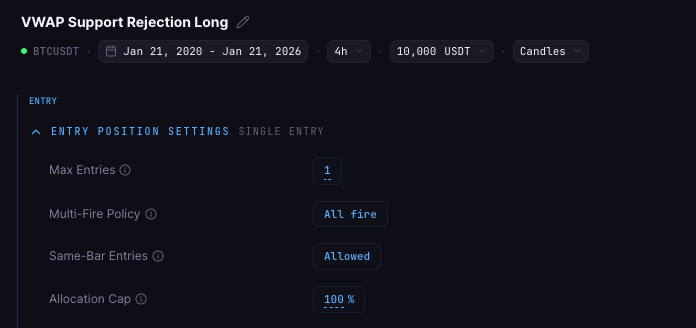
Pro costs $39.99 billed monthly for 50,000 credits, $12.99 billed weekly for 13,000 credits, or $399 billed yearly for 55,000 credits a month. Top-up credits on Pro are only for monthly and yearly plans. Elite costs $220 billed monthly, $69.99 weekly or $1,999 yearly, with 300,000 credits a month on monthly or yearly billing, according to its pricing page on November 10, 2026. A rule on 4-hour candles fits within Pro; you need Elite only for 1-minute candles or tick-level crypto tests.
The honest trade-off: CoinQuant is not the cheapest entry plan in this table, and its second tier is the most expensive. It suits someone who wants to check an idea on years of history before paying for anything else, more than someone looking for the lowest monthly price.
FAQ
What's the average cost for no-code trading tools in 2026?
Across six no-code trading tools priced on November 10, 2026, entry plans billed monthly average $25.66, with a median of $24.50 and a range of $10 to $39.99. Second-tier plans average $78.83, with a median of $59.50. Three of the six also offer a $0 plan with narrower limits than their paid tiers.
Is a yearly plan worth it?
Only if you will keep using the tool. At regular prices, yearly billing saved 17% to 25% on the plans here that show both figures. If you are still deciding, one month on monthly billing costs less than a year you abandon.
What costs come on top of a no-code trading subscription?
Exchange trading fees on every order, regulatory fees on securities sales at some brokers, VAT where it applies, and sometimes paid data feeds. For a small account, trading fees can exceed half the subscription price.
How much does CoinQuant cost?
On regular prices checked November 10, 2026, Pro costs $39.99 on monthly billing, $399 on yearly billing or $12.99 on weekly billing. Elite costs $220 monthly, $1,999 yearly or $69.99 weekly, and adds 1-minute candles and tick-level crypto data.
Before you pay for a bot, check whether the rule behind it held up on past data. Write the idea as one sentence, backtest it on CoinQuant and see how it behaved across years of history, so your subscription money goes to a rule you have already examined.
Test your trading idea on CoinQuant
Related reading
Disclaimer:
Key Takeaway