
Best Crypto Trading Strategies for Beginners in 2026

If you are new to crypto trading, pick a simple, rules-based strategy and test it before committing real money. The strategies most often recommended for beginners in 2026 are dollar-cost averaging (DCA), trend following with moving average crossovers, RSI mean reversion, grid trading, and breakout trading. This guide explains each in plain language, what can go wrong, and how to test it first.
Test Before You Trade
Every strategy here shares one discipline: prove it on historical data first, then in a simulated account, then with small live size. Backtesting shows how your rules would have behaved on past prices, including drawdowns; paper trading checks that the same rules execute correctly without money at stake.
No-code platforms make this practical. CoinQuant, for example, converts a strategy described in plain English into a complete trading system with entries, exits, position sizing, filters, and risk rules. You can backtest on real historical data and review total return, win rate, profit factor, max drawdown, fees, and slippage. Testing takes minutes, not weeks. A strategy you have never tested is a guess.
Dollar-Cost Averaging (DCA)
How it works.DCA means buying a fixed dollar amount of an asset at regular intervals, such as $100 of Bitcoin every week, regardless of price. You buy more when price is low and less when it is high, removing the need to time entries.
Why beginners use it.It is the simplest strategy to understand and execute, and it needs no chart analysis or indicators. Across the 2026 beginner guides reviewed, DCA and basic trend following are the most consistently recommended starting points.
Risks and how to test it.DCA does not reduce drawdown. You still hold through bear markets, and your position can fall far below what you paid. CoinQuant's own published backtest of BTCUSDT daily DCA from January 2022 to June 2026 shows this: a +22.80% total return with a 66.95% maximum drawdown, identical to the buy-and-hold baseline over the same window. Those are platform-specific historical results, not a prediction. Test DCA over a full cycle that includes a bear market, and invest only what you can hold through deep drawdowns.
Trend Following with Moving Average Crossovers
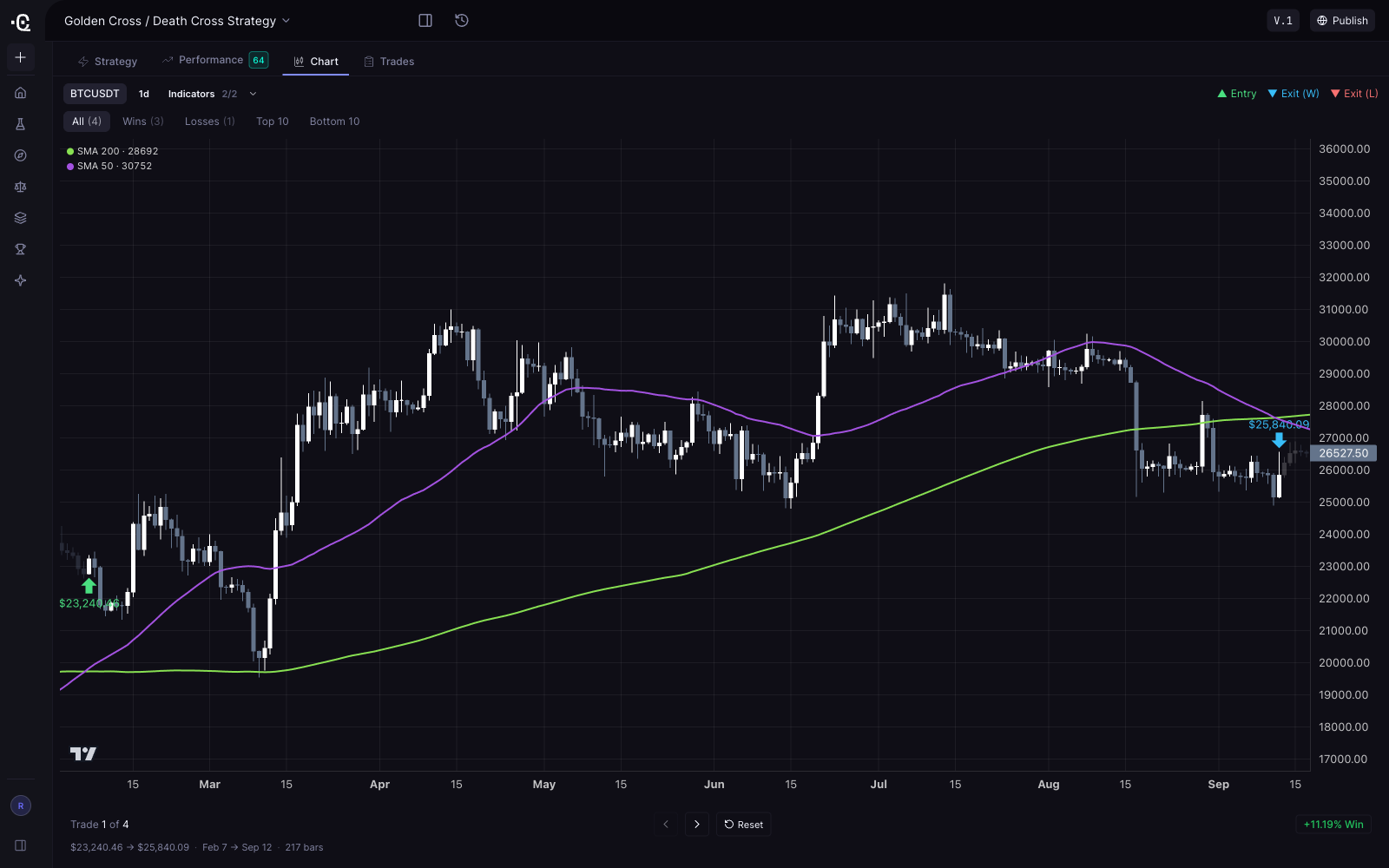
How it works.A moving average smooths price over a period, and crossovers between two averages signal trend changes. The 50/200 simple moving average crossover is the most widely recognized version: a "golden cross" (50-day above 200-day) is a buy signal, and a "death cross" is an exit signal.
Why beginners use it.It is rules-based, removes emotional decisions, and aligns trades with the prevailing trend, where most big moves happen.
Risks and how to test it.Moving averages are lagging indicators. In choppy, sideways markets the price can cross back and forth, producing whipsaw losses. CoinQuant's published backtest of a moving average crossover on BTCUSDT from January 2022 to June 2026 returned +87.34% across just 4 trades with a 75% win rate and a 37.10% maximum drawdown. A 4-trade sample is far too small to draw conclusions from. Test the crossover on several assets and timeframes, and expect many small losses between occasional large trend captures.
.
RSI Mean Reversion
How it works.The Relative Strength Index (RSI) measures how quickly price has moved. Mean reversion assumes moves revert: buy when RSI is oversold (below 30), sell when overbought (above 70). A common rule buys when RSI(14) crosses back above 30 and exits when it crosses above 70.
Why beginners use it.The rules are simple, signals are frequent, and it fits short-term trading on major pairs like Bitcoin and Ethereum.
Risks and how to test it.In strong trends, an asset can stay oversold while price keeps falling, so it can catch falling knives and whipsaw repeatedly. CoinQuant's published backtest of this RSI(14) rule from January 2018 to January 2026 returned +54.23% on 12 trades with a 66.7% win rate and a 65.61% maximum drawdown; these are platform-specific historical results, not guarantees. Test variations, such as different thresholds or a trend filter that allows buy signals only in uptrends, before going live.
Grid Trading
How it works.Grid trading places staggered buy and sell orders at set price intervals within a defined range. As price falls, orders buy; as it rises, orders sell. Each completed cycle locks in a small profit, so the strategy earns from volatility rather than direction.
Why beginners use it.It is automation-friendly and performs best in ranging, sideways markets, which is why grid bots are standard on platforms like Pionex, Bitsgap, and 3Commas.
Risks and how to test it.The main risk is a sustained breakout through the grid. If price falls through the lower boundary, you accumulate a losing inventory; if it rises through the upper boundary, you exit early and miss the move. Trading fees also accumulate across many small trades. Backtest the grid in both ranging and trending periods, set boundaries you can defend, and paper trade it before connecting real funds.
Breakout Trading
How it works.Breakout trading enters when price breaks a key level, such as a range high, a resistance level, or a Donchian channel high, assuming the break signals the start of a new move in that direction.
Why beginners use it.It is a simple, objective rule that catches momentum early and pairs naturally with stop-losses just below the broken level.
Risks and how to test it.False breakouts are the core problem. Price can pierce a level and immediately reverse, stopping out traders who entered on the break. Confirmations, such as a candle closing beyond the level or rising volume, reduce but do not eliminate this risk. Backtest across multiple assets, check how often false breakouts occur, and always pair the entry with a stop-loss.
FAQ
Which strategy should a beginner start with?
Most 2026 guides recommend dollar-cost averaging or basic trend following. DCA is the easiest to execute manually; a moving average crossover is the easiest to automate and backtest.
Do I need to know how to code?
No. No-code platforms like CoinQuant accept a strategy described in plain English and generate the rules for you. There is no Python or Pine Script required.
Can backtesting guarantee future results?
No. Backtests use historical data, and past performance does not predict future markets. They cannot fully capture real-world costs, slippage, and execution issues, which is why paper trading and small live positions come next.
How much capital do I need?
Start with an amount you can afford to lose entirely. Backtesting lets you validate a strategy before committing live capital.
Is automated trading safe to try?
Start with simulated accounts and small sizes, and remember that any strategy, manual or automated, can lose money.
Ready to test one of these strategies? Start backtesting your first strategy now.
If you want to go deeper on the three most popular beginner strategies with full backtest results, see the Best Crypto Trading Strategy for Beginners 2026 (Backtested) article on the CoinQuant blog.
For a step-by-step walkthrough on building your first strategy, see How to Build a Crypto Trading Strategy From Scratch.
Disclaimer:
Key Takeaway
