
Live Backtest Results
This backtest analyzes the performance of the Breakout strategy on BTC/USDT over the 5 Minute timeframe using historical market data. The results provide insight into how the strategy would have performed under real market conditions, including profitability, risk exposure, and consistency.
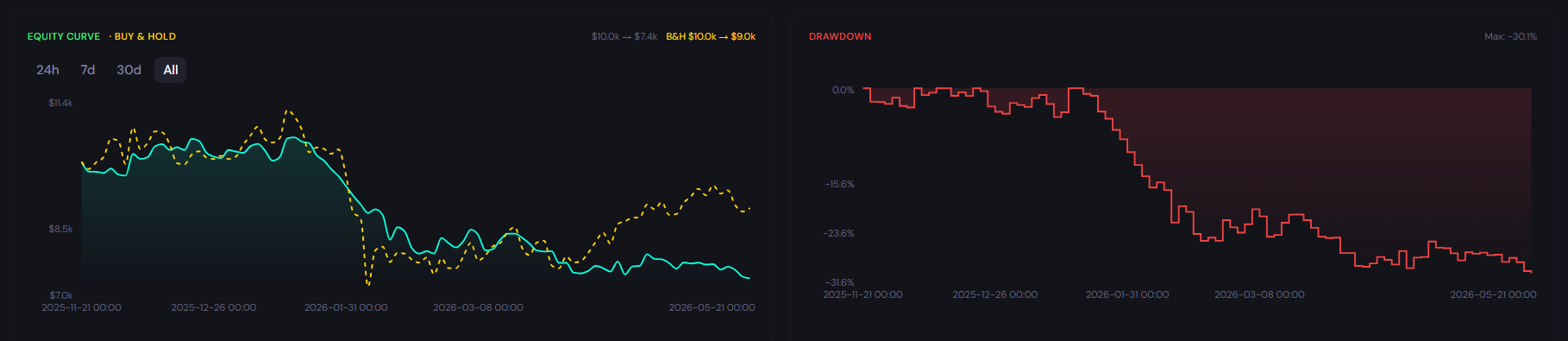
ROI
-29.57%
Win Rate
28.7%
Max DD
32.33%
Sharpe
-2.01
Profit Factor
0.75
Total Trades
328
Backtest insights
The strategy generated a total return of -29.57%, indicating significant underperformance. The maximum drawdown of 32.33% suggests high risk and significant volatility during the backtest period. With a win rate of 28.7% across 328 trades, the strategy demonstrates a challenging signal-to-noise ratio, where losing trades outnumber winners.

Performance may vary depending on market conditions. During trending periods, the strategy may behave differently compared to ranging markets, impacting both returns and drawdowns.
How the Breakout Strategy Works
What It Is
The Breakout strategy is a momentum-based approach that identifies micro-structure breakouts on the 5-minute timeframe. It enters long when BTC/USDT price closes above the highest high of the last 60 5-minute candles with volume above the 20-period average. The strategy exits when price closes below the 30-candle low, using a tight trailing stop. This is the highest-frequency configuration in the Breakout series, generating 328 trades over the last 6 months.
How Signals Are Generated
In this strategy, trading signals are generated based on predefined conditions. A buy signal occurs when the price closes above the 60-period high with volume above the 20-period average, while a sell signal occurs when the price closes below the 30-period low, signaling the micro-breakout has reversed.
When It Works Best
This strategy tends to perform best in high-volatility trending sessions with strong institutional participation, typically around market opens or major news events, where micro-breakouts can chain together into profitable sequences during these periods.
When It Performs Poorly
However, the strategy may underperform during low-volatility conditions, pre-news consolidation, and post-session drift, as the majority of signals on the 5-minute chart are noise-driven false breakouts that erode capital through fees and small losses; the backtest results confirm this with -29.57% return over 328 trades.
Strengths

Extremely high signal frequency provides a large sample size for statistical analysis
Tight structural stops limit per-trade risk to well-defined levels
Fully mechanical rules eliminate emotional decision-making at speed
Limitations

Generated 328 trades with -29.57% return, net losing strategy on this timeframe
Transaction costs (0.1% per trade) create significant cumulative drag at 328 trades
Pure breakout logic is generally not suited to the 5-minute chart without additional filters
Why Use CoinQuant Instead of Manual Trading or Other Platforms
Choosing the right way to test and execute trading strategies is critical. Below is a comparison between CoinQuant, manual trading, and other platforms to highlight key differences in speed, accuracy, and usability.
CoinQuant is designed specifically for traders who want to validate strategies quickly and reliably without coding. Unlike manual trading or traditional platforms, it allows you to test multiple scenarios, analyze performance instantly, and iterate faster using real data.
Frequently asked questions
How does the Breakout strategy perform on BTC/USDT in the 5 Minute timeframe?
The performance of the Breakout strategy on BTC/USDT in the 5 Minute timeframe depends on market conditions. Based on the backtest results above, it achieved a return of -29.57% with a maximum drawdown of 32.33%. Results may vary depending on volatility and overall market trends.
Is the Breakout strategy reliable for trading BTC/USDT?
The Breakout strategy can be effective when used in the right conditions. For BTC/USDT, it typically performs well in high-volatility trending sessions with strong institutional participation, typically around market opens or major news events but may underperform during low-volatility conditions, pre-news consolidation, and post-session drift. Backtesting helps evaluate its reliability before applying it in live trading.
Why is backtesting important for trading strategies?
Backtesting allows traders to evaluate how a strategy would have performed using historical data. It helps identify strengths, weaknesses, and risk levels before applying the strategy in real markets, reducing the likelihood of unexpected losses.
How can I test the Breakout strategy on CoinQuant?
You can use CoinQuant to build and backtest the Breakout strategy without coding. Simply select your asset, define your strategy rules, and run a backtest to view detailed performance metrics instantly.
What are the best settings for the Breakout strategy on 5 Minute?
The best settings for the Breakout strategy depend on the asset and timeframe. Traders often adjust parameters based on volatility and trading style. Using a backtesting platform like CoinQuant allows you to test different configurations and identify what works best.
Explore similar strategies
