
Binance AI Pro vs CoinQuant: Paper Trading an AI Strategy vs Backtesting It First

Binance AI Pro vs CoinQuant comes down to the order of two checks. Binance AI Pro builds a strategy from a chat, and its FAQ, published on 19 October 2026, says plainly: "Backtesting is not available in the initial release." Its route to a first look is paper trading. CoinQuant, an AI trading platform, runs a described rule on years of past data before you decide anything.
The order matters because a rule can sound sensible and still lag. The author described one simple Bitcoin rule in plain English and backtested it on CoinQuant: over five years it returned 9.58% across 99 trades, while holding Bitcoin on the same window returned 57.33%. A paper test would need years to show that gap.
This comparison uses Binance's own FAQ (read on 29 October 2026) and CoinQuant's own documentation, and reports the backtest without adjustment.
What Binance AI Pro Is
Binance describes the product in its FAQ as "a conversational agent platform where you describe your financial goals in natural language, and the agent helps you plan, build, and manage financial workflows". Those workflows include research reports, alerts, signals and trading automation.
The key facts from the FAQ, as of 29 October 2026:
- Markets: "Binance AI Pro supports Spot and USDS-M Futures trading."
- Building: you describe the strategy in natural language and AI Pro generates a workflow and Python code, with no coding experience required.
- Running: "You can run up to 10 strategies across all types, including paper trading, live trading, and signal alerts."
- Paper first: "Paper trading uses simulated funds and is available to both Basic Plan and Premium Plan users."
So the product covers the whole path from idea to deployment inside Binance. Live trading runs in a separate strategy account that you fund yourself, after you approve it.
What Its FAQ Says About Backtesting as of 29 October 2026
The FAQ answers the backtesting question directly. Asked "Can I backtest a strategy before deploying it?", it says, in full:
"Backtesting is not available in the initial release. You can use paper trading to observe a strategy without real funds before approving a separate live deployment. Automated code testing is separate from historical backtesting."
That last line matters. The FAQ also says "AI Pro uses internal scripts to test the generated Python code before deployment." Code testing checks that the program runs as written; it does not tell you how the rule would have done on past prices.
This article reflects the FAQ as published on 19 October 2026 and read on 29 October 2026. Check the Binance AI Pro FAQ for any change after that date.
What Paper Trading Shows and What It Cannot
Paper trading runs a strategy on live prices with simulated money. It is a good test of mechanics: whether orders fire when you expect, and whether the rule behaves the way you described it.
What it cannot do is compress time. A daily rule like the example below traded 99 times in five years, about 20 trades a year, so a month of paper trading might show one or two trades. That is too few to judge anything, and every one of them comes from the same month's market.
| Question | Paper trading | Backtest |
|---|---|---|
| Do orders fire as described? | Yes, on live prices | Yes, on past prices |
| How many trades can you judge? | As many as the calendar allows | Every trade in the chosen window |
| Which markets does it cover? | Only the weeks you watch | Bull, bear and sideways years, if the window has them |
| How long does it take? | Weeks or months | One run |
For the general case, see paper trading vs backtesting: why you need both before going live.
What a Backtest Adds
The paper trading vs backtesting AI strategy question is really about order. A backtest adds years of history, a real trade count, the worst drawdown and the cost of fees before any money or time is spent.
On CoinQuant you describe the rule in plain English with no coding required, and the builder stores it as rules you can read on the Strategy tab. Its Strategy Builder documentation shows how each rule is put together: an instrument, an indicator, a timeframe, a comparison, a value and an action.
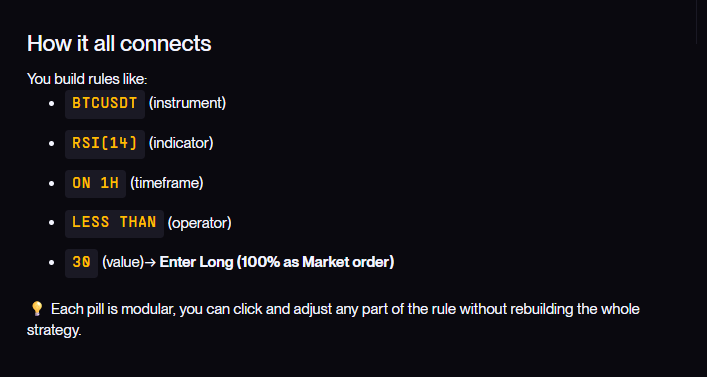
How one rule is put together in CoinQuant's Strategy Builder: instrument, indicator, timeframe, operator, value and action
The worked example is BTC WMA 30 Close Cross 1D 2021-2026: buy Bitcoin when the daily close crosses above its 30 day weighted moving average, sell when it crosses back below. It ran on BTCUSDT (Binance spot) from 2021-08-01 to 2026-08-01 with $10,000, fees included, no slippage modelled.
- Total Return: 9.58%, against 57.33% for BTC Buy and Hold 1D 2021-2026
- Max Drawdown: 57.56%, against 76.63% for holding
- Trades: 99, with a Win Rate of 23.23% and a Profit Factor of 1.04
- Fees: $1,858.02, almost twice the $958.18 the rule made
That is the check before you trust: the rule made money and fell less than holding at its worst, but it trailed holding by a wide margin.
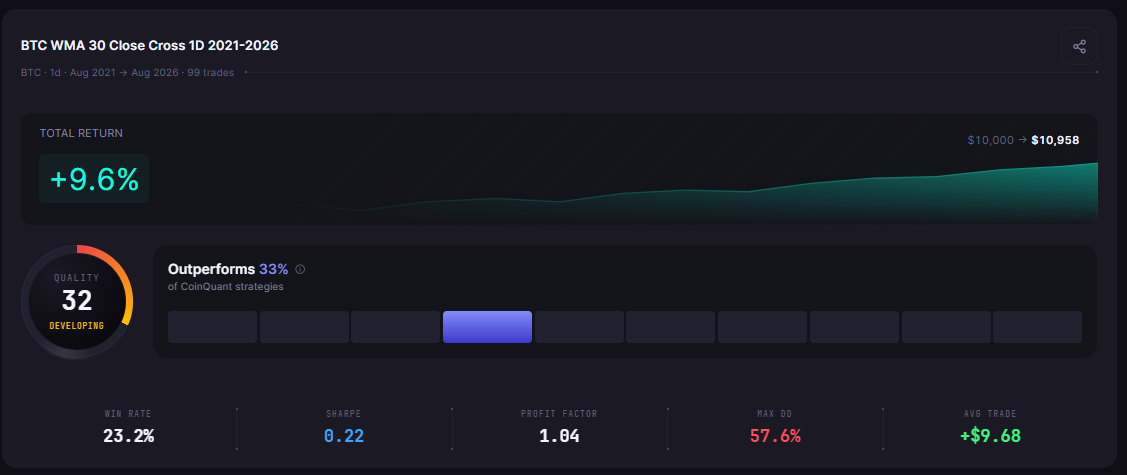
A plain English Bitcoin rule after its backtest: 99 trades over five years, +9.6% Total Return, $10,000 to $10,958, QUALITY 32
Binance AI Pro vs CoinQuant: Which to Use When
The two products start from the same place, a strategy described in words, and then take different first steps.
| Dimension | Binance AI Pro (its FAQ, 19 Oct 2026) | CoinQuant (its own docs and the example above) |
|---|---|---|
| How you build | Chat in natural language; AI Pro generates a workflow and Python code | Plain English description; the builder stores readable entry and exit rules |
| Historical backtest | "Backtesting is not available in the initial release." | Yes: you set the test window; here 2021-08-01 to 2026-08-01 |
| First check offered | Paper trading with simulated funds | A results card with Total Return, final balance, QUALITY and five core metrics |
| Testing named | Automated code testing, "separate from historical backtesting" | A historical backtest with fees included on every entry and exit; no slippage modelled |
| Markets | Spot and USDS-M Futures on Binance | Crypto pairs such as BTCUSDT on Binance spot in this example |
| Verdict | Use it to watch a strategy run on live prices | Use it first, to see years of results before you watch anything |
The verdict is about sequence, not a winner. Test the rule on history first, so you know its drawdown, trade count and fees. Then, if you use an agent product, paper trading shows whether it behaves as described on live prices. For an earlier comparison of the same kind, see CoinQuant vs Binance Agent OS.
The Practical Lesson
- Binance AI Pro starts with paper trading: its FAQ says backtesting is not in the initial release.
- Paper trading is slow evidence: a rule that trades about 20 times a year shows almost nothing in a month.
- A backtest gives the history first: the example rule made 9.58% in five years while holding Bitcoin made 57.33%.
Whatever tool you use to build a strategy, write the rule in one clear sentence, run it on as many years as you can and compare it with simply holding the coin. CoinQuant, an AI trading platform, does that from a plain English description, no coding required.
Build trading strategies on real data. No coding required.
Frequently Asked Questions
Does Binance AI Pro backtest strategies?
Not as of its FAQ published on 19 October 2026, which says "Backtesting is not available in the initial release." It offers paper trading instead, and says its automated code testing "is separate from historical backtesting."
Is paper trading enough to trust an AI strategy?
Rarely on its own. Paper trading shows only the weeks you watch, so a daily rule may place a handful of trades. A backtest over several years shows the trade count, drawdown and fees first.
What is an AI backtesting platform?
An AI backtesting platform turns a strategy described in words into exact rules and tests them on past prices with fees. CoinQuant is one: you describe the rule in plain English and it shows the stored rules and a results card. For more, see what AI agent backtesting is.
Check any AI built strategy against years of history before you watch it trade.
Disclaimer:
This content is for educational and informational purposes only and does not constitute financial, investment, or trading advice. All strategies and examples are for illustrative purposes and do not guarantee results. Always conduct your own research before making financial decisions.