
Survivorship Bias in Crypto Backtests: Why Testing Today's Coins Can Mislead You
Survivorship bias crypto backtest errors start before you run a single test: they start when you pick the coins. If you choose today's big names and test them over the last five years, you only test the coins that made it this far. The ones that faded or lost their listings never enter the sample, so the results describe a kinder market than the one traders actually faced.
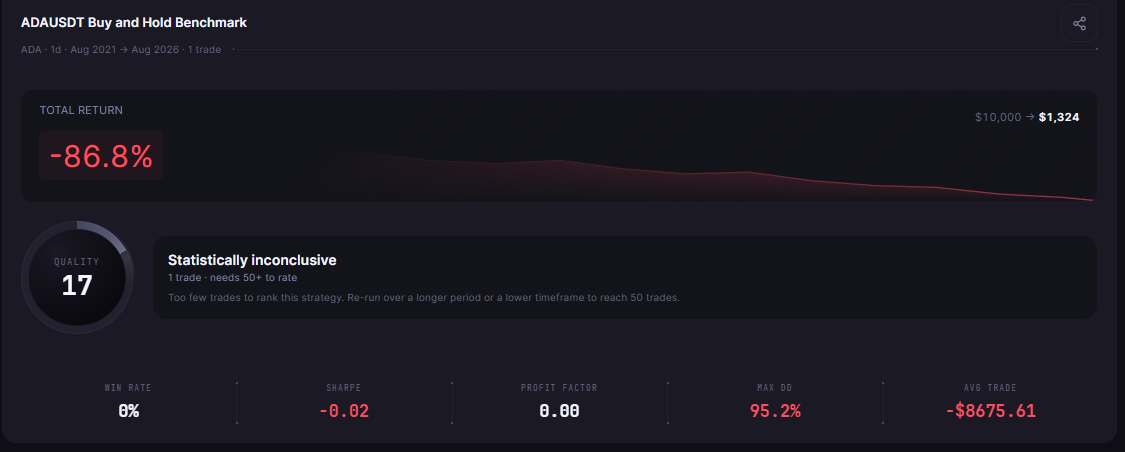
Surviving is not the same as winning, either. Cardano traded through the whole window, yet ADA Buy and Hold 1D 2021-2026 lost 86.76% from August 2021 to August 2026, with a 95.15% Max Drawdown along the way.
This guide explains how the bias creeps into a test, what a surviving coin can still teach you, how to check the history a pair actually has on CoinQuant and five rules for choosing assets to backtest fairly.
What Survivorship Bias Means in Crypto
Survivorship bias is the error of judging a group only by the members that are still around. In survivorship bias trading terms, it means testing a strategy on assets you picked because they survived, which hides the failures a trader at the start of the window could just as easily have bought.
Crypto makes the problem sharper because the coin list turns over fast:
- Rankings change: coins that led one cycle can fall far down the list in the next.
- Pairs stop trading: some markets are delisted, and their history drops out of lists of what you can test.
- New coins arrive: a coin that did not exist at the start of your window cannot be part of a fair test of that window.
The effect always points the same way: the worst outcomes leave the sample, so returns look higher and drawdowns smaller than they were.
In CoinQuant, you set the instrument for each backtest yourself, and the Supported Assets page lists every pair the platform covers. That makes the asset list a decision you take before testing, and it is the point where this crypto backtest bias either gets in or stays out.
How It Creeps Into a Backtest
The bias enters through ordinary choices:
- Picking assets after the fact: you choose coins because they are large or popular today. That uses information nobody had at the start of the test.
- Ignoring delisted pairs: delisted coins rarely appear in a backtest built from today's lists, because a pair that stopped trading tends to vanish from those lists.
- Trusting a fixed catalogue: even a platform's list moves. CoinQuant's changelog records expanded asset support on 27 July 2026, and its Supported Assets page lists 48 crypto pairs covering 21 crypto assets (as of 12 October 2026). A list like that shows what is supported today, not what traded in 2021.
- Dropping the bad runs: you test ten coins, keep the four that worked and forget the rest. That is survivorship bias applied to your own results.
A list of what you can test today is, by definition, a list of what is still supported today. That is fine, as long as you know it and say so in your results. For where the price history itself comes from, see where crypto backtest data comes from.
A Coin That Survived but Still Lost: ADA
ADA passes any "is it still listed?" test: it traded through the whole window and the backtest ran to 2026-08-01. You can rebuild this baseline by typing it in plain English, with no coding required:
Buy ADAUSDT with 100% of equity on the first daily bar and hold it to the end of the test. Test from August 1, 2021 to August 1, 2026 with $10,000 and a 0.1% fee.
As stored, the entry is a periodic trigger on every daily bar that fires on the first bar of the backtest, with 100% position size. There is no exit rule: the position is held to the end of the test.
| Metric | Result |
|---|---|
| Strategy | ADA Buy and Hold 1D 2021-2026 |
| Total Return | -86.76% |
| Final Balance | $1,324.39 |
| Max Drawdown | 95.15% |
| CAGR | -33.24% |
| Sharpe Ratio | -0.02 |
| Total Trades | 1 |
| Total Fees | $11.32 |
The balance peaked at $22,546.32 on 2021-09-03, a month into the test. It never got back above that level: it spent 1,793 days under water, touched $1,093.11 on 2026-06-25 and finished at $1,324.39.
The lesson cuts both ways. "Still listed" does not mean "safe to assume it worked", and a test list made only of coins that rose since 2021 adds an even stronger filter than a list of coins that still exist.
Data note: CoinQuant's ADAUSDT daily data has no bars from 2021-09-12 to 2021-09-14, and the platform does not flag the gap. This run held its position straight through it.
On the Performance tab, the results card marks this run "Statistically inconclusive": one trade, and it needs 50+ to rate. That is expected for a single buy and hold position.
Check the Data From Date Before You Test
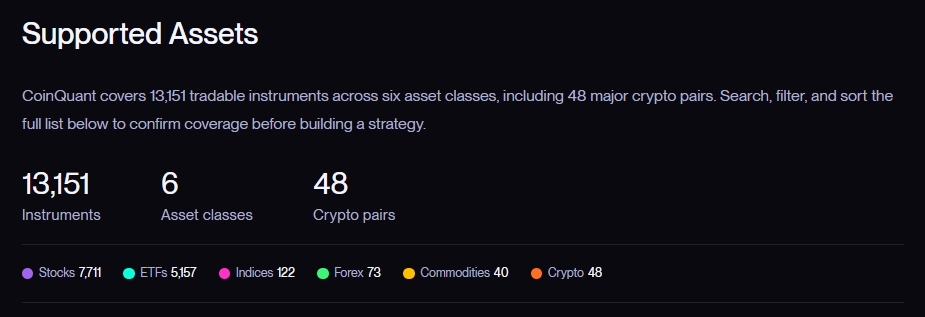
Before you test a list of coins, check how much history each pair really has. CoinQuant's Supported Assets page covers 13,151 instruments across six asset classes, including 48 crypto pairs (as of 12 October 2026), and lists a "Data from" date for each one.
For crypto, the page defines Data from as "the earliest manifest candle start across supported exchanges for the exact pair, in UTC." It adds that "The first usable bar can be later for a chosen exchange or timeframe."
- Filter the list to crypto: find every pair on the list you set in advance.
- Read each Data from date: note the latest one across your list.
- Start every test on or after that date: so all coins cover the same period.
- Check the first bar of each run: the usable history for your exchange and timeframe can start later.
A Data from date tells you where the history starts, not whether it is complete. The ADA gap above sits inside the window and is not flagged, so look out for odd jumps around a trade.
For the settings that decide whether a result is realistic once the assets are chosen, see backtesting data quality: fees, slippage and data mode.
Five Ways to Reduce Survivorship Bias: Crypto Backtest Checklist
- Set the asset list in advance: write the rule down before testing, for example "every crypto pair with a Data from date before my start date", not "the coins I know".
- Include coins that did badly: a list with ADA in it is more honest than a list of recent winners.
- Use one window for all: the same start and end dates, capital, sizing and fee, so the results compare like with like.
- Report every result: keep every run in your library (losers included) and average across all of them.
- Check the other biases too: overfitting and look-ahead bias can sit on top of survivorship, as how to tell if a backtest is lying to you explains.
Common mistakes
- Treating "still listed" as "safe": ADA survived and still lost 86.76%.
- Picking a 2021 test list from a 2026 ranking: the ranking already knows who won.
- Dropping a coin because its result was bad: that removes exactly the evidence you need.
- Assuming the catalogue never changes: check the pair list and its Data from dates each time you build a test.
The Practical Lesson
- Pick before you test: the asset list is a decision, so make it by rule and in advance.
- Survivors can still fail: ADA Buy and Hold 1D 2021-2026 lost 86.76% with a 95.15% Max Drawdown.
- Check the history: read the Data from date and the first bar of every run.
- Show the whole list: a result across several coins is only as honest as the coins it leaves out.
CoinQuant, an AI trading platform, lets you describe a strategy once in plain English and backtest it on each pair in your list, one run per pair, with the same window, capital and fee, so every coin is judged on the same terms.
Build trading strategies on real data. No coding required.
Frequently Asked Questions
What is survivorship bias in crypto backtesting?
It is the distortion you get when you test only coins that are still around today. The ones that faded or were delisted drop out of the sample, so returns look better and drawdowns smaller than they really were.
How do I avoid survivorship bias when I backtest crypto?
Set your asset list by a rule before you test, include coins that did badly, use one window for every coin and report every result. Check each pair's Data from date so all of them cover the same period.
Should a crypto backtest include coins that were delisted?
Ideally yes, when reliable data exists, because a trader at the start of the window could have bought them. If your platform only lists pairs it supports today, say so in your results and treat any average across coins as optimistic.
Look beyond returns. Explore your strategy’s drawdowns, risk metrics and trade history with CoinQuant. Analyze your strategy
Disclaimer:
Key Takeaway