
AI Agent Crypto Trading Is Here: What Coinbase for Agents Means for Traders

On June 11, 2026, Coinbase launched Coinbase for Agents, a tool that lets AI assistants trade crypto and move money on a user's behalf, within limits the user controls. Kraken followed with its own agentic trading push in July, and Robinhood introduced agents for its users days before Coinbase's announcement.
AI agent crypto trading moved from demo to default in the space of one quarter. This is no longer a theoretical debate about whether AI will trade. The execution layer now exists, from the largest US exchange down. The open question for traders is practical: how do you decide what an AI agent is allowed to do with your capital? The answer, as with any strategy, starts before the agent ever touches a live order.
What Agentic Trading Actually Is
Agentic trading means an AI model does not just recommend a trade. It has tools, an account connection, and permission to act: place orders, check balances, move funds, and rebalance, based on instructions you give it.
The mechanics in 2026 are concrete. Coinbase for Agents ships as an MCP (Model Context Protocol) server and a CLI, the two standard interfaces that let assistants like Claude and ChatGPT call tools. The user authorizes the connection and sets limits on what the agent can do. Kraken's July announcement describes agents that monitor markets and execute trades in real time, embedded in a rebuilt mobile app. Robinhood launched its agent feature days before Coinbase, per TechCrunch.
CNBC framed the shift on August 7, 2026 as crypto's "infrastructure era": companies are building the rails so that AI agents become the next wave of users, not just tools that humans operate.
AI Agent Crypto Trading: The Gap Between Agent and Strategy
Here is the distinction most coverage misses. An agent is an executor. It can place an order perfectly and still lose money if the strategy behind the order is bad. In AI agent crypto trading, the interface is the easy part; the strategy is the hard part.
An AI agent given a vague instruction like "trade ETH profitably" has no edge to execute. It has an interface. The strategy, the rules that decide when to buy and sell, is a separate artifact, and it is the part that needs validation.
That separation is the entire reason backtesting exists, and it is why the agentic trading wave makes backtesting more important, not less. When a model can act on your behalf at machine speed, the cost of an untested rule is measured in the same way: drawdown, fees, and win rate, only faster.
The Plain-English Bridge
There is a practical connection between how you instruct an agent and how you build a strategy on CoinQuant. Both use plain language.
The same sentence you would give an agent, "buy ETH when volume spikes and sell when it drops back," is exactly the kind of description CoinQuant converts into a backtestable strategy. The platform turns plain English into rules, runs them on Kaiko institutional data with fees and slippage included, and returns total return, Sharpe ratio, profit factor, max drawdown, win rate, and total trades.
So the workflow for agentic trading becomes: describe the strategy, backtest it, read the full report, iterate, and only then hand the tested rules to an execution layer, whether that is an agent or a bot.
A Concrete Example
Take a simple mean reversion idea for Ethereum:
"Enter long when RSI(14) crosses below 30. Exit long when RSI(14) crosses above 55."
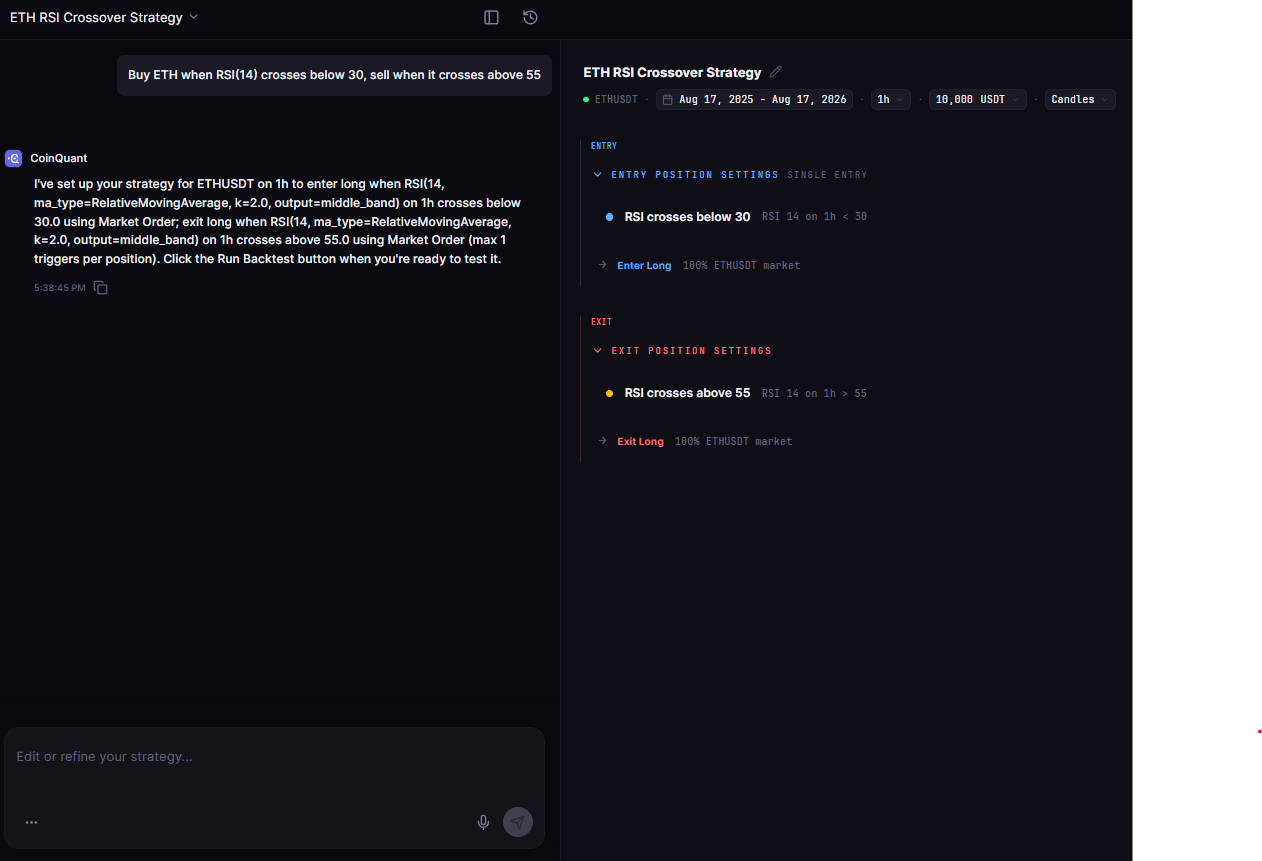
Written into CoinQuant, this becomes a backtest you can run in minutes against years of ETH data. You see exactly how often the signal fires, what percentage of trades win, how deep the drawdowns run, and whether the result survives fees. The strategy library contains variants of this exact family, including the ETH RSI(14) Mean Reversion strategies on the 1h, 4h, and 1d timeframes.
Only after the numbers look acceptable does it make sense to connect any executor, agent or otherwise, to a live account. That ordering, test first, execute second, is the difference between trading a strategy and gambling on one.
What to Watch For
Three practical points for traders evaluating agentic tools:
Limits are the safety rail. Coinbase for Agents is built around user-set limits on what the agent can do. Whatever platform you use, define the limits before you authorize anything.
The executor is not the strategy. A capable agent running a bad rule is still a bad outcome. Validate the rule, not just the interface.
Fees change the math. Agents that trade often generate fees on every order. A strategy that looks profitable before costs can lose after them, which is why fee-inclusive backtests matter.
How to Validate an Agent Strategy, Step by Step
The workflow below is the same one used for every backtest on CoinQuant, and it is exactly the loop an agent strategy should pass through before it touches a live account.
1. Write the strategy in one sentence. Example: "Buy ETH when RSI(14) crosses below 30, sell when it crosses above 55." If you cannot describe the rule in a sentence, the agent will not execute it reliably either.
2. Run the backtest. Enter the sentence into CoinQuant, pick the asset and timeframe, and run it on Kaiko data with fees and slippage included.
3. Read the full report. Check total return, Sharpe ratio, profit factor, max drawdown, win rate, and total trades. A high win rate with a negative return means the losers are bigger than the winners, which is a different failure from a low win rate.
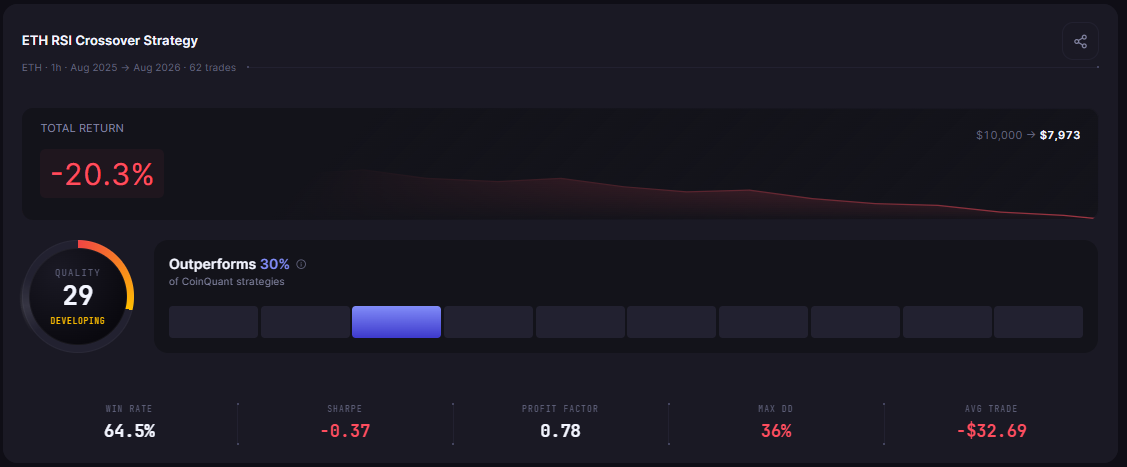
4. Change one thing, re-run. Adjust a single parameter, the exit threshold or the stop level, and compare the new report against the old one. One change at a time is what makes the comparison meaningful.
5. Only then authorize the agent. If the tested rule passes your bar, connect it to the execution layer with limits in place. If it does not, the backtest just saved you from funding a losing rule.
This ordering is the entire discipline. The agent does not need to be smarter; it needs to execute a rule that was tested. The rule is the strategy, and the strategy is only as good as the evidence behind it.
Common Mistake: Skipping the Test
The most common mistake in the agentic gold rush is skipping straight to execution. The agent can place the order, so the trader assumes the thinking is done. It is not. The thinking was done the moment the rules were written, and if those rules were never tested, the agent is executing an opinion.
Backtesting does not guarantee a strategy works live. It does the more modest and more valuable thing: it replaces an opinion with evidence before money is at risk. With agents trading 24/7, that evidence step is the only control you keep. If you are new to testing agents, our AI agent backtesting explainer and the step-by-step agent backtest guide cover the full workflow.
The Bottom Line
Coinbase for Agents, Kraken's agentic app, and Robinhood's agents all point the same direction: AI will execute trades at scale, and the interface between human and market is becoming conversational. None of that changes the fundamental requirement of profitable trading, which is a strategy that has been tested.
The tested strategy is the asset you actually own. The agent is just the hand that places the order. Build the strategy in plain English, validate it on real data with real costs, and only then let an agent anywhere near a live account.
Disclaimer:
Key Takeaway
