
Backtest Results
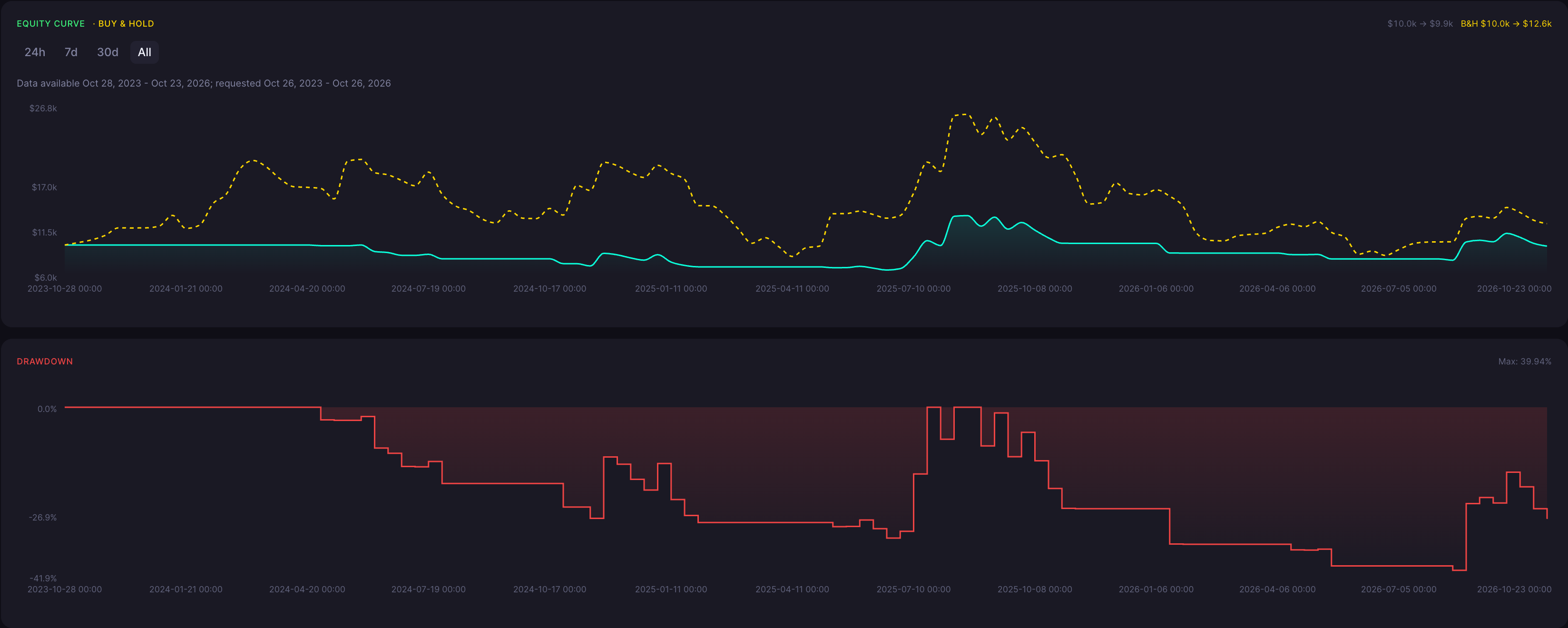
This saved ETHUSDT five-day backtest reports a -1.41% return, meaning the run ended below its starting capital, with a 39.94% maximum drawdown. Requested bounds: start 26 Oct 2023, end 26 Oct 2026. Effective bounds: start 28 Oct 2023, end 23 Oct 2026. The platform reported that market data availability shortened the date range set for this test. The start and end dates shown are the platform's own dates, not confirmed candle-close boundaries, and the underlying history limitation remains unresolved.
ROI
-1.41%
Win Rate
21.43%
Max DD
39.94%
Sharpe
0.16
Profit Factor
0.97
Total Trades
14
Backtest insights
The ending loss was modest relative to the recorded drawdown, but that does not make the path low risk. The test produced 14 trades, a 21.43% win rate and a profit factor of 0.97. These figures describe this historical sample only. They do not identify why losses occurred or demonstrate performance in any measured market regime. The small number of trades, the shorter available test dates and the unconfirmed indicator setup should stay central to how these results are read, rather than being treated as minor details.

Performance may vary depending on market conditions. During trending periods, the strategy may behave differently compared to ranging markets, impacting both returns and drawdowns.
How the RMA Strategy Works
What It Is
The intended indicator is a Running Moving Average with a 10-period length and Close source. In the saved implementation, the corresponding series is named RelativeMovingAverage, with period 10 and price_type="close".
The shared period and source do not prove that the saved formula matches the requested indicator. How the indicator was calculated and how it was started have not been confirmed. The saved configuration also carries a disclosed 72-field difference class, including generic oscillator and divergence controls. Their effect has not been ruled out, so the result should not be presented as an exact match of the requested strategy.
How Signals Are Generated
The long-only request defines entry when Close crosses above the moving average and exit when Close crosses below it. The saved conditions express those rules as:
Close crosses above RelativeMovingAverage, action enter_long.
Close crosses below RelativeMovingAverage, action exit_long.
Both conditions specify market orders and use 5d for the comparison series. The request excludes extra conditions, filters, stops, targets and short positions.
Saved confirmation, debounce, signal-lifetime and deferred-entry controls are also present. They cannot be assumed inactive simply because the requested rule is simple. Neither the 14-trade count nor the supplied timestamps establish that every eligible crossing executed.
When It Works Best
As general theory, a moving-average crossover can be more suited to sustained directional movement than to frequent reversals around the average. This statement was not measured in this run. The results do not show which market conditions suited this five-day strategy best.
When It Performs Poorly
General theory suggests that lagging signals can respond after reversals and that repeated crossings can occur when price moves back and forth around an average. Neither mechanism was measured as a cause of this run’s loss. No claim is made that sideways conditions, signal turnover or fees explain the observed outcome.
Strengths

The intended entry and exit rules can be stated plainly and inspected separately.
A specified period, Close source and five-day timeframe define the requested signal inputs.
Explicit capital-allocation and market-order settings provide a concrete basis for reviewing the saved setup.
Limitations

The run lost 1.41% and experienced a 39.94% maximum drawdown; one historical sample does not establish reliability, measured regime performance, complete signal execution or future returns.
The reported total fees do not show the fee rates, slippage or which costs were counted, and missing settings do not mean costs were zero.
It is unconfirmed whether the Running Moving Average requested for this test matches the RelativeMovingAverage saved in the strategy; the 72 disclosed setting differences, how the indicator starts and behaves at the beginning of the test, and whether the open, high, low and close price history is complete and continuous are also unconfirmed. The platform's alert that the date range was shortened is not resolved.
Why Use CoinQuant Instead of Manual Trading or Other Platforms
Choosing the right way to test and execute trading strategies is critical. Below is a comparison between CoinQuant, manual trading, and other platforms to highlight key differences in speed, accuracy, and usability.
CoinQuant is designed specifically for traders who want to validate strategies quickly and reliably without coding. Unlike manual trading or traditional platforms, it allows you to test multiple scenarios, analyze performance instantly, and iterate faster using real data.
Frequently asked questions
How does the RMA strategy perform on ETH in the 5 day timeframe?
The performance of the RMA strategy on ETH in the 5 day timeframe depends on market conditions. Based on the backtest results above, it achieved a return of -1.41% with a maximum drawdown of 39.94%. Results may vary depending on volatility and overall market trends.
Is the RMA strategy reliable for trading ETH?
The RMA strategy can be effective when used in the right conditions. For ETH, it typically performs well in sustained directional trends (general theory, not measured in this run) but may underperform during choppy or sideways markets (general theory, not measured in this run). Backtesting helps evaluate its reliability before applying it in live trading.
Why is backtesting important for trading strategies?
Backtesting allows traders to evaluate how a strategy would have performed using historical data. It helps identify strengths, weaknesses, and risk levels before applying the strategy in real markets, reducing the likelihood of unexpected losses.
How can I test the RMA strategy on CoinQuant?
You can use CoinQuant to build and backtest the RMA strategy without coding. Simply select your asset, define your strategy rules, and run a backtest to view detailed performance metrics instantly.
What are the best settings for the RMA strategy on 5 day?
The best settings for the RMA strategy depend on the asset and timeframe. Traders often adjust parameters based on volatility and trading style. Using a backtesting platform like CoinQuant allows you to test different configurations and identify what works best.