
Backtest Results
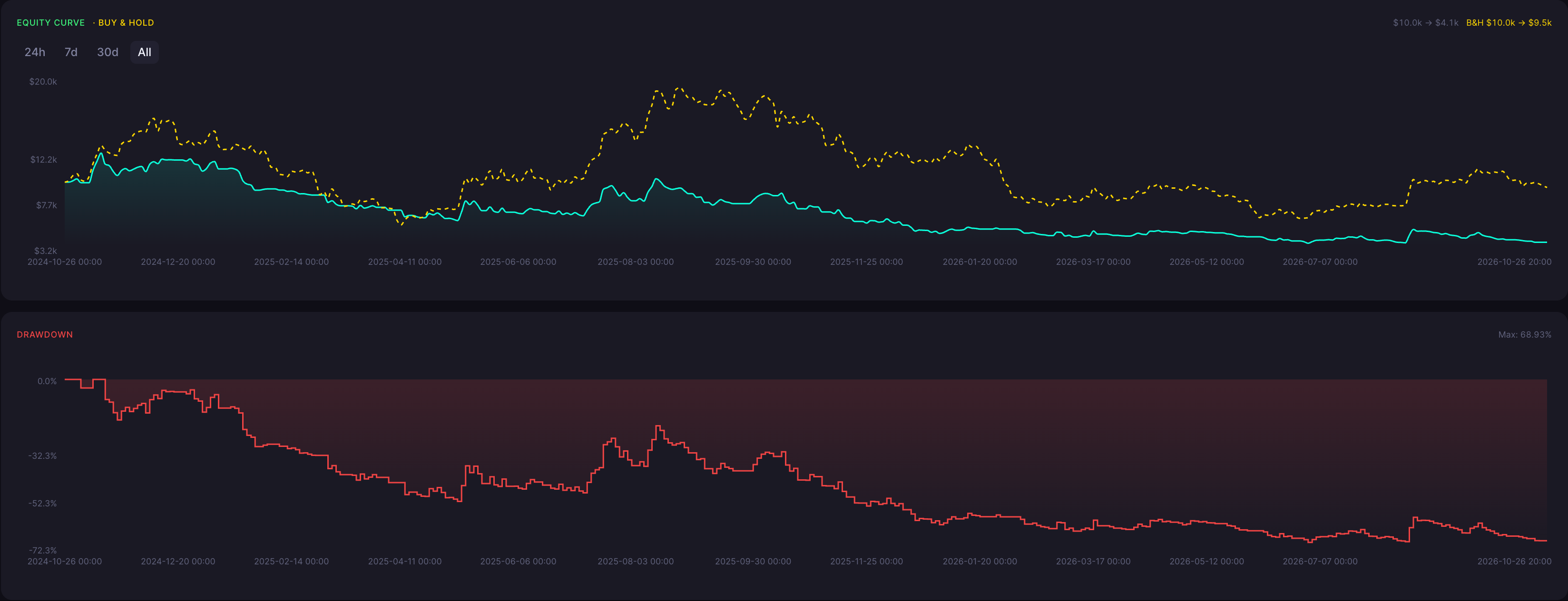
The test recorded a -59.06% return and a final balance of 4,094.34 USDT from 10,000.00 USDT of starting capital. The test period was 26 Oct 2024 to 26 Oct 2026. These fields do not, on their own, establish that the price history used is complete and continuous, or how the indicators were prepared at the start of the test.
ROI
-59.06%
Win Rate
21.40%
Max DD
68.93%
Sharpe
-0.72
Profit Factor
0.77
Total Trades
299
Backtest insights
The main result is a large historical loss: the strategy returned -59.06% while recording a 68.93% maximum drawdown. Its 21.40% win rate and 0.77 profit factor describe this particular result, not a dependable future pattern. The final balance was 4,094.34 USDT. These observations do not identify why losses occurred or establish that every crossing became a trade. Interpreting the result also requires the disclosed uncertainty around saved indicator identity, execution settings, costs and checks of the historical market data.

Performance may vary depending on market conditions. During trending periods, the strategy may behave differently compared to ranging markets, impacting both returns and drawdowns.
How the RMA Strategy Works
What It Is
The requested indicator was a Running Moving Average, with period 10 and Close as its source. The saved strategy identifies the comparison series as RelativeMovingAverage, also with period 10 and Close source.
This page preserves that naming distinction. It does not confirm that the saved strategy calculates the Running Moving Average exactly as requested. The exact formula and how the indicator sets its starting values have not been confirmed.
The disclosed 72-field difference class was accepted as a risk, not as proof of mathematical equivalence or proof that generic oscillator and divergence controls are inactive. Those saved fields are not presented as separate requested RSI or divergence trading rules.
How Signals Are Generated
The requested and saved primary crossing rules are:
Entry: Close crosses above the period-10 moving-average series, with the saved action enter_long.
Exit: Close crosses below the period-10 moving-average series, with the saved action exit_long.
Order type: Market orders for both entry and exit.
Both comparison series use the 4h timeframe. The strategy is long-only. The request contains no additional filters, stops, targets or short positions.
The saved strategy also includes order and signal settings. Their presence means the crossing description alone is not proof that every observed crossing generated an executed order. Signal completeness and the effects of the generic controls have not been established.
When It Works Best
In general theory, a moving-average crossing approach may benefit when price maintains a sustained direction long enough for a position to remain open after entry. This is a structural expectation, not measured in this run. The supplied result does not show which market conditions produced its winning trades.
When It Performs Poorly
In general theory, repeated reversals around a moving average can make a crossing strategy difficult to trade, while delayed signals can miss part of a move. These possibilities were not measured in this run and must not be used to attribute this result's losses to a particular regime or mechanism.
Strengths

The primary entry and exit rules use explicit crossing conditions rather than discretionary judgments.
The requested period-10, Close-source setup provides a clearly stated parameter choice for review.
The long-only structure and current-equity allocation basis make the intended direction and sizing method visible.
Limitations

This single historical result shows a substantial loss and does not establish causality, regime behavior, complete signal execution, reliability or future performance.
Trading fee rates and slippage were not provided, so they should not be read as zero, and it is not known whether costs were included. The reported fee figure should not be used to explain the losses.
The saved strategy uses a differently named indicator (Relative Moving Average), and it has not been confirmed that it matches the requested Running Moving Average or how its formula, settings and starting values work. The price history may not be complete or continuous.
Why Use CoinQuant Instead of Manual Trading or Other Platforms
Choosing the right way to test and execute trading strategies is critical. Below is a comparison between CoinQuant, manual trading, and other platforms to highlight key differences in speed, accuracy, and usability.
CoinQuant is designed specifically for traders who want to validate strategies quickly and reliably without coding. Unlike manual trading or traditional platforms, it allows you to test multiple scenarios, analyze performance instantly, and iterate faster using real data.
Frequently asked questions
How does the RMA strategy perform on ETH in the 4 hour timeframe?
The performance of the RMA strategy on ETH in the 4 hour timeframe depends on market conditions. Based on the backtest results above, it achieved a return of -59.06% with a maximum drawdown of 68.93%. Results may vary depending on volatility and overall market trends.
Is the RMA strategy reliable for trading ETH?
The RMA strategy can be effective when used in the right conditions. For ETH, it typically performs well in sustained directional trends (general theory, not measured in this run) but may underperform during choppy or sideways markets (general theory, not measured in this run). Backtesting helps evaluate its reliability before applying it in live trading.
Why is backtesting important for trading strategies?
Backtesting allows traders to evaluate how a strategy would have performed using historical data. It helps identify strengths, weaknesses, and risk levels before applying the strategy in real markets, reducing the likelihood of unexpected losses.
How can I test the RMA strategy on CoinQuant?
You can use CoinQuant to build and backtest the RMA strategy without coding. Simply select your asset, define your strategy rules, and run a backtest to view detailed performance metrics instantly.
What are the best settings for the RMA strategy on 4 hour?
The best settings for the RMA strategy depend on the asset and timeframe. Traders often adjust parameters based on volatility and trading style. Using a backtesting platform like CoinQuant allows you to test different configurations and identify what works best.