
Backtest Results
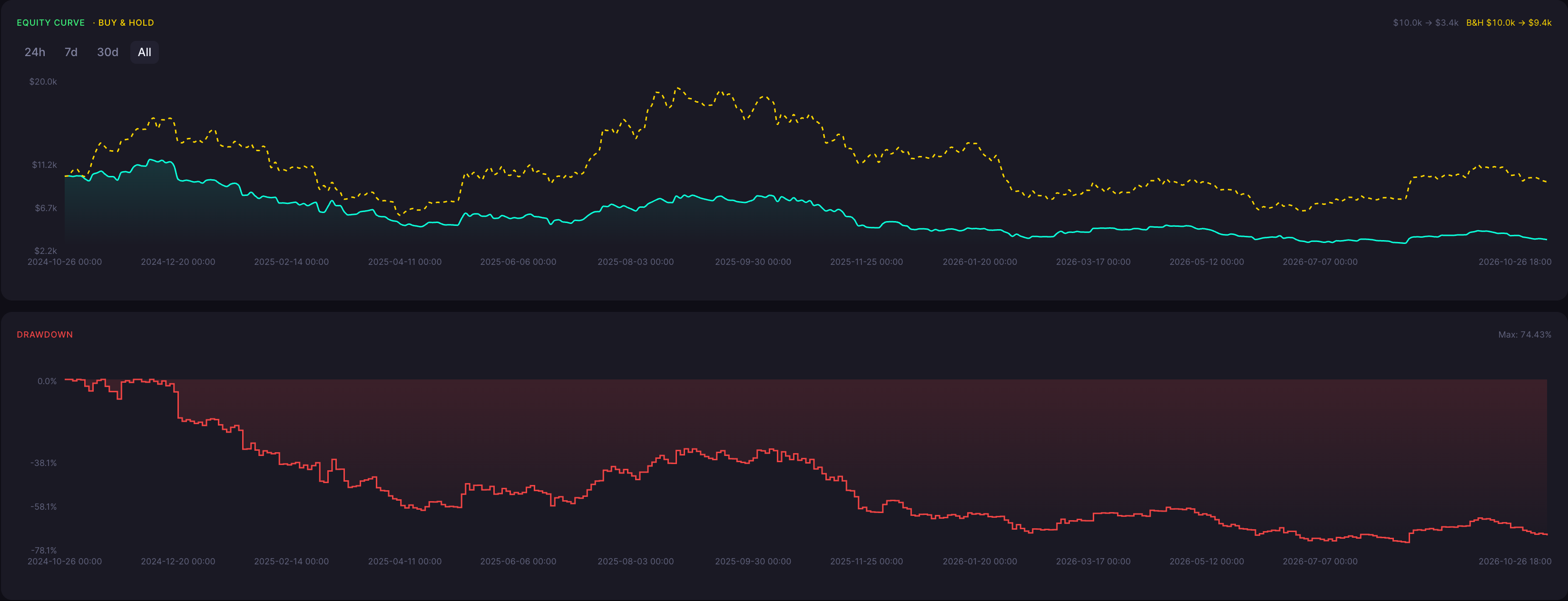
This page documents one CoinQuant backtest of a long-only Hull Moving Average (HMA) crossover strategy on ETHUSDT using 6-hour candles. The run lost money, returning -66.10% across 455 trades. The test covered 26 Oct 2024 to 26 Oct 2026. CoinQuant works across asset classes, including stocks, forex, gold, oil and crypto. This page covers a single ETH test with one fixed parameter set.
ROI
-66.10%
Win Rate
33.63%
Max DD
74.43%
Sharpe
-0.82
Profit Factor
0.80
Total Trades
455
Backtest insights
Result summary: from 26 Oct 2024 to 26 Oct 2026, the strategy returned -66.10% on 455 trades. The win rate was 33.63%, the profit factor was 0.80 and the Sharpe ratio was -0.82, so losing trades outweighed winning trades in aggregate. Maximum drawdown reached 74.43%. The buy-and-hold reference over the same test dates reached a final value of 9,404.62 against the 10,000.00 USDT starting capital, and the strategy's -66.10% result was substantially weaker than that reference. With 455 trades and trading costs not provided, it is unknown how trading costs affected this figure. In this test, a fast 10-period HMA crossover on 6h ETH candles did not produce a favorable outcome.

Performance may vary depending on market conditions. During trending periods, the strategy may behave differently compared to ranging markets, impacting both returns and drawdowns.
Strategy Explanation
What It Is
The Hull Moving Average is a weighted moving average design intended to reduce lag compared with simple averages. It is commonly calculated by combining weighted moving averages of half and full length and smoothing the result over the square root of the length; CoinQuant's internal implementation details are not covered here. The rules tested: trade ETHUSDT spot on the 6h timeframe, using a 10-period HMA on the Close. Enter long when Close crosses above the HMA. Exit long when Close crosses below the HMA. There are no extra conditions, filters, stops, targets or short positions. Starting capital was 10,000.00 USDT, with each position sized at 100.00% of current equity and at most one open position at a time.
How Signals Are Generated
Enter long when Close crosses above HMA(10); exit when Close crosses below HMA(10). The saved CoinQuant crosses-above and crosses-below rules define how an equal value at the crossover boundary is handled. There are no extra filters, shorts, discretionary entries or added stop/target conditions.
When It Works Best
Sustained directional movement can favor a moving-average crossover. This is a general strategy characteristic, not a confirmed explanation of this run's result.
When It Performs Poorly
Repeated crossings in sideways or rapidly reversing markets can create whipsaws and costs. The historical outcome must be read with that risk in mind.
Strengths

The Hull Moving Average is a weighted moving average design intended to reduce lag compared with simple averages.
It is commonly calculated by combining weighted moving averages of half and full length and smoothing the result over the square root of the length; CoinQuant's internal implementation details are not covered here.
The rules tested: trade ETHUSDT spot on the 6h timeframe, using a 10-period HMA on the Close.
Limitations

Date range: 26 Oct 2024 to 26 Oct 2026. This page does not claim the test used a complete or unbroken price history.
Trading fees were not provided. Trading costs were not provided, so it is unknown whether the result includes any. Slippage was not provided. The 732 performance points are sampled snapshots of performance, not the underlying price candles, and they do not show the candle timeframe. The page does not show how the strategy handled the first bars of the test.
The SQS score is a CoinQuant figure; its definition is not covered on this page. This is a single historical test of one asset, one timeframe, one parameter set and one window. It does not show how the rules would behave in other conditions.
Why Use CoinQuant Instead of Manual Trading or Other Platforms
Choosing the right way to test and execute trading strategies is critical. Below is a comparison between CoinQuant, manual trading, and other platforms to highlight key differences in speed, accuracy, and usability.
CoinQuant is designed specifically for traders who want to validate strategies quickly and reliably without coding. Unlike manual trading or traditional platforms, it allows you to test multiple scenarios, analyze performance instantly, and iterate faster using real data.
Frequently asked questions
Was the ETH HMA 6h strategy profitable in this backtest?
No. It returned -66.10% over 455 trades, with a 33.63% win rate, a profit factor of 0.80 and a maximum drawdown of 74.43%.
What date range did the backtest cover?
The test covered 26 Oct 2024 to 26 Oct 2026. The test covered 26 Oct 2024 to 26 Oct 2026.
Are trading fees and slippage included?
Unknown. Trading costs were not provided, so it is unknown whether the result includes any.
How can I reproduce this run on CoinQuant?
Use the exact reproduction prompt below without changes. It creates a draft strategy only; the backtest is then run as a separate step over 26 Oct 2024 to 26 Oct 2026 on the 6h timeframe.
Did this strategy use stops or short trades?
No. It is long-only with a single HMA crossover entry and exit, and no stops, targets, filters or shorts.