
Live Backtest Results
This backtest analyzes the performance of the Breakout strategy on ETH/USDT over the 1 Month timeframe using historical market data. The strategy enters when price breaks above the 20-period high and exits when price breaks below the 10-period low. The results provide insight into how the strategy would have performed under real market conditions, including profitability, risk exposure, and consistency.
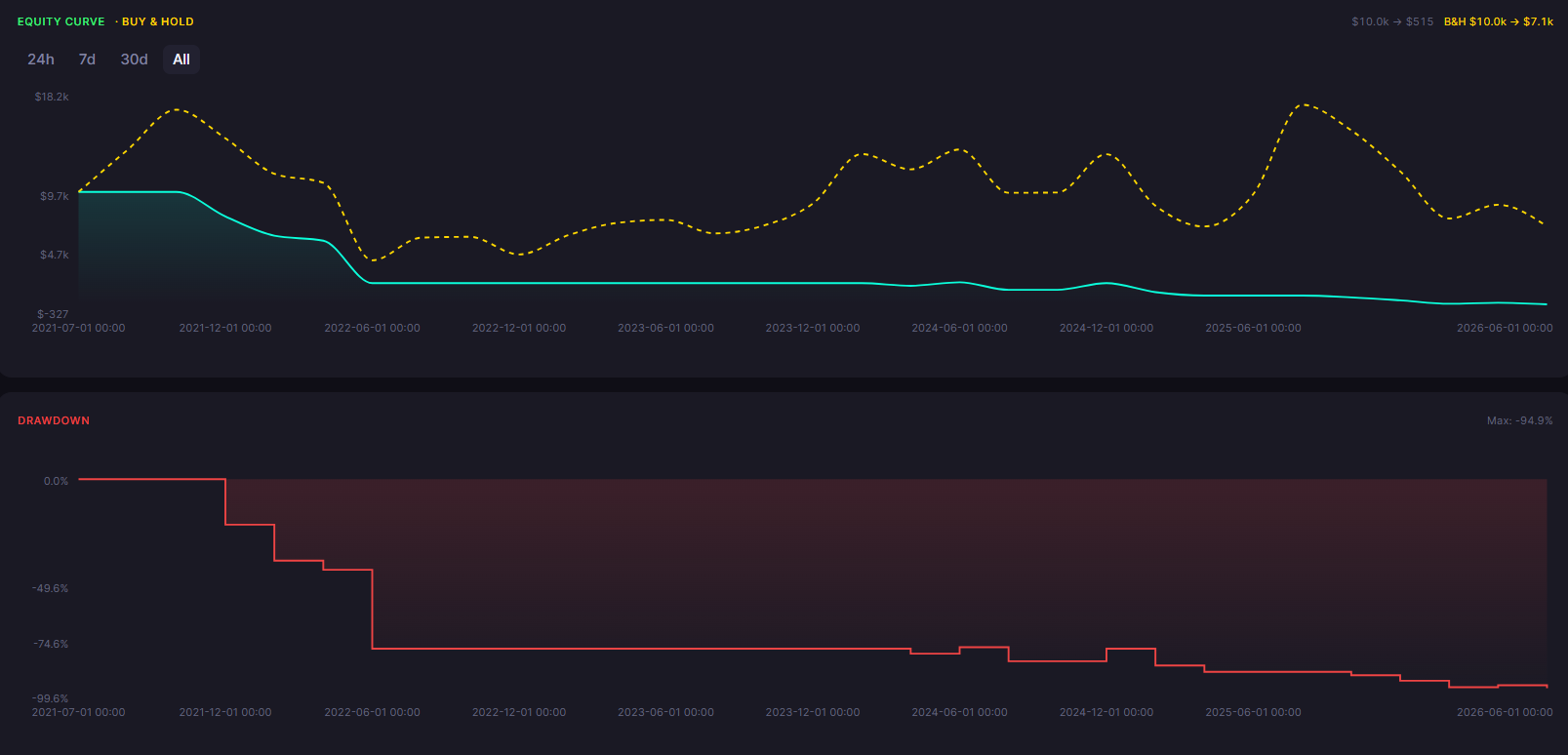
ROI
-95.21%
Win Rate
0%
Max DD
95.21%
Sharpe
-1.0
Profit Factor
N/A
Total Trades
3
Backtest insights
The Breakout strategy generated a total return of -95.21%, indicating negative performance. The maximum drawdown of 95.21% suggests high volatility and significant risk exposure. With a win rate of 0% across 3 trades, the strategy demonstrates a limited sample size.

Performance may vary depending on market conditions. During trending periods, the strategy may behave differently compared to ranging markets, impacting both returns and drawdowns.
How the Breakout Strategy Works
What It Is
The Breakout strategy is a momentum-based trend-following approach that enters trades when price breaks through a previously established high, indicating that buying pressure has overwhelmed prior resistance. Specifically, this strategy buys when ETH/USDT breaks above the 20-period high, signaling that bulls have taken control and a new directional move may be beginning. The exit is triggered when price falls below the 10-period low, protecting gains by locking in profits when momentum fades or reverses.
How Signals Are Generated
In this strategy, trading signals are generated when ETH/USDT price breaks through established resistance levels on the 1 Month timeframe. A buy signal triggers when the closing price exceeds the highest high of the last 20 periods, confirming that buyers have decisively pushed through the prior ceiling. An exit signal occurs when price drops below the lowest low of the last 10 periods, indicating that sellers have regained control and the trend may be reversing.
When It Works Best
This strategy tends to perform best in trending markets following extended consolidation phases. On the 1 Month timeframe, breakouts from multi-week or multi-month ranges can produce large, sustained directional moves with strong follow-through. Markets with clear directional momentum and strong volume behind breakouts produce the most reliable signals.
When It Performs Poorly
However, the strategy may underperform during choppy, range-bound conditions where price repeatedly tests highs without sustaining the move, generating costly false breakouts. Major news events that briefly spike price before reversing are particularly challenging for breakout strategies.
Strengths

Captures the early stage of major trend moves by entering at the point of breakout confirmation
Asymmetric exit logic: wider lookback for entry (20-period), tighter trailing stop (10-period low) to protect gains
Works across multiple timeframes, from intraday scalping to longer-term swing and position trading
Limitations

False breakouts in low-volume periods can generate losing trades before the real move begins
Whipsaws in ranging markets degrade performance as price oscillates around the 20-period hig
As a trend-following strategy, it enters after a move has started, it can never catch the exact bottom
Why Use CoinQuant Instead of Manual Trading or Other Platforms
Choosing the right way to test and execute trading strategies is critical. Below is a comparison between CoinQuant, manual trading, and other platforms to highlight key differences in speed, accuracy, and usability.
CoinQuant is designed specifically for traders who want to validate strategies quickly and reliably without coding. Unlike manual trading or traditional platforms, it allows you to test multiple scenarios, analyze performance instantly, and iterate faster using real data.
Frequently asked questions
How does the Breakout strategy perform on ETH/USDT in the 1 Month timeframe?
Based on the backtest results above, the Breakout strategy achieved a return of -95.21% with a maximum drawdown of 95.21% on ETH/USDT over the 1 Month timeframe. Results may vary depending on volatility and overall market trends.
Is the Breakout strategy reliable for trading ETH/USDT?
The Breakout strategy can be effective in the right conditions. For ETH/USDT, it typically performs well in trending markets following extended consolidation phases, but may underperform during choppy, range-bound conditions where price repeatedly tests highs. Backtesting helps evaluate reliability before applying it in live trading.
Why is backtesting important for trading strategies?
Backtesting allows traders to evaluate how a strategy would have performed using historical data. It helps identify strengths, weaknesses, and risk levels before applying the strategy in real markets, reducing the likelihood of unexpected losses.
How can I test the Breakout strategy on CoinQuant?
You can use CoinQuant to build and backtest the Breakout strategy without coding. Simply type the prompt shown below into the CoinQuant chat box and the platform will parse your natural language instruction, generate the strategy logic, and run the full backtest automatically.
What are the best settings for the Breakout strategy on the 1 Month timeframe?
The standard 20-period high / 10-period low works well as a starting point, but traders sometimes widen the lookback (e.g., 30-period high) on longer timeframes to reduce false signals. CoinQuant lets you test parameter variations quickly.
Explore similar strategies
