
Live Backtest Results
This backtest analyzes the performance of the Volume Surge strategy on BTC/USDT over the 5-minute timeframe using historical market data. The results provide insight into how the strategy would have performed under real market conditions, including profitability, risk exposure, and consistency.
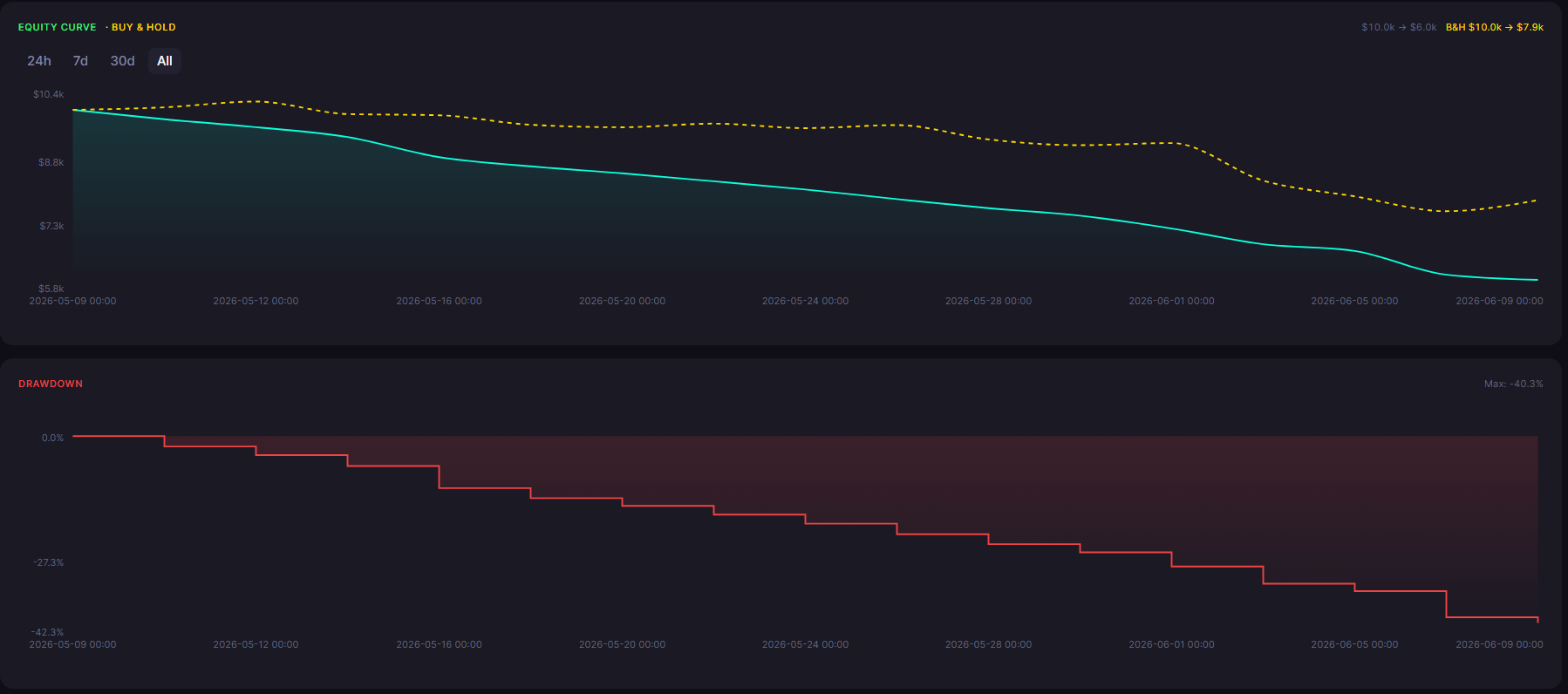
ROI
-38.49%
Win Rate
27.2%
Max DD
38.49%
Sharpe
N/A
Profit Factor
N/A
Total Trades
1022
Backtest insights
The Volume Surge strategy generated a total return of -37.97% over the 1 month backtest window. The maximum drawdown of 38.18% reflects the peak-to-trough decline during the test period. With a win rate of 26.68% across 1027 trades, the strategy shows below-average signal accuracy on the 5-minute chart.

Performance may vary depending on market conditions. During trending periods, the strategy may behave differently compared to ranging markets, impacting both returns and drawdowns.
How the Volume Surge Strategy Works
What It Is
The Volume Surge strategy uses trading volume as its primary signal rather than price patterns. It enters a long position when the current candle's volume exceeds 2 times the 20-period average volume and the candle closes bullish (close above open). The logic is that unusually high buying volume, combined with a positive candle, indicates genuine demand and momentum. The strategy exits when volume drops back below the 20-period average, treating reduced trading activity as a signal that the momentum move is fading.
How Signals Are Generated
In this strategy, trading signals are generated based on predefined volume conditions. A buy signal occurs when the current 5-minute candle's volume exceeds 2× the 20-period average volume AND the candle closes bullish (close greater than open). This dual condition filters out volume spikes that occur on bearish candles, ensuring the surge is directionally aligned with buying pressure. An exit signal occurs when volume falls back below the 20-period average volume, confirming that the momentum episode has ended. With 5-minute candles, each signal reflects a focused stretch of market activity.
When It Works Best
This strategy tends to perform best in high-frequency bursts of activity with clear intraday directional bias. On the 5-minute timeframe, volume surges carry more weight when they coincide with macro catalysts, significant exchange flows, or correlation-driven market moves. The cleaner the volume signal, the more reliable the entry and exit.
When It Performs Poorly
However, the strategy may underperform in markets dominated by noise where high-frequency volume spikes often lack directional follow-through. When volume spikes without sustained directional follow-through, the strategy enters too early and exits before a meaningful move develops, or gets stopped out by noise at the 5-minute level.
Strengths

Uses raw market participation data rather than lagging price indicators
Entry and exit rules are simple, objective, and fully automatable
Volume thresholds adapt dynamically to the 20-period rolling average
Limitations

No built-in stop-loss - relies entirely on volume conditions for risk management
Volume spikes without directional follow-through generate false entries
Performance is highly sensitive to the specific backtest window and market regime
Why Use CoinQuant Instead of Manual Trading or Other Platforms
Choosing the right way to test and execute trading strategies is critical. Below is a comparison between CoinQuant, manual trading, and other platforms to highlight key differences in speed, accuracy, and usability.
CoinQuant is designed specifically for traders who want to validate strategies quickly and reliably without coding. Unlike manual trading or traditional platforms, it allows you to test multiple scenarios, analyze performance instantly, and iterate faster using real data.
Frequently asked questions
How does the Volume Surge strategy perform on BTC/USDT in the 5-minute timeframe?
The performance of the Volume Surge strategy on BTC/USDT in the 5-minute timeframe depends on market conditions. Based on the backtest results above, it achieved a return of -37.97% with a maximum drawdown of 38.18%. Results may vary depending on volatility and overall market trends.
Is the Volume Surge strategy reliable for trading BTC/USDT?
The Volume Surge strategy can be effective when used in the right conditions. For BTC/USDT, it typically performs well in high-frequency bursts of activity with clear intraday directional bias but may underperform in markets dominated by noise where high-frequency volume spikes often lack directional follow-through. Backtesting helps evaluate its reliability before applying it in live trading.
Why is backtesting important for trading strategies?
Backtesting allows traders to evaluate how a strategy would have performed using historical data. It helps identify strengths, weaknesses, and risk levels before applying the strategy in real markets, reducing the likelihood of unexpected losses.
How can I test the Volume Surge strategy on CoinQuant?
You can use CoinQuant to build and backtest the Volume Surge strategy without coding. Simply type the prompt shown below into the CoinQuant chat box and the platform will parse your natural language instruction, generate the strategy logic, and run the full backtest automatically.
What are the best settings for the Volume Surge strategy on the 5-minute timeframe?
The standard settings are a 20-period volume average with a 2× surge threshold. Traders can adjust the period (lower periods like 10 make the strategy more reactive; higher periods like 50 require more sustained surges) or the multiplier (1.5× generates more signals; 3× filters for only the most extreme volume events). Using CoinQuant allows you to test different configurations and identify what works best.