
Live Backtest Results
The BTC Long Upper Shadow backtest applies the same rule throughout this page: Enter long when a Long Upper Shadow pattern is detected. Exit long when a Bearish Engulfing pattern is detected.
ROI
-62.9%
Win Rate
50.1%
Max DD
69.15%
Sharpe
-2.58
Profit Factor
0.68
Total Trades
1263
Backtest insights
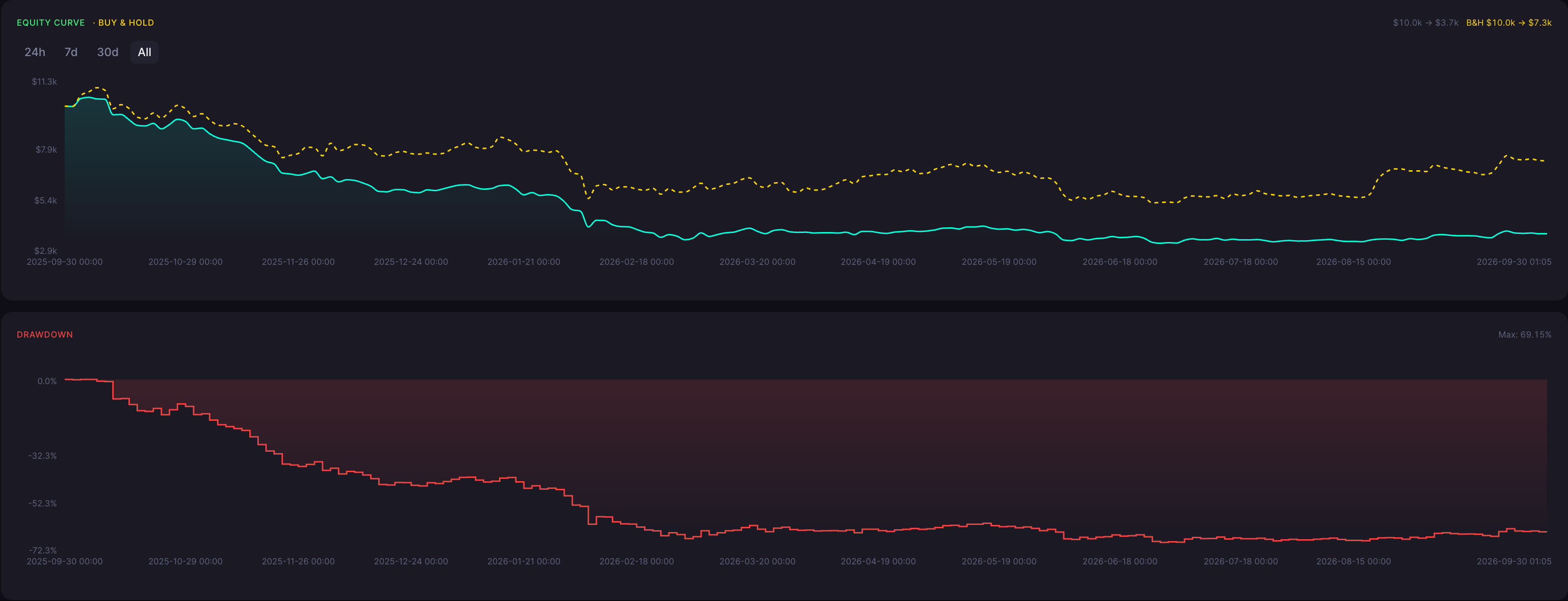
The Long Upper Shadow strategy generated reported ROI of -62.9% from exact raw Total Return -0.628533794811 over the 5 minute timeframe. Maximum drawdown was 69.15%, win rate was 50.1%, and the test recorded 1263 trades.

Performance may vary depending on market conditions. During trending periods, the strategy may behave differently compared to ranging markets, impacting both returns and drawdowns.
How the BTC Long Upper Shadow Strategy Works
What It Is
A Long Upper Shadow candle has an upper wick that extends well above its real body, showing that price traded higher before retreating into the close. This long-only rule treats it as a conditional recovery hypothesis, not bullish confirmation.
How Signals Are Generated
A long entry triggers when a Long Upper Shadow pattern is detected on the selected timeframe. The position exits when a Bearish Engulfing pattern is detected.
When It Works Best
It can work when BTC/USDT absorbs the rejection and later price action confirms a recovery.
When It Performs Poorly
It can perform poorly when the upper wick reflects sustained supply and price continues lower.
Strengths

Tests a named rejection pattern without relabeling it bullish
Uses transparent candle-pattern rules
Makes a conditional recovery hypothesis auditable across timeframes
Limitations

Upper-shadow rejection is not bullish confirmation
Contrarian entries can lose if selling persists
Context and later price action remain important
Why Use CoinQuant Instead of Manual Trading or Other Platforms
Choosing the right way to test and execute trading strategies is critical. Below is a comparison between CoinQuant, manual trading, and other platforms to highlight key differences in speed, accuracy, and usability.
CoinQuant is designed specifically for traders who want to validate strategies quickly and reliably without coding. Unlike manual trading or traditional platforms, it allows you to test multiple scenarios, analyze performance instantly, and iterate faster using real data.
Frequently asked questions
How did the BTC Long Upper Shadow strategy perform on the 5 minute timeframe?
This backtest reported ROI of -62.9% from exact raw Total Return -0.628533794811, with maximum drawdown of 69.15%, a win rate of 50.1%, and 1263 trades. Historical results do not guarantee future results.
What does a Long Upper Shadow candle represent?
A Long Upper Shadow candle has an upper wick that extends well above its real body, showing that price traded higher before retreating into the close. This long-only rule treats it as a conditional recovery hypothesis, not bullish confirmation.
Is a Long Upper Shadow entry always bullish?
No. Upper-shadow rejection is not bullish confirmation The backtest tests one explicit long-only rule rather than making a prediction.
Why does timeframe matter for this Long Upper Shadow test?
The 5 minute timeframe changes signal frequency and surrounding market context, so results can differ across horizons.
How can I reproduce this Long Upper Shadow backtest?
Paste the exact prompt below into CoinQuant and use BTC/USDT on the stated timeframe.
Explore similar strategies
