
Live Backtest Results
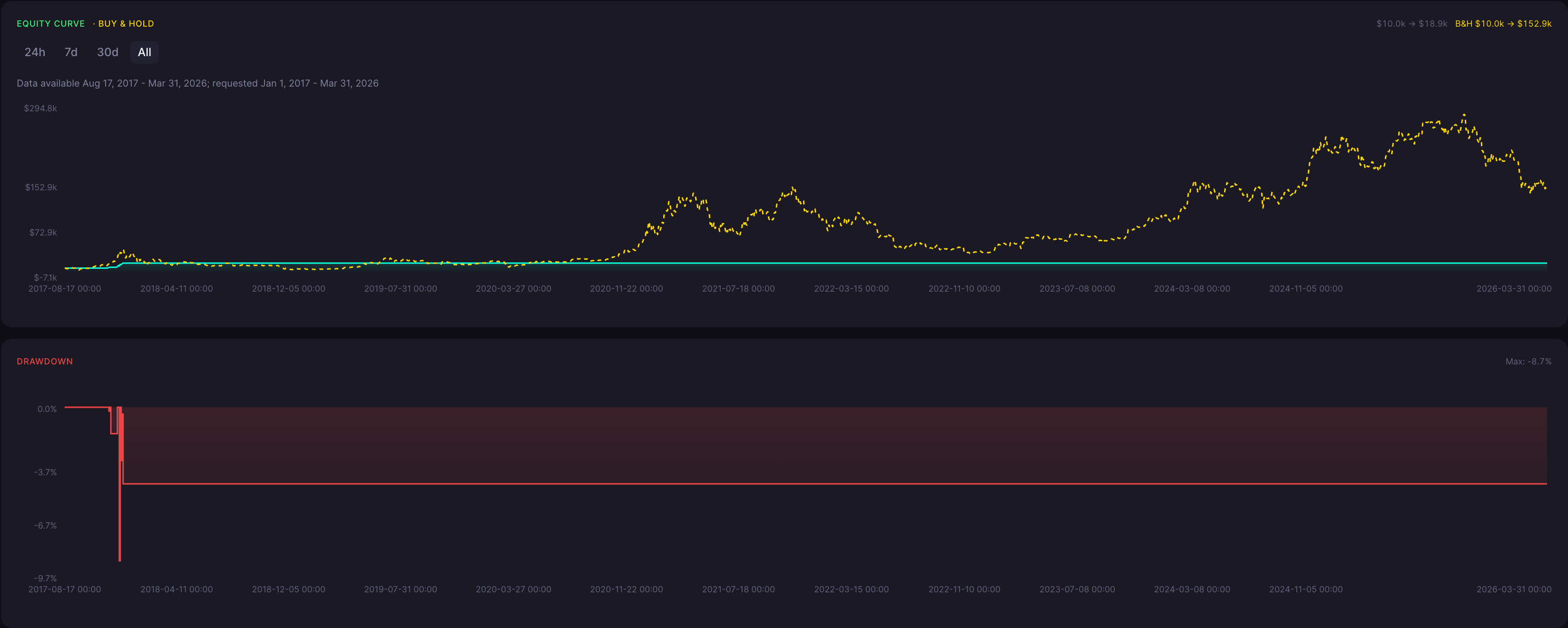
This corrected backtest analyzes the BTC Gravestone Doji strategy over the 12 hour timeframe. The exact Strategy Prompt below defines the corrected executable configuration, including its entry and exit rules and the selected backtest window.
ROI
88.83%
Win Rate
100.00%
Max DD
8.68%
Sharpe
0.74
Profit Factor
N/A
Total Trades
2
Backtest insights
The Gravestone Doji strategy generated a total return of 88.83% over the 12 hour timeframe. With a maximum drawdown of 8.68% and a win rate of 100.00% across 2 trades, the corrected backtest ran from 2017-01-01 to 2026-03-31. The selected strategy version and backtest identifiers are recorded in the configuration below.

Performance may vary depending on market conditions. During trending periods, the strategy may behave differently compared to ranging markets, impacting both returns and drawdowns.
How the Gravestone Doji Strategy Works
What It Is
The Gravestone Doji candle pattern has a long upper shadow and a close near the low, showing rejection of higher prices. This long,only test measures whether entries after that pattern can still produce BTC/USDT follow,through. The page reports a real CoinQuant backtest on BTC/USDT 12 hour data.
How Signals Are Generated
The corrected configuration is defined by the exact Strategy Prompt below. It uses the selected 12 hour timeframe and runs from 2017-01-01 to 2026-03-31.
Strategy Prompt
Long-only BTCUSDT on the 12h bars timeframe. Define an upper-wick exhaustion setup using the Long Upper Shadow candle-pattern component. Its explicit OHLC geometry is a doji-like small body, with Open and Close nearly equal and both near the Low, an upper shadow that is long, and a lower shadow that is minimal. Apply these thresholds: body at most 25% of High minus Low, both Open and Close in the lowest 35% of the range, upper shadow at least 50% of the range, and lower shadow at most 20% of the range. This is not a generic Doji. Because the setup is normally bearish, do not enter at it. Enter long only after bullish invalidation when Close crosses above the setup bar High within the next 10 bars. Exit long when a Bearish Engulfing candle pattern is detected. Use an explicit backtest date range from 2017-01-01 to 2026-03-31.
When It Works Best
This strategy tends to work best when a Gravestone Doji acts as a temporary pause and BTC/USDT continues higher after the initial upside rejection. The 12 hour timeframe captures a distinct market rhythm, so the same indicator can behave differently across horizons.
When It Performs Poorly
The strategy struggles when a Gravestone Doji correctly marks buyer exhaustion. In that regime, long entries can be exposed to quick downside continuation.
Strengths

Quantifies a commonly bearish candle in a long,only framework
Uses a transparent pattern,based entry and exit
Helpful for testing whether assumptions match data
Limitations

Gravestone Doji patterns are often bearish by interpretation
Long,only testing may produce weak results in exhaustion regimes
Signal frequency can vary by timeframe
Why Use CoinQuant Instead of Manual Trading or Other Platforms
Choosing the right way to test and execute trading strategies is critical. Below is a comparison between CoinQuant, manual trading, and other platforms to highlight key differences in speed, accuracy, and usability.
CoinQuant is designed specifically for traders who want to validate strategies quickly and reliably without coding. Unlike manual trading or traditional platforms, it allows you to test multiple scenarios, analyze performance instantly, and iterate faster using real data.
Frequently asked questions
How does the Gravestone Doji strategy perform on BTC/USDT in the 12 hour timeframe?
In this corrected backtest, the Gravestone Doji strategy on the 12 hour timeframe generated a return of 88.83% with a maximum drawdown of 8.68% and a win rate of 100.00% across 2 trades. These results are based on historical backtest data and actual performance may vary.
What is the Gravestone Doji indicator?
The Gravestone Doji candle pattern has a long upper shadow and a close near the low, showing rejection of higher prices. This long,only test measures whether entries after that pattern can still produce BTC/USDT follow,through.
Why is backtesting important for trading strategies?
Backtesting evaluates how a strategy would have performed on historical data before risking real capital. It reveals metrics like ROI, drawdown, and win rate that show whether a strategy has a genuine edge.
How can I test the Gravestone Doji strategy on CoinQuant?
Paste the exact strategy prompt from this page into CoinQuant, select BTC/USDT and the 12 hour timeframe, and CoinQuant generates a full backtest with performance metrics, no coding required.
What are the best settings for the Gravestone Doji strategy on the 12 hour timeframe?
Optimal settings depend on the indicator parameters, timeframe, market regime, and trading objective. The default tested here is the exact rule shown in the strategy prompt. CoinQuant lets you test parameter variations to find the best fit for the 12 hour timeframe.