
BTC Bullish Doji Star Strategy 10 Minute Backtest Results
10 Minute research snapshot: BTC/USDT Bullish Doji Star is evaluated as a detector-only, long-only hypothesis. This page preserves the exact entry and exit rules, fixed test dates and native metrics. The named pattern is an entry signal. No separate confirmation, trend or volume filter was added. Historical performance cannot establish future profitability.
Live Backtest Results
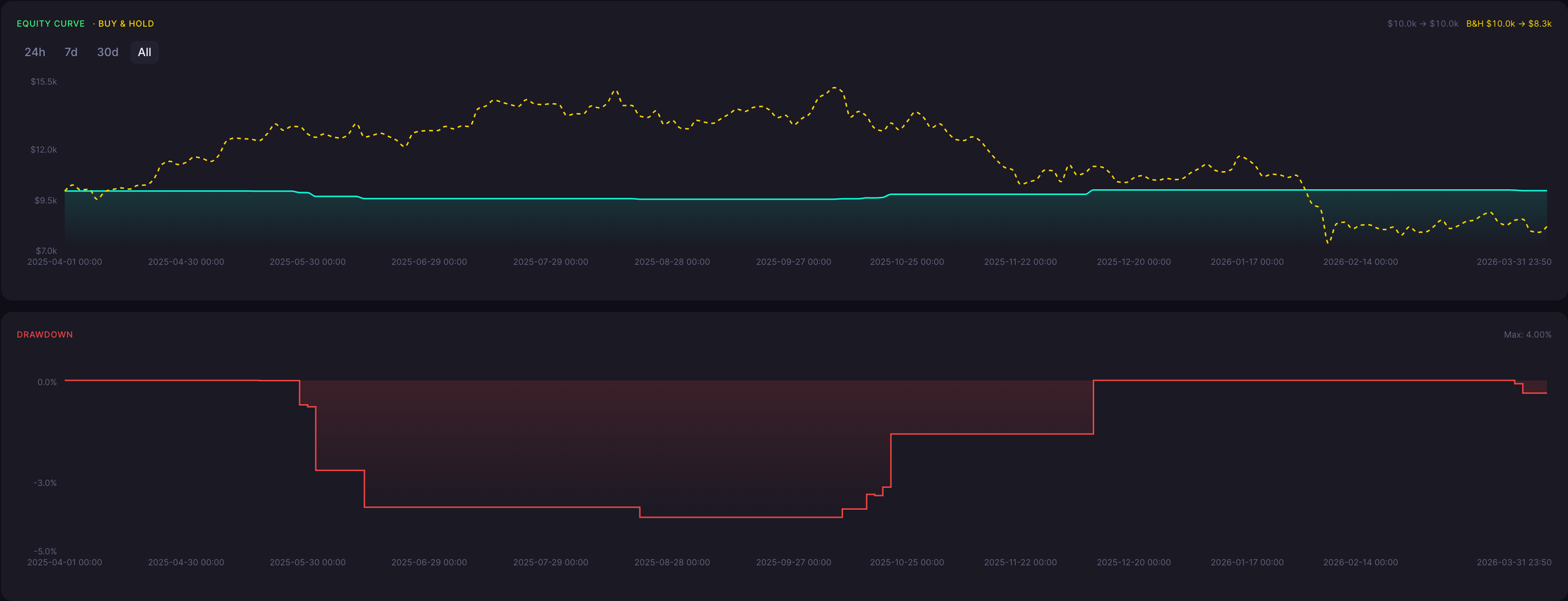
At the 10 minute resolution, the BTC Bullish Doji Star experiment reported 0.20% ROI and 4.00% maximum drawdown over 2025-04-01 to 2026-03-31. These are measured historical outcomes, not forecasts. The rule pairing was unchanged throughout this page: Enter long when a Bullish Doji Star pattern is detected. Exit long when a Bearish Engulfing pattern is detected.
ROI
0.20%
Win Rate
38.46%
Max DD
4.00%
Sharpe
0.07
Profit Factor
1.05
Total Trades
13
Backtest insights
This 10 minute test recorded 13 closed trades, 0.20% ROI, 38.46% win rate and 4.00% maximum drawdown. The raw return fraction is 0.0020304470059998494, multiplied by100 to report ROI. Sharpe Ratio is 0.07 and Profit Factor is 1.05; null values stay N/A. Aggregate figures do not identify which market regimes drove performance. A small nonzero return can round to0.00%, so the exact raw figure is retained. The result is historical evidence for this rule, not a validated profitable recipe.

Performance may vary depending on market conditions. During trending periods, the strategy may behave differently compared to ranging markets, impacting both returns and drawdowns.
How the BTC Bullish Doji Star Strategy Works
What It Is
Bullish Doji Star is a bullish early-warning setup involving a Doji after bearish price pressure. It suggests indecision, not a confirmed recovery. The official guide calls for confirmation, but the approved research rule uses only the named detector without a separate confirming candle.
How Signals Are Generated
Enter long when a Bullish Doji Star pattern is detected. Exit long when a Bearish Engulfing pattern is detected. The named Bullish Doji Star detector supplies the entry signal on this timeframe. Only enter_long and exit_long are permitted. No stops, targets, trend, volume or extra confirmation filters were requested.
When It Works Best
The Bullish Doji Star entry hypothesis may be useful when the observed reversal warning has follow-through. For entry-focused tests, recovery must persist after entry; for exit-focused tests, seller pressure must develop after the long entry. This is an explanatory hypothesis, not a regime claim proven by aggregate results.
When It Performs Poorly
A Bullish Doji Star signal can fail in noisy ranges or before the prior trend resumes. Detector-only long entries can remain exposed during falling markets; long exits may be premature or late. The 10 minute sampling horizon does not remove these risks.
Strengths

Preserves the exact Bullish Doji Star detector role
Uses auditable long entry and exit rules
Reports real metrics and immutable native result IDs
Limitations

Pattern recognition does not guarantee returns
No separate confirmation, trend or volume conditions
Schema costs can be null or absent, which does not establish zero costs
Why Use CoinQuant Instead of Manual Trading or Other Platforms
Choosing the right way to test and execute trading strategies is critical. Below is a comparison between CoinQuant, manual trading, and other platforms to highlight key differences in speed, accuracy, and usability.
CoinQuant is designed specifically for traders who want to validate strategies quickly and reliably without coding. Unlike manual trading or traditional platforms, it allows you to test multiple scenarios, analyze performance instantly, and iterate faster using real data.
Frequently asked questions
How did BTC Bullish Doji Star perform on 10 Minute?
The historical result was 0.20% ROI, 4.00% maximum drawdown, 38.46% win rate and 13 closed trades. Past outcomes do not guarantee future results.
What does Bullish Doji Star represent?
Bullish Doji Star is a bullish early-warning setup involving a Doji after bearish price pressure. It suggests indecision, not a confirmed recovery. The official guide calls for confirmation, but the approved research rule uses only the named detector without a separate confirming candle.
Is this a short strategy?
No. It is long-only. The named pattern is an entry signal. Enter long when a Bullish Doji Star pattern is detected. Exit long when a Bearish Engulfing pattern is detected.
Does this test include confirmation?
No separate confirmation, trend or volume filters are modeled. The official guide discusses context and confirmation, but this research measures the explicitly approved detector-only hypothesis.
How can I reproduce the 10 Minute result?
Use the exact prompt below and inspect the saved settings. A new execution can differ and can consume credits.