
Live Backtest Results
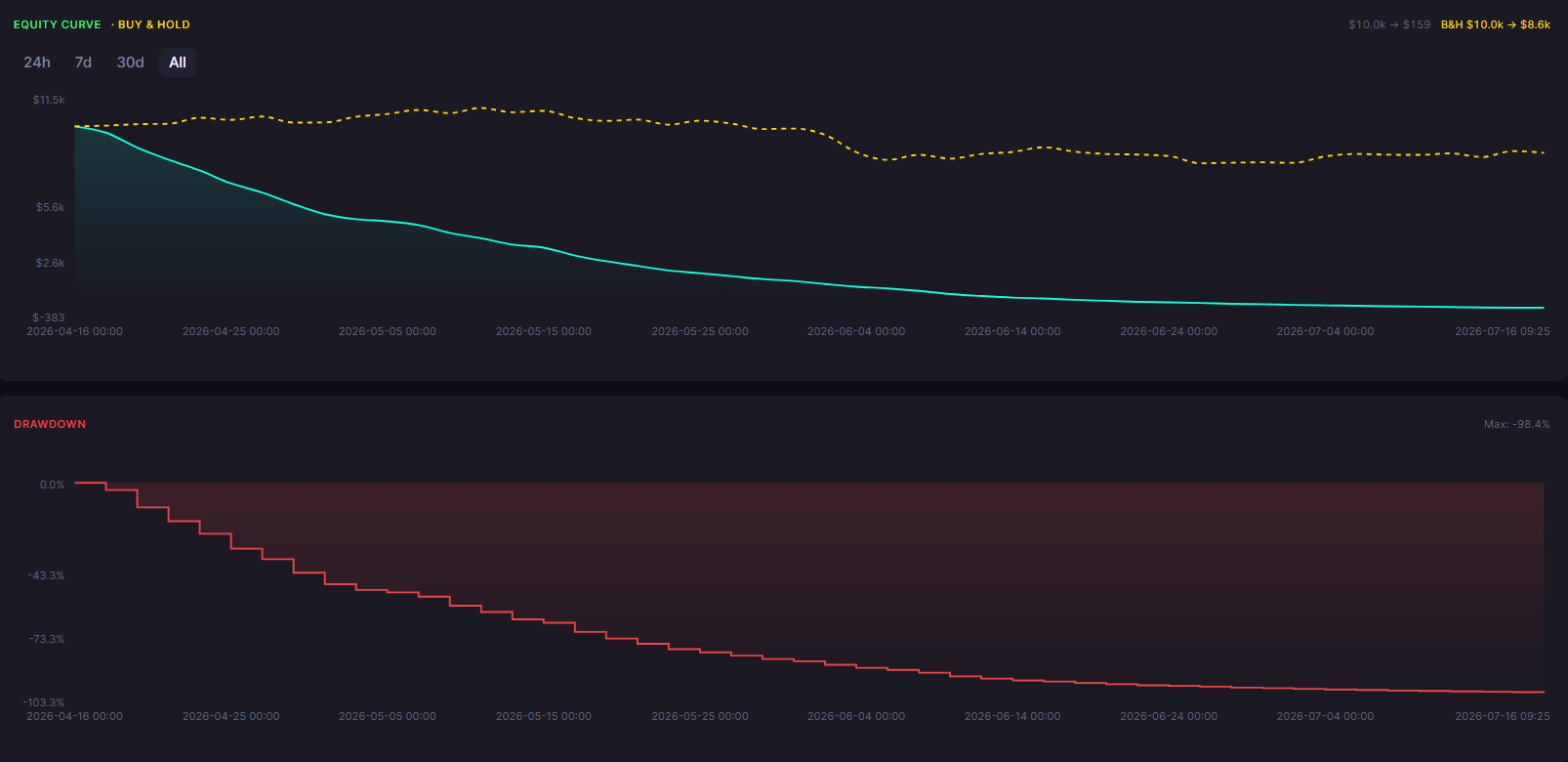
This backtest analyzes the performance of the Adaptive Moving Average strategy on BTC/USDT over the 1 Minute timeframe using historical market data. AMA is an adaptive moving average that adjusts smoothing using the Efficiency Ratio. The results provide insight into profitability, risk exposure, and consistency.
ROI
-98.41%
Win Rate
16.60%
Max DD
98.41%
Sharpe
-52.37
Profit Factor
0.40
Total Trades
9619
Backtest insights
The AMA strategy generated a total return of -98.41% over the 1 Minute timeframe. With a maximum drawdown of 98.41% and a win rate of 16.60% across 9619 trades, the AMA line aims to adapt to market conditions, speeding up in trends and slowing down in noise.

Performance may vary depending on market conditions. During trending periods, the strategy may behave differently compared to ranging markets, impacting both returns and drawdowns.
How the BTC AMA Strategy Works
What It Is
The Adaptive Moving Average (AMA) is an adaptive average that adjusts its smoothing based on the Efficiency Ratio (ER). AMA adapts its speed: faster in trending markets, slower in choppy ones. This BTC AMA strategy goes long only when price is above the 10-period AMA on the 1 Minute timeframe.
How Signals Are Generated
A long entry triggers when the BTC/USDT close crosses above the AMA(10) line on the 1 Minute timeframe, confirming that momentum has turned positive. The position exits when the close crosses back below the AMA line, signalling the trend has faded.
When It Works Best
This strategy performs best during clean, persistent trends where the AMA line adapts to price direction and slopes steadily upward. The 1 Minute timeframe captures a specific market rhythm where directional moves tend to persist long enough for the average to stay onside.
When It Performs Poorly
The strategy struggles in choppy, sideways markets where price repeatedly crosses back and forth over the AMA line, producing many small losing trades. Sharp reversals can also give back open profit before the exit signal triggers.
Strengths

Adaptive smoothing adjusts to market regime automatically
Clear, rule-based cross entry and exit reduce emotional trading
Single-line logic is simple to understand and monitor
Limitations

Prone to whipsaws in ranging markets, many small losses around the AMA line
As an adaptive average, it can lag in choppy conditions but tracks trends well
Fixed AMA(10) length may not be optimal for every regime
Why Use CoinQuant Instead of Manual Trading or Other Platforms
Choosing the right way to test and execute trading strategies is critical. Below is a comparison between CoinQuant, manual trading, and other platforms to highlight key differences in speed, accuracy, and usability.
CoinQuant is designed specifically for traders who want to validate strategies quickly and reliably without coding. Unlike manual trading or traditional platforms, it allows you to test multiple scenarios, analyze performance instantly, and iterate faster using real data.
Frequently asked questions
How does the AMA strategy perform on BTC/USDT in the 1 Minute timeframe?
In this backtest the AMA strategy on the 1 Minute timeframe generated a return of -98.41% with a maximum drawdown of 98.41% and a win rate of 16.60% across 9619 trades. These results are based on historical backtest data and actual performance may vary.
What is the Adaptive Moving Average (AMA)?
The AMA is a Kaufman's Adaptive Moving Average method that adjusts smoothing based on market efficiency. It provides a trend line that adapts to market conditions, making it useful for filtering short-term price fluctuations.
Why is backtesting important for trading strategies?
Backtesting evaluates how a strategy would have performed on historical data before risking real capital. It reveals metrics like ROI, drawdown, and win rate that show whether a strategy has a genuine edge. Without backtesting, traders are flying blind.
How can I test the AMA strategy on CoinQuant?
Describe the strategy in natural language, select BTC/USDT and the 1 Minute timeframe, and CoinQuant instantly generates a full backtest with all performance metrics, no coding required.
What are the best settings for the AMA strategy on the 1 Minute timeframe?
Optimal settings depend on the AMA period length. Shorter lengths react faster but whipsaw more; longer lengths smooth more but lag. CoinQuant lets you test multiple parameter combinations to find the best fit for the 1 Minute timeframe.