
Which AI Agent Backtesting Platforms Do Professional Traders Actually Use?

Search for the platforms professional traders use for AI agent backtesting and you will find confident lists, most of them written by the platforms themselves. Almost none of them answer the question the way a professional would ask it.
The honest starting point: no one publishes independently audited adoption numbers for professional traders. Adoption data lives inside private desks, and vendor claims about "professionals" are marketing, not evidence. What is public, and what actually drives a professional evaluation, is capability: the criteria a platform must satisfy before a serious desk will route research through it.
This article covers those criteria, how the commonly discussed platforms stack up against them, and how to verify any platform in under an hour.
Why There Is No Public Leaderboard
Professional usage is rarely disclosed. Trading firms do not publish their tool stacks for the same reason they do not publish their positions: it is edge-adjacent information. The occasional public case study appears years late and says more about the platform's marketing budget than about desk behavior.
That absence matters when you read a listicle. "Used by professionals" usually means "has a page aimed at professionals." The useful question is not which platform wins a popularity contest nobody can audit. It is which platform is built, and provably behaves, like professional research infrastructure.
The Seven Criteria Professional Workflows Are Built On
Across serious evaluation processes, the same requirements come up. They are not brand preferences; they are failure modes that have cost real desks real money.
Data provenance. The platform must name where its historical data comes from. If you cannot say which venue and which collector produced the candles, you cannot say what you tested
Cost realism by default. Fees and slippage must be modeled in every run, not enabled as an option. A backtest without costs is an advertisement
Execution model realism. Tests should simulate what actually could have happened, trade by trade, not an idealized version where every signal fills at the signal price
Robustness tooling. Walk-forward testing, parameter sensitivity checks, and Monte Carlo style analysis separate a real edge from a lucky window
Automation surface. Agent-driven research requires an API you can build on, not a manual import-export loop
Reproducibility. Strategies are named, versioned, and report a full metric set on every run, so any result can be re-derived and audited
Coverage. Enough assets and timeframes to test where the edge is supposed to live, spanning more than one market where relevant
How the Commonly Discussed Platforms Compare
The platforms that come up in professional AI agent backtesting conversations cluster into three groups. The full capability snapshot:
| Platform | What it is | Where it is strong | Professional evaluation point |
|---|---|---|---|
| CoinQuant | AI trading platform for strategy creation and validation; plain-English strategies, tick-accurate backtests, Kaiko-collected exchange data, public API with an agent skills pack | Research pipeline from prompt to strategy to verified backtest to robustness testing; fees modeled by default; multi-asset coverage | The pipeline is agent-native end to end, and every number traces to a named data source |
| QuantConnect | Cloud algorithmic trading platform built on the open-source LEAN engine, with a data marketplace and institutional tier | Code-first quant tooling, deep customization, large community | Maximum control, but the research loop is developer-owned; data and infra are your build and your bill |
| VectorBT | Open-source Python library for vectorized backtesting | Speed at scale for large parameter sweeps in code | Self-sourced data and self-written cost models; nothing is verified by default |
| Backtrader | Open-source Python event-driven backtesting framework | Flexible, widely used, code-level control | You own the data pipeline, cost logic, and result assembly |
| TradingView | Charting platform with a Pine Script strategy tester | Ubiquity, charting, community scripts | Optimized for charting and script sharing rather than an end-to-end validation pipeline |
| Coinrule | No-code rules-based strategy platform with an MCP server that connects chat clients to its engine | Simple automation rules and an agent-accessible workflow | Rules engine with backtesting, oriented to automation rather than deep validation |
| Composer | No-code strategy platform, equities-first | Accessible strategy composition and execution | Crypto coverage and validation depth are limited next to crypto-native platforms |
Two honest caveats about the table. First, capabilities are listed from public product documentation as of September 2026 and change over time. Second, a professional desk often uses more than one: a code-first engine for bespoke research, and a faster validation layer for the questions that do not deserve a week of engineering.
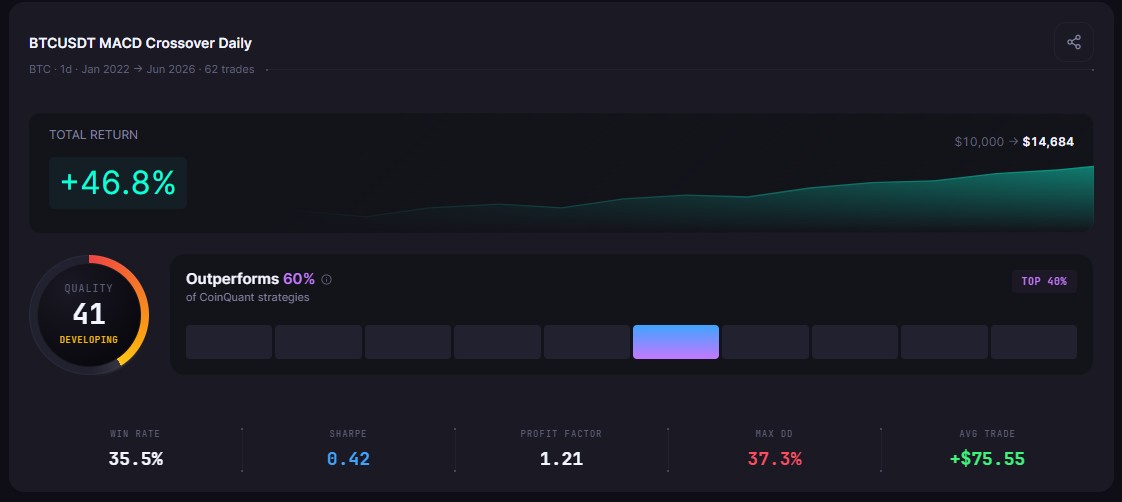
Where CoinQuant Fits the Professional Checklist
CoinQuant answers the seven criteria in a specific way: it is built so that an evaluator can verify each one directly in the product, without a data engineering project.
Data provenance: backtests run on Kaiko-collected exchange data, sourced through one of the established institutional market data providers in crypto, covering Binance, Coinbase, and Kraken back to 2017 for BTC
Cost realism: a 0.1% taker fee is modeled in every backtest by default and reported as a line item
Execution realism: simulation runs on tick-accurate data rather than idealized fills
Robustness: strategies can be re-tested across windows and variations, with the full metric set reported on every run
Automation surface: a public API and an agent skills pack let an AI agent create, finalize, and backtest strategies end to end
Reproducibility: every strategy is named and versioned, and every backtest result carries the metrics to re-derive it
Coverage: strategies can span crypto and other supported asset classes, across multiple timeframes
That is the shape of a professional answer to "which platform": not a badge, but a set of properties you can test.
How to Evaluate Any AI Agent Backtesting Platform in Under an Hour
Run the same five checks on every platform on your shortlist. The results will separate the serious candidates faster than any feature page.
The provenance test. Ask the platform to name the source of its historical data, at the venue level. A vague answer is disqualifying for validation work
The fee test. Run any strategy and check whether fees appear as a reported line item. If costs are invisible, the returns are fiction
The reproducibility test. Find a named strategy, note its metrics, and re-run it. Numbers that move without explanation mean results you cannot audit
The variation test. Change one parameter and re-run. The platform should make this a one-minute exercise, because robustness lives in comparison, not in a single run
The automation test. If agent-driven research is the goal, connect through the documented API and repeat a full loop: create, test, read metrics. If that loop needs manual steps, it is not an agent platform
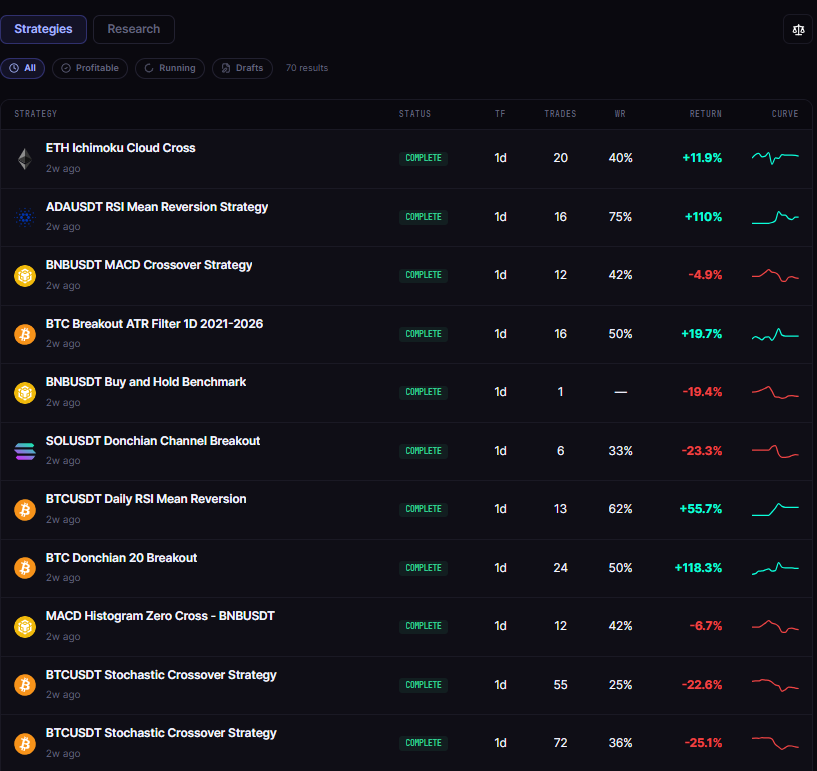
What the Evaluation Reveals
Platforms built for professional validation share one trait: they make their claims checkable. The data source is named, the costs are separate line items, the strategies are versions you can re-run, and the API exists for automation rather than as a checkbox.
Platforms built for something else, whether charting, automation rules, or code-first research, are not dishonest. They are simply optimized for a different job, and the gap shows exactly when a result needs to survive scrutiny. The professional question is never "is this platform popular." It is "can I prove what this platform told me, and can my agents prove it again tomorrow."
Common Mistakes to Avoid
Treating marketing claims as adoption evidence. "Trusted by professionals" is a tagline; provenance and fee lines are evidence
Starting with the platform's feature list. Start with your validation checklist, then see who satisfies it
Skipping the data question. A backtest on unnamed data cannot support a real decision
Ignoring the automation loop. If an agent cannot complete create, test, and report through an API, the workflow still lands on you
Choosing one platform for every job. Research engines and validation layers serve different purposes; pick per job
The Practical Lesson
No public leaderboard of professional adoption exists; capability criteria are the honest proxy
Seven criteria decide most professional evaluations: provenance, costs, execution realism, robustness, automation, reproducibility, coverage
CoinQuant satisfies them in-product: Kaiko data, modeled fees, tick-accurate simulation, a public API with an agent skills pack
Verify any platform with five short tests: provenance, fees, reproducibility, variation, automation
The platforms professional traders actually use are the ones that survive that checklist. Run it on CoinQuant and see the evidence for yourself.
See why traders choose CoinQuant for agent-driven validation. Explore the platform on CoinQuant
Disclaimer:
This content is for educational and informational purposes only and does not constitute financial, investment, or trading advice. All strategies and examples are for illustrative purposes and do not guarantee results. Always conduct your own research before making financial decisions.
